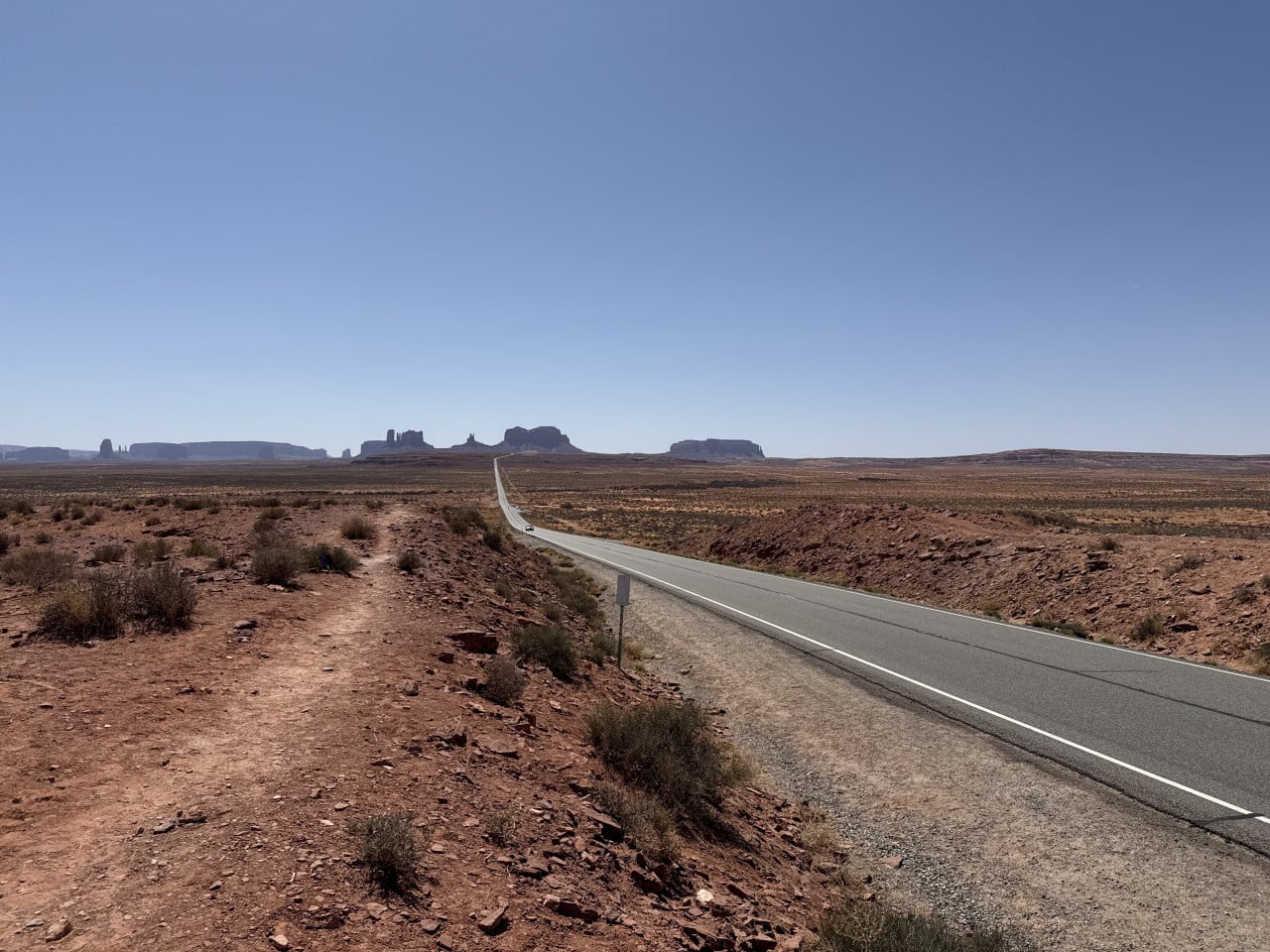
After visiting Monument Valley, we headed to a place that almost every movie fan knows—the famous Forrest Gump Road. And I have to admit that even though I knew what to expect, the sight of the endlessly straight road with monumental rock formations in the background impressed me more than I expected.
What exactly is Forrest Gump Road?
It is a section of US Route 163, specifically around mile marker 13, near the Utah-Arizona border. The road runs straight through the heart of Monument Valley and crosses the Navajo Nation—the largest Native American reservation in the United States.
It was right here, at this very spot, that one of the most iconic movie scenes of all time took place. In the 1994 film Forrest Gump, the main character, played by Tom Hanks, suddenly stops after more than three years of running nonstop across America, turns to his followers, and says: “I'm pretty tired. I think I'll go home now." And then he simply goes home.
That moment—the long, straight road disappearing into the distance with majestic buttes on the horizon—became one of the most recognizable movie shots ever.
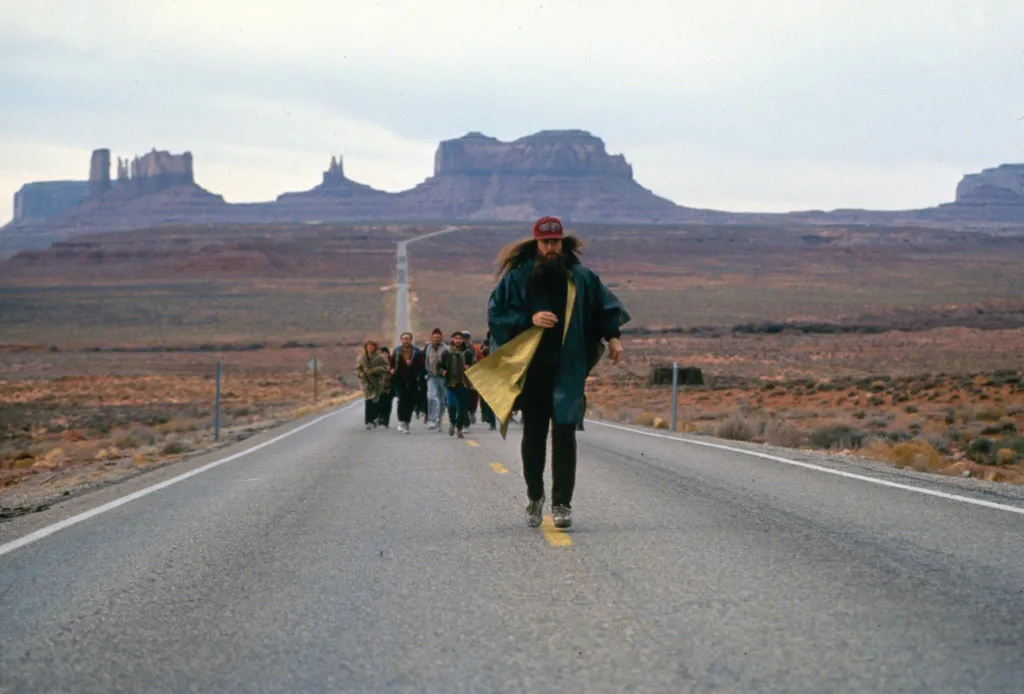
A few words about the movie that made this road famous
Forrest Gump is a 1994 film directed by Robert Zemeckis. It tells the story of a simple man from Alabama with a below-average IQ who, thanks to his kind heart and an incredible series of coincidences, witnesses and takes part in key moments of American history during the second half of the 20th century—from the Vietnam War and ping-pong diplomacy to the founding of the Bubba Gump Shrimp company.
The film won six Academy Awards, including Best Picture and Best Actor for Tom Hanks. With a budget of $55 million, it became one of the most successful films of the decade. Interestingly, Tom Hanks and director Zemeckis gave up their salaries in exchange for a share of the profits—a decision that paid off many times over.
And here is another lesser-known fact: Tom Hanks did not always film the famous running scenes himself. In many shots, he was replaced by his younger brother, Jim Hanks, who served as his running double. The running scenes were filmed all across America—in Arizona, Montana, Vermont, Maine, North Carolina, and, of course, Monument Valley in Utah. The entire crew was nicknamed the “crusade unit"—a special unit that traveled across the country to film the few minutes we ultimately see in the movie.
How far did Forrest actually run?
This is probably the most interesting question fans of the movie ask. According to the film, Forrest ran for exactly 3 years, 2 months, 14 days, and 16 hours. Someone took the time to map his route on Google Maps, and it came to about 19,000 miles, or approximately 30,000 kilometers. That works out to roughly 16 miles a day, or about 26 kilometers. Every day. For three years straight.
Sports and medical experts examined it in more detail and, surprisingly, agreed that such a feat would theoretically be possible. According to them, Forrest's main advantage was that he had no specific goal—he simply ran. He did not worry about distances or how much farther he still had to go. And this very sense of ease and lack of pressure is something real ultramarathon runners consider crucial.
What definitely would not have worked well, according to the experts, was Forrest's clothing. Khaki pants and a cotton shirt for running through the desert? That is a recipe for blisters, chafing, and overheating. His Bubba Gump cap and red windbreaker were apparently fairly good choices, though. And those early Nikes? Minimalist shoes with zero drop between the heel and toe—according to running experts, actually a solid choice for the time. The problem is that with the average running shoe lasting around 500 kilometers, Forrest would have needed more than 60 pairs over the entire run. But no one addresses that in the movie.
What Forrest Gump Point is like in real life
When we arrived, the first thing that surprised me was the roadside sign. Or rather, what was left of it—it was completely covered in stickers from tourists all over the world. A kind of unofficial guestbook, only a little more chaotic.
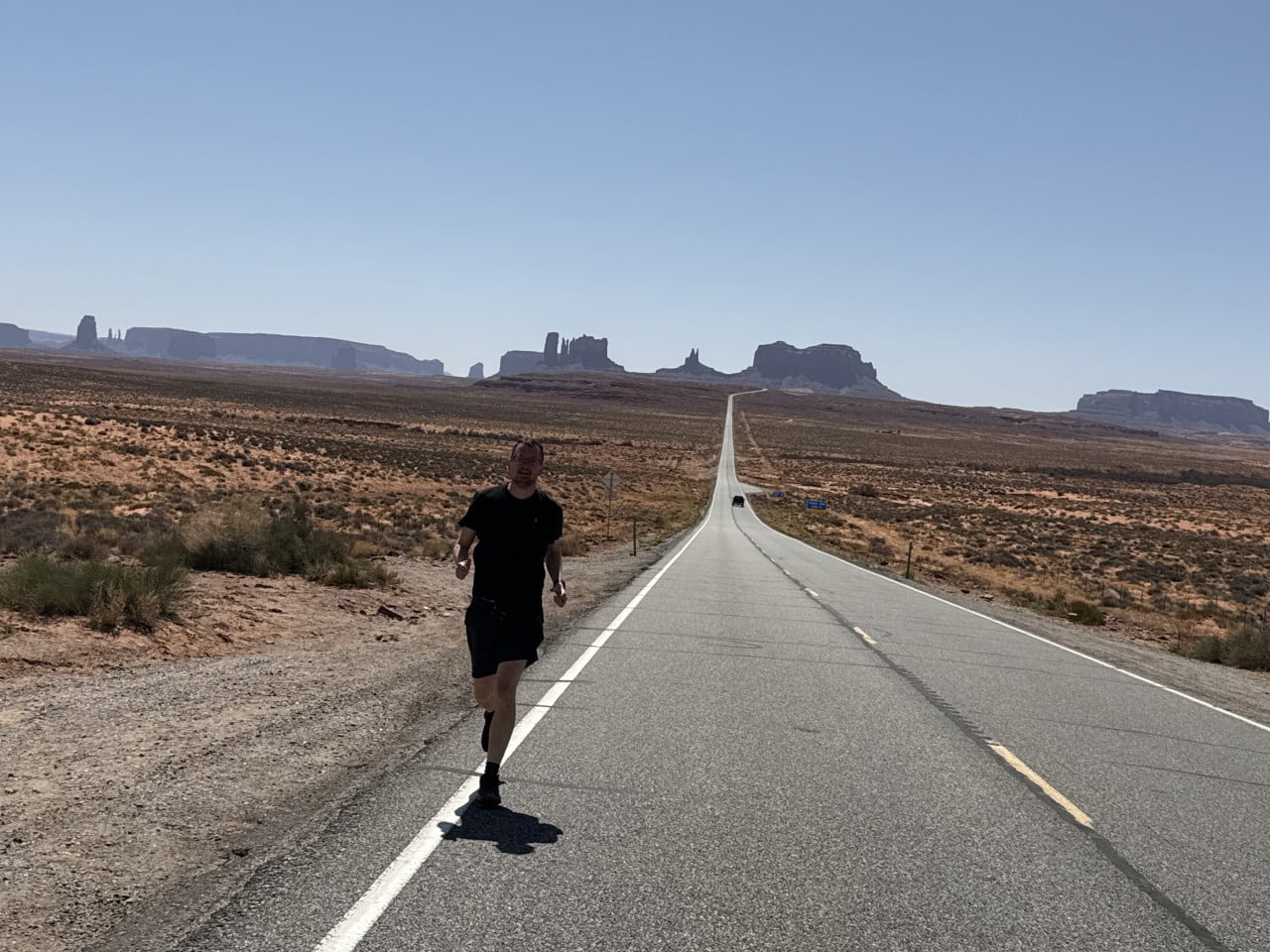
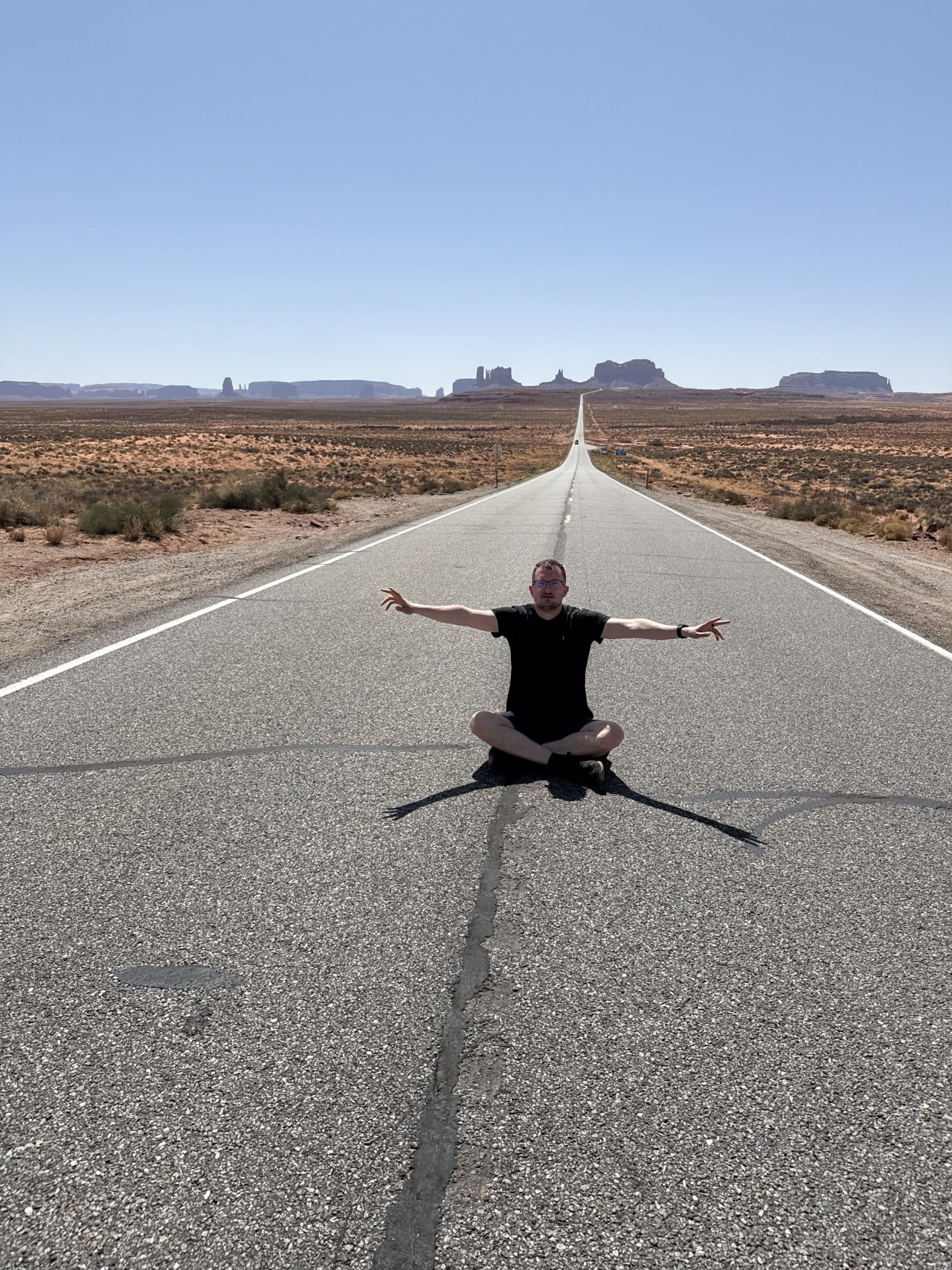
The view itself, however, is absolutely spectacular. You stand on a gentle rise, and a perfectly straight road stretches out in front of you, disappearing somewhere into infinity. The iconic rock formations of Monument Valley rise on the horizon—buttes, mesas, and towers of red sandstone shaped by erosion over hundreds of millions of years. The entire area was once the bottom of a shallow sea, and these monumental rocks are remnants of ancient sedimentary layers.
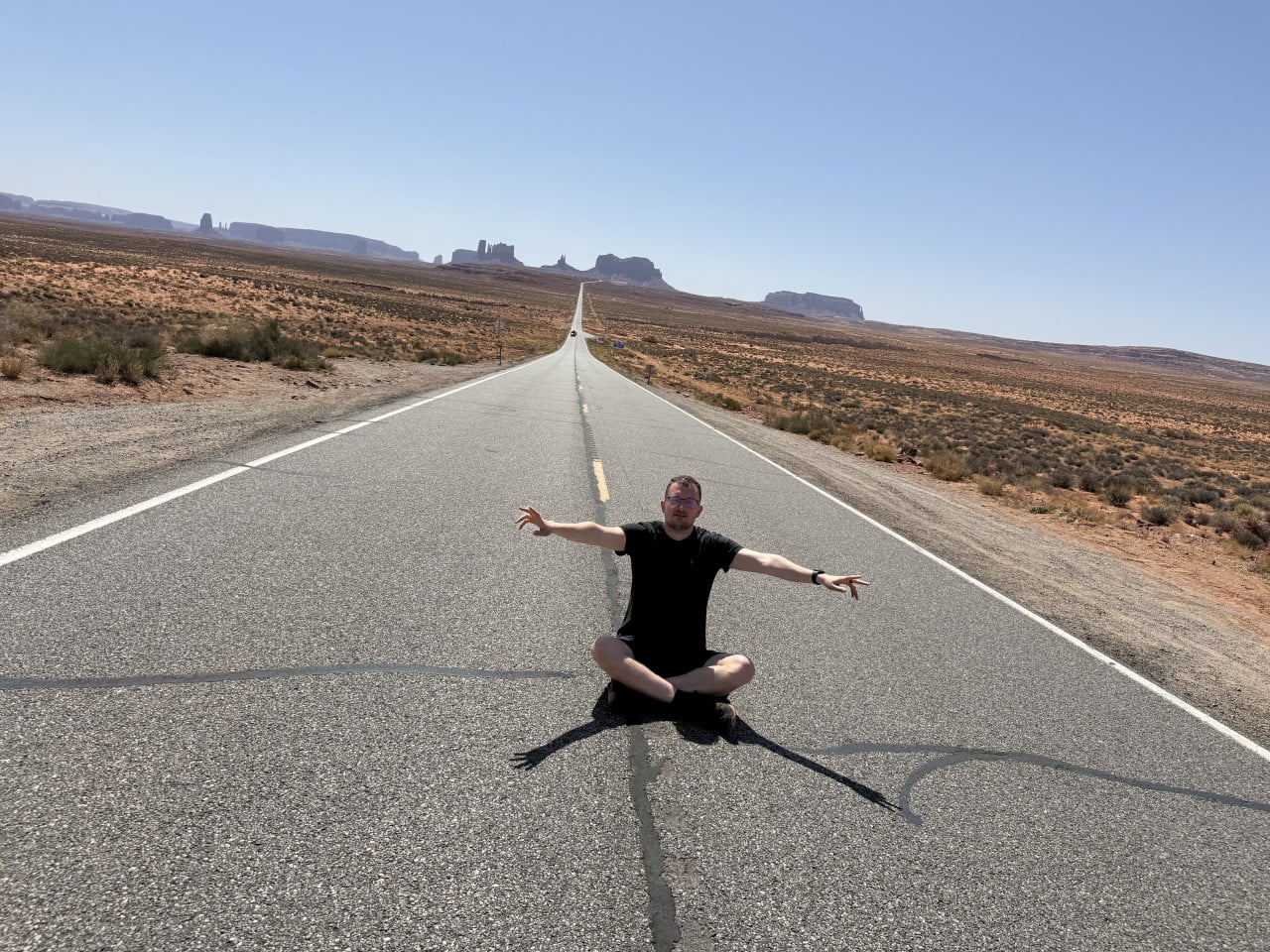
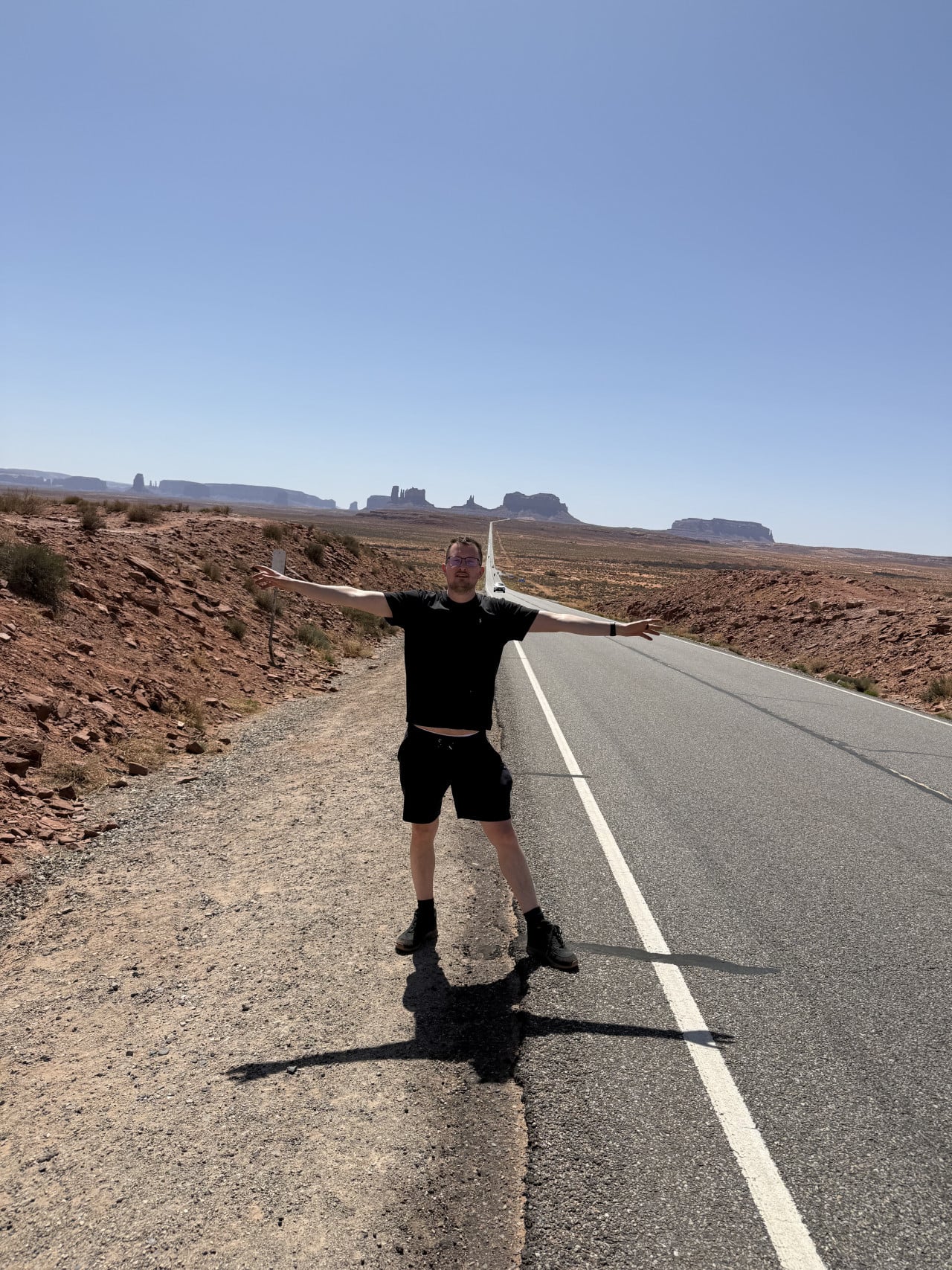
In photos, it looks as though you are completely alone in the middle of an empty desert road. But the reality is a little different. On the rise behind you, where the famous shot toward Monument Valley is taken, there was quite a line of people. They took turns going out onto the road—some ran, some posed, and some simply took photos. Of course, we could not resist either and ran down the road exactly as Forrest did.
But it is fair to say that apart from the amazing view, there is nothing else to see there. No museum, no souvenir shop (at least not when we were there), just the road and the landscape. But that simplicity is precisely what makes it so beautiful.
Practical tips for your visit
Forrest Gump Point is located at mile marker 13 on US Route 163, approximately 20 kilometers north of the entrance to Monument Valley Navajo Tribal Park. The GPS coordinates are 37.101445, -109.990812. Admission is free—the road is public.
Keep in mind that US-163 is an active road with traffic. I know it is tempting to stand in the middle of the road and take photos, but be careful. Unfortunately, several accidents have already occurred here because of inattentive tourists. There are small gravel pullouts on both sides of the road where you can park safely.
As for the best time for photography, the so-called golden hour is ideal—the period shortly after sunrise or before sunset, when the light is soft and warm. In the middle of the day, the light is fairly harsh, and the photos lack the same atmosphere. We were there at noon, and the heat was unbearable, but the view was still worth it.
Incidentally, the entire US-163 is about 103 kilometers long and is designated a National Scenic Byway. If you have time, drive it slowly and stop at different places—the views are breathtaking along virtually its entire length.
Is it worth visiting?
Definitely yes—especially if you are in the Monument Valley area, which you absolutely should be when traveling through the American Southwest. It is a 15–20-minute stop, but it is exactly the kind of place you will remember. And if the movie resonated with you as much as it did with me, it will be a small personal pilgrimage.
As Forrest would say: “I just felt like running." And honestly, when you stand on that road and gaze into the distance, you understand it a little.