Try to imagine it this way: you teach a computer to predict how balls move in an industrial rotary hopper. You run the simulation, and after a while the model starts claiming that a ball has passed through a wall or is moving faster and faster for no reason. This is exactly what happens when artificial intelligence does not understand physics. And this is exactly what scientists at EPFL wanted to change.
A team from the Intelligent Maintenance and Operations Systems (IMOS) laboratory at the École Polytechnique Fédérale de Lausanne developed an algorithm called Dynami-CAL GraphNet, which was published in the prestigious journal Nature in February 2026. The result? An AI model that adheres tenaciously to the laws of physics, even after thousands of simulations.
Why conventional AI ignores physics
Traditional AI models are based on statistics. They learn patterns from data and then extrapolate them. But physical systems have their own rules, which statistics alone cannot guarantee. Errors accumulate step by step, like a snowball rolling down a slope, and over time the simulation collapses into nonsense.
On the other side are classical physical models. Although they follow the laws of physics perfectly, they are extremely computationally demanding. Modeling thousands of interacting particles in real time? Forget it. The EPFL scientists were looking for a middle ground. And they found it in Newton's third law.
Newton's law built directly into the network architecture
We all know Newton's third law from school: for every action, there is an equal and opposite reaction. When you kick a ball, the ball kicks back. When an engine propels a car forward, the exhaust gases move backward. This law applies universally, from molecules to industrial machinery.
Dynami-CAL GraphNet does not incorporate this law as an additional constraint, but directly into the network's structure. The algorithm uses graph neural networks (GNNs), in which objects form the graph's nodes and their interactions are represented by edges. Each edge is assigned its own local coordinate system that is antisymmetric, meaning that if you reverse the direction of the edge, all vectors change sign. This mathematically guarantees that the forces between two objects are always equal in magnitude and opposite in direction.
The result? The model conserves both linear and angular momentum, even in situations it has never encountered before.
From industry to proteins
The scientists tested the algorithm on four very different scenarios, and the results are impressive.
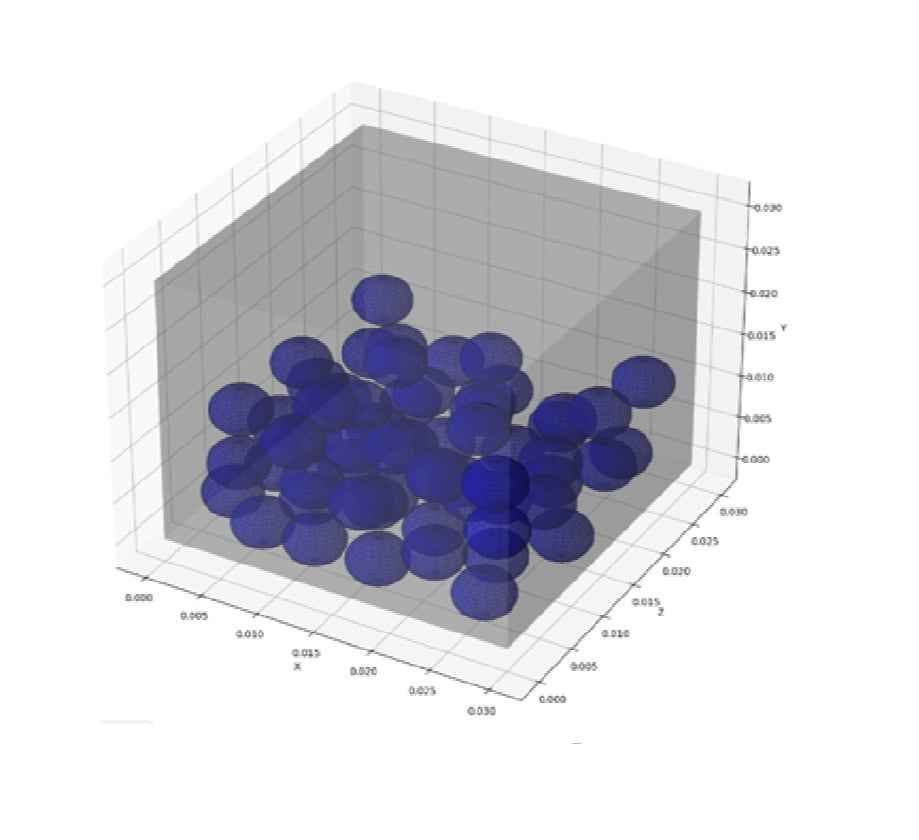
They began with granular systems, involving thousands of balls colliding with one another and with the walls of a rotating cylindrical mixer. The model learned the system's behavior from just five simulations involving 60 balls in a box. They then deployed it in a scenario with more than 2,000 balls in a rotating cylinder with moving walls. Dynami-CAL GraphNet maintained a stable simulation for more than 16,000 steps, while competing models broke down after the first few cycles.
Next came human body movement. The algorithm was able to predict a person's walking motion using only simple movement data, without anyone telling it how much force the foot exerts on the ground. It simply inferred this on its own because the laws of physics are encoded within it.
And finally, proteins. The model successfully predicted minute deformations of protein molecules in solution, processes that occur at the microscopic level. The same approach, on a completely different scale.
A significant breakthrough
Doctoral researcher Vinay Sharma summed it up simply: "We have moved from a model that statistically tries to guess physical behavior to one that is built specifically to obey it."
This distinction is crucial. Dynami-CAL GraphNet offers something that most AI models cannot: transparency. At every step, an engineer can verify whether the model is correctly upholding the law of conservation of momentum. No black box, no guesswork. Every intermediate calculation makes physical sense.
The second major advantage? The model can learn from minimal data. It needs only a few simulations of a simple system and can extrapolate to more complex configurations, larger systems, and different conditions. This is exactly what industry needs, because real-world measurements are expensive and difficult to obtain.
Professor Olga Fink, head of the laboratory, described it this way: "Our model not only generalizes, meaning it applies what it has learned to similar situations, but also extrapolates, meaning it makes reliable predictions in situations it has never encountered. And that is something machine learning rarely does well."
Dynami-CAL GraphNet opens the door to fields where accurate and rapid simulations of physical systems can determine success or failure. Robotics, aerospace, materials science, biomedicine. Anywhere you need to know how things move, how they interact, and what will happen in an hour or a year.
When physics is woven directly into a model's structure, the machine stops guessing and begins to truly understand. And that is exactly the direction AI in science should take.