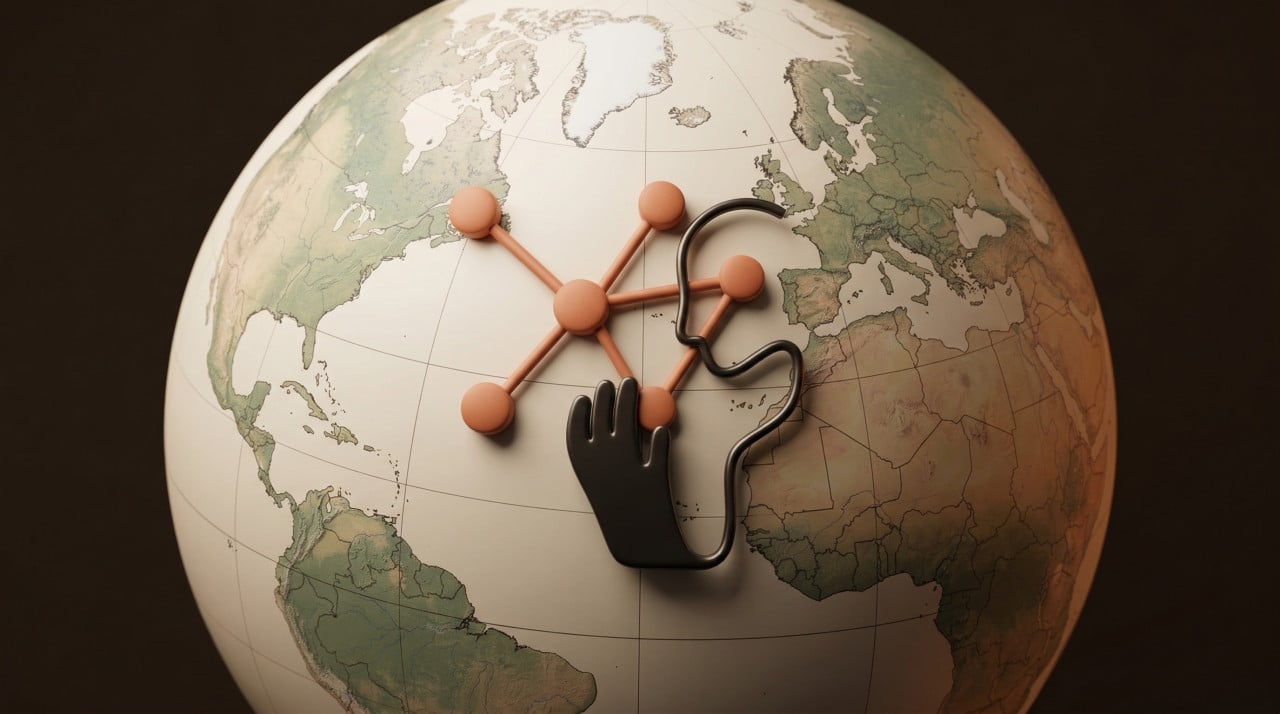
Anthropic had its chatbot Claude interview more than 80,500 of its own users from 159 countries and in 70 languages. The result is the largest qualitative study on artificial intelligence ever conducted. And what does it reveal? That the truth about how people perceive AI is far more complex than either enthusiasts or critics portray it.
Anthropic created a special version of Claude called the Anthropic Interviewer, which conducted a structured yet adaptable interview with each participant. It asked about their dreams, concerns, and specific experiences with the technology. The results were then analyzed by other AI models, which sorted the interviews into categories. A human team then reviewed selected quotes and removed identifying information.
The result? More than 80,000 candid accounts from around the world, from a soldier in Ukraine to a lawyer in Israel, from an entrepreneur in Cameroon to a stay-at-home mother in the US.
What do we actually want from AI?
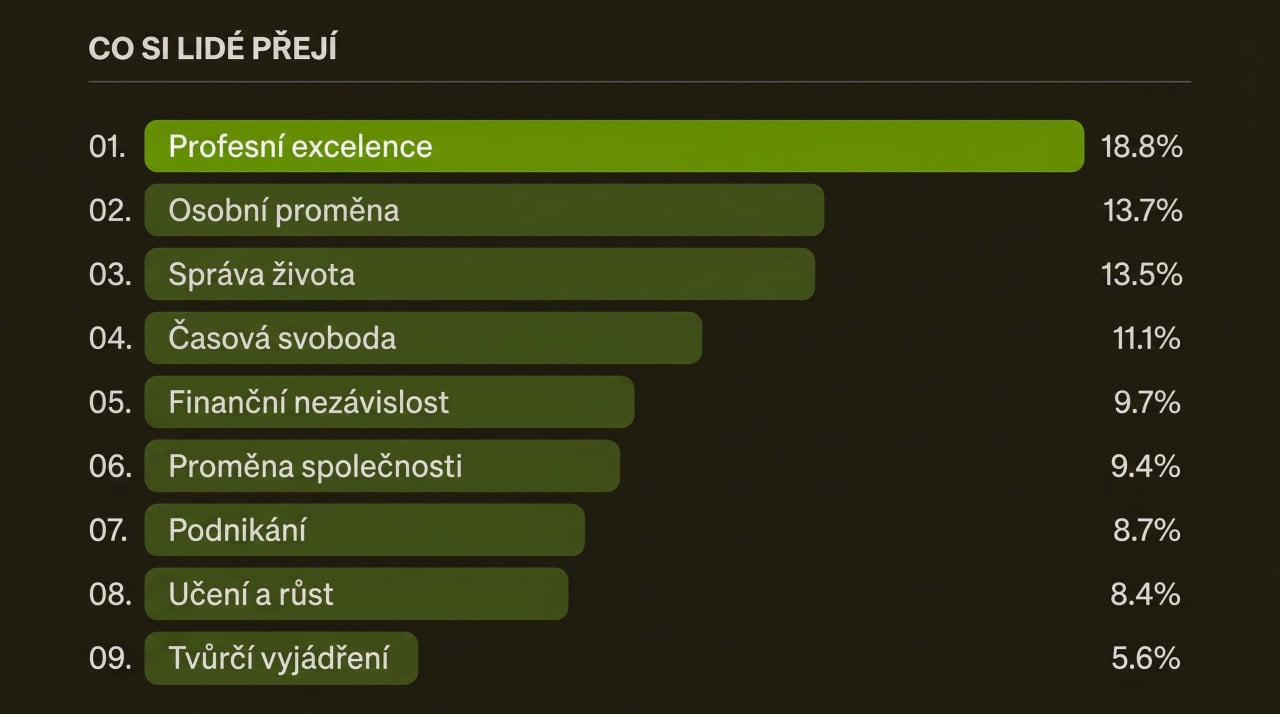
The largest group of respondents, a full 18.8%, wants what the study calls "professional excellence" from AI. In other words, they want AI to handle tedious routine tasks so they can focus on more meaningful work. A nurse from the US described how AI took over her documentation, suddenly giving her the patience to talk with patients' families.
But when the interviewer asked more deeply what greater productivity would actually bring people, the answers changed. It was not about careers. It was about time with family. A software engineer from Mexico wrote: "Thanks to AI, I can leave work on time and pick up my children from school." A worker from Colombia expressed a similar sentiment: "Last Tuesday, AI allowed me to cook with my mother instead of finishing assignments."
More than 13% of people want AI as a guide for personal transformation, while another 13.5% want it to manage the chaos of everyday life. Entrepreneurs from Africa, Latin America, and Asia see something different in AI: a way to overcome a lack of capital and infrastructure. An entrepreneur from Cameroon summed it up in one sentence: "I am in a technologically disadvantaged country. AI did in 30 seconds what would otherwise have taken me a month. It is an equalizer."
Light and shadow: Two sides of the same coin
Anthropic described the study's main finding as "light and shadow". It is a paradox: the things people love about AI are exactly the things they fear.
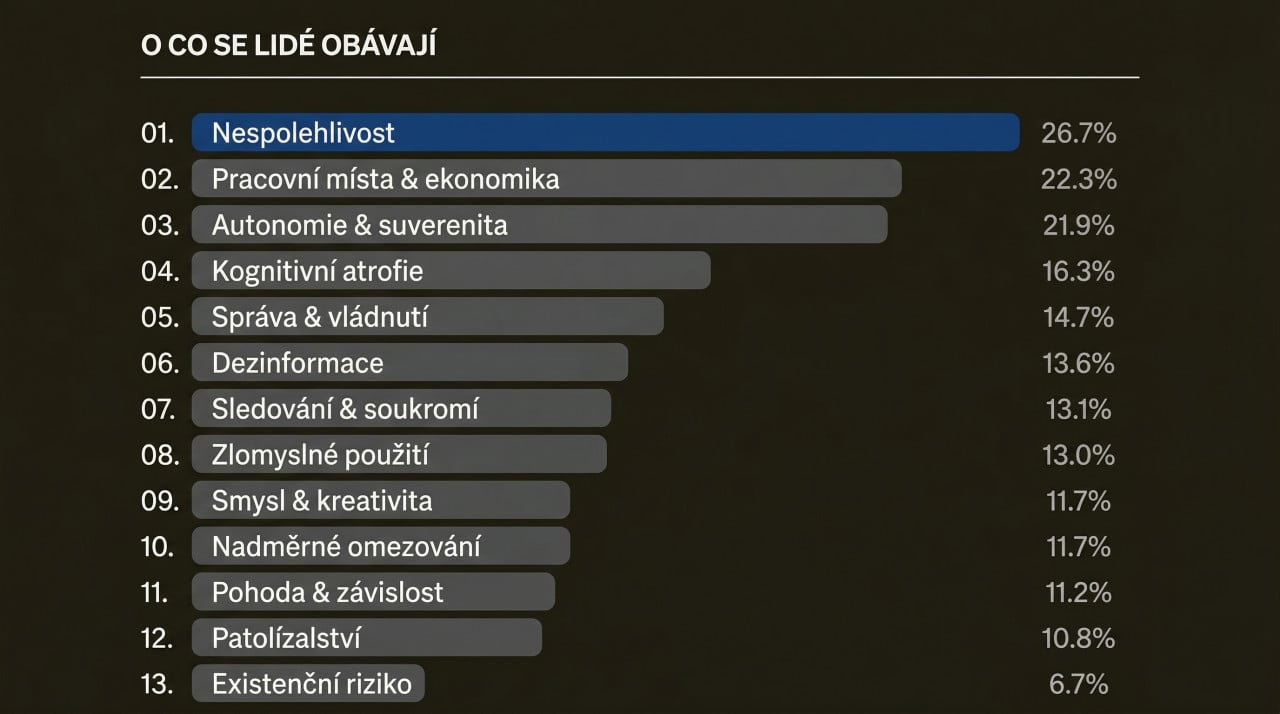
Someone who values AI as a source of emotional support is three times more likely to also fear becoming dependent on it. A student from South Korea admitted it openly: "My relationship with a friend got worse, and instead I talked to you more. Because you understood my thoughts. But it was a foolish decision. So I lost that friend." A lawyer from Israel wrote: "I use AI to review contracts, saving time... and at the same time I am afraid: am I losing the ability to read on my own? Thinking was the final frontier."
The average respondent expressed 2.3 different concerns. Only 11% of people had none.
A world divided into optimists and skeptics
Globally, 67% of respondents view AI positively. No country fell below 60%. But the differences are significant. Latin America, sub-Saharan Africa, and much of Asia are considerably more optimistic than Europe or North America. Why? The answer is simple: fear of job loss was the strongest predictor of a negative attitude toward AI. And in countries where AI has not yet entered the labor market on a massive scale, this fear is simply not as tangible. Moreover, in poorer regions, people see AI as a way to move up, not as a threat.
Teachers and academics were among the most concerned voices. They were 2.5 to 3 times more likely than average to observe cognitive atrophy among their students due to the overuse of AI. Tradespeople, by contrast, reported major benefits for learning and almost no negative effects.
Stories that stay with us
Behind the numbers are stories that make you stop and think. A freelancer from the US wrote that Claude helped him correctly diagnose an illness after nine years of misdiagnoses. A soldier from Ukraine admitted that during the most difficult moments, when the dead lay around him, conversations with AI pulled him back toward life. A nonverbal worker from Ukraine built a text-to-speech tool with Claude and, for the first time in his life, was able to communicate with friends almost in real time.
These are stories about gaps. About places where human institutions have failed or simply are not enough. And AI is stepping into those gaps, whether we want it to or not.
Perhaps the most apt metaphor came from one respondent in the US: "During the Third Industrial Revolution, horses disappeared from the streets and were replaced by cars. Now people are afraid that they are the horses." The study cannot tell us whether that is what will happen. But at least, for the first time, we know what more than 80,000 people from around the world think about it.