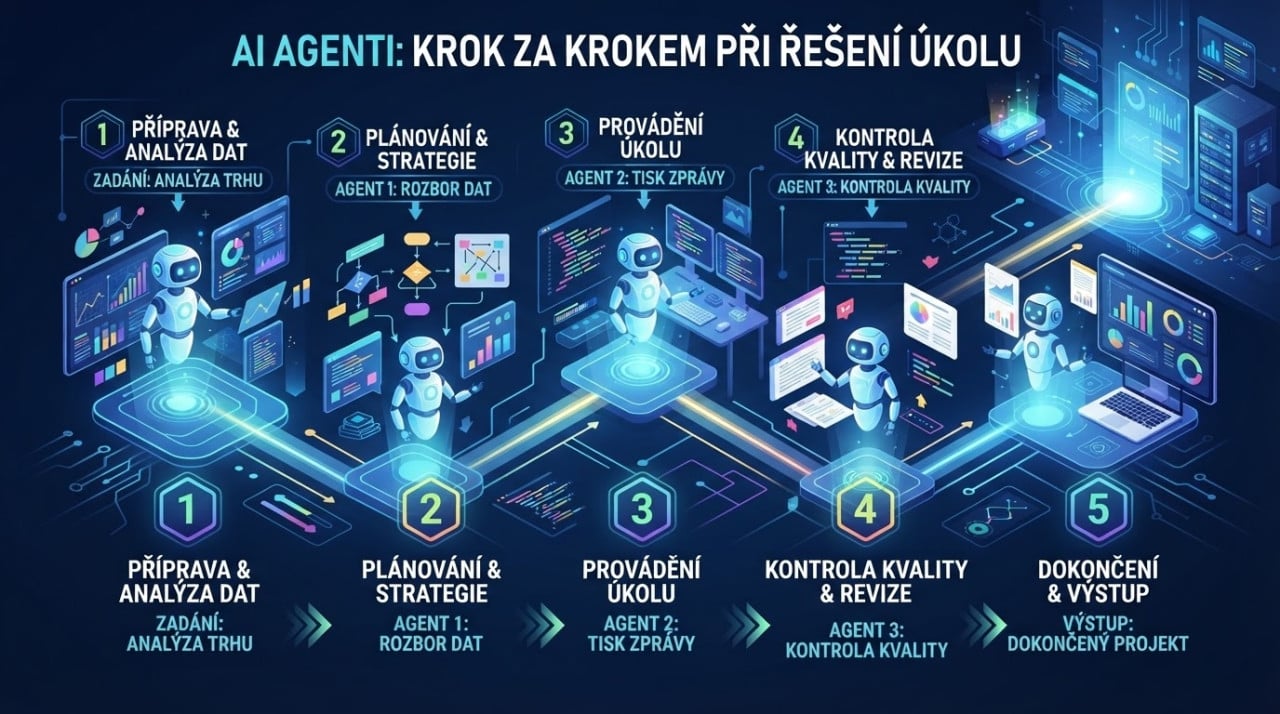
Until recently, artificial intelligence was mainly good at one thing: answering questions. You asked a question and got a text response. An AI agent works differently. It is given a goal, breaks it down into smaller steps on its own, and completes them one by one without anyone directing it.
Let’s illustrate the difference with a vacation. A chatbot will advise you where to go and what to pack. An agent will plan the entire trip for you, browse airline websites, compare prices, and complete the booking.
This article explains how agents work, what they can do today, and how they came about.
How an agent thinks and acts
A large language model powers every agent. It is the same technology behind ChatGPT or Claude. The difference lies in what surrounds the model. An agent is not given precise instructions; it is given a task. It creates the plan itself. The entire process runs in a loop. The model looks at the task, considers the next step, carries it out, and checks the result. If something fails, it tries a different approach or method. If it gets closer to the goal, it continues. This allows it to handle even tasks that cannot be completed in a single response.
Tools give an agent its power. It can search the internet, run a program, edit a file, or send a message. Without tools, it would only talk, much like a chatbot, but with them, it can actually get things done. Many agents also have memory. They keep track of what they have already done and discovered, so they do not lose their way during a long task.
Where agents are most useful
They are currently most advanced in programming. Tools such as Claude Code or Cursor write part of the code, test it themselves, find bugs, and fix them. The developer specifies what they need and only checks the finished work.
They also perform well in customer support. An agent reads the query, looks up order details, handles a complaint, or passes the case to a person when it does not know what to do.
They can also handle information searches. They browse dozens of websites, organize their findings, and compile a summary. They help companies sort emails, schedule meetings, or prepare proposals. Most of these assistants still work under human supervision; they are only beginning to gain independence.
The journey from the first chatbots to today’s agents
The idea of a machine that can converse with a person is decades old. The ELIZA program was created as early as the 1960s and simulated a conversation with a psychotherapist. However, it could only rearrange words from your sentences. It understood nothing. For many decades, researchers struggled with how to teach machines language. The breakthrough came in 2017. A team at Google introduced an architecture called the transformer, which allowed models to process text much more intelligently. The GPT models were built on it.
In 2020, OpenAI unveiled GPT-3, a model that could write coherent texts on any topic. Two years later, ChatGPT arrived, and millions of people tried it within a few weeks. Artificial intelligence reached ordinary users. However, one limitation still remained. The model could talk, but nothing more. It could not verify or carry out anything. That changed when companies gave models the ability to use tools. Suddenly, a model could access the internet, calculate an example using code, or request data from other sources.
Around 2023, the first attempts emerged to turn a model into an autonomous agent. The AutoGPT project showed that a model could plan steps on its own and complete them gradually. It worked unreliably, but pointed the way forward. Since then, major companies such as OpenAI, Google, and Anthropic have been building agents that work more reliably and can handle more complex tasks.
An interesting side note: artificial intelligence had already been able to act independently before, but only in the closed world of games. In 2016, the AlphaGo program defeated the world’s best Go player, and systems from the same company learned to play old video games better than humans. However, those agents could only handle their particular game. Today’s agents can tackle tasks from everyday life.
Where agents currently fall short
Independence comes at a cost. When a model makes a mistake in a single response, the damage is minor. When an agent makes a mistake in the first step of a long chain, the error carries forward and compounds. Models occasionally “hallucinate,” meaning they state falsehoods with complete confidence. For an agent with access to email or payments, such a mistake can cause serious damage. Security experts therefore warn against agents that act without oversight.
The questions of who bears responsibility when an agent harms someone and how to prevent people from using it for fraud also remain unresolved. Companies therefore currently keep most agents on a tight leash and require a person to approve important steps. Meanwhile, money is pouring into the field. Major technology companies and investors are investing enormous sums in agent development.