SpaceXAI has released its new Grok 4.5 model. It describes it as its smartest tool yet, capable of handling programming, autonomous tasks, and routine office work. It is the first model the company has unveiled since going public several weeks ago.
According to the company, Grok 4.5 can handle almost everything that machines are currently attempting to take over from humans in the field of artificial intelligence. Writing code, building applications, office and administrative work, research, and writing text. And it is supposed to do all of this more cheaply. SpaceXAI trained Grok 4.5 on tens of thousands of Nvidia GB300 graphics chips. The company emphasizes that it paid close attention to data quality. It cleaned the data, removed duplicates, and evaluated it so that only useful samples were fed into the model.
Grok 4.5 is also the first tangible result of a major acquisition. Last month, SpaceX announced that it would acquire Anysphere, the company behind Cursor, in a sixty-billion-dollar all-stock deal. The goal was to strengthen its position in the lucrative market for enterprise artificial intelligence tools. The model was developed alongside Cursor, just a few weeks after Musk closed both this deal and SpaceX's initial public offering.
It lags behind Fable and GPT models in tests
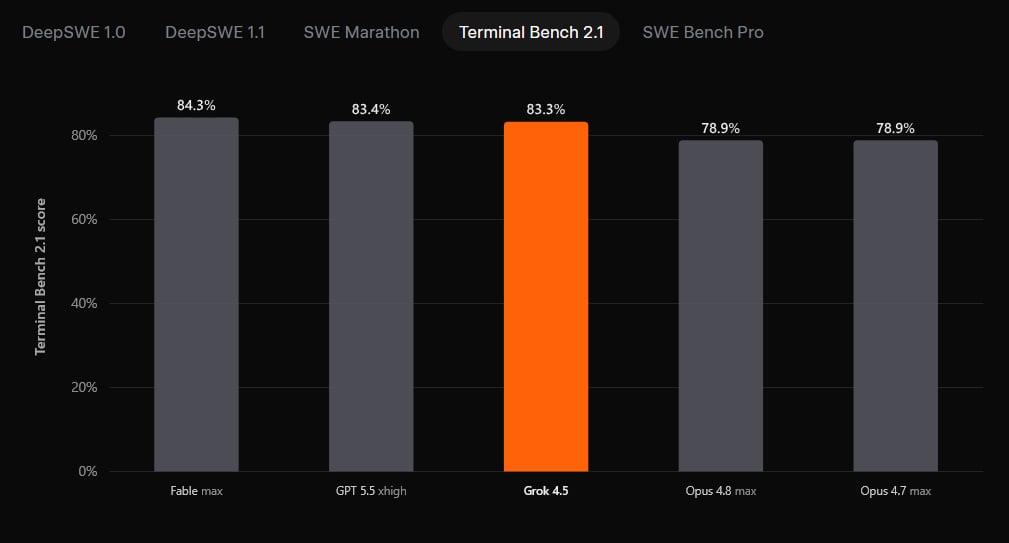
The test results paint a rather mixed picture. In Terminal Bench 2.1, which assesses complex command-line tasks, Grok 4.5 scored 83.3 percent. It nearly matched GPT 5.5 and finished just one point behind Anthropic's Fable 5.
Elsewhere, the differences are greater. In DeepSWE 1.1, which tracks how a model resolves real-world bugs from GitHub, Grok 4.5 fell to 53 percent. GPT 5.5 achieved 67 percent, while Fable 5 reached 70 percent. In the more demanding SWE Bench Pro test, Grok scored just under 65 percent. This put it ahead of Opus 4.8, but it could not match Fable 5 and its score of over 80 percent.
The model performed better in one specific area. Grok 4.5 took first place in Harvey's ranking for legal tasks.
Speed and token savings
What Grok 4.5 lacks in accuracy, it aims to make up for in speed and efficiency. The model produces roughly 80 tokens per second, a speed users have come to expect from lightweight models.
Its consumption is more interesting. SpaceXAI claims that Grok 4.5 uses about 4.2 times fewer tokens than Opus 4.8 on SWE Bench Pro tasks. While Opus burns through more than 67 thousand tokens on average, Grok needs only about sixteen thousand. And because these models are priced by token, this difference is quickly reflected in the bill.
A price the competition cannot match
The new model is focused primarily on price. Grok 4.5 costs two dollars per million input tokens and six dollars per million output tokens. That is far below the competition.
Opus 4.8 costs five dollars for input and twenty-five for output. GPT 5.5 and the upcoming GPT 5.6 are priced at five and thirty dollars. Fable 5 is the most expensive, charging ten dollars for input tokens and fifty for output tokens. When lower token consumption is added to the lower price, Grok 4.5 emerges as by far the cheapest option in its performance category. Chinese developers such as Zhipu and DeepSeek pursue a similar strategy. They approach the leaders in performance and then win customers over with low prices.
SpaceXAI CEO Elon Musk compared the new model to Anthropic's Opus. “It is an Opus-class model, but faster, more token-efficient, and cheaper,” he wrote on X. He later added that, according to the company's internal evaluation, Grok 4.5 is roughly comparable to the older Opus 4.7, but runs much faster.
Our internal assessment is that Grok 4.5 is roughly comparable to Opus 4.7, but much faster. The combination of capability, faster speed and lower cost is what makes it competitive.
— Elon Musk (@elonmusk) July 8, 2026
We are closing the loop on real-world usefulness, not benchmarks. Hardcore engineers at Tesla &… https://t.co/FqoJzHkrRY
It can also handle Excel, Word, and PowerPoint
Grok 4.5 has become the default model in the Grok Build tool. In addition to programming, it can also work with spreadsheets. It can build a more complex Excel model, find supporting information for it on the web, work with formulas across worksheets, and leave notes in the file for future reference.
It works just as carefully in PowerPoint and Word. In presentations, it creates diagrams from shapes directly in PowerPoint, designs slide content, and writes coherent text in Word. Add-ins for all three office applications are already available.
It will not arrive in Europe until mid-July
Grok 4.5 is available immediately through the Grok Build tool, in the Cursor editor across all plans, and through the SpaceXAI developer console. Users simply need to obtain an API key and get started. For a limited time, the company is offering free access in both Grok Build and Cursor.
However, users in the European Union will have to wait. SpaceXAI does not yet offer the model in EU countries and plans to launch it in mid-July.