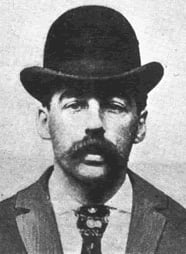
Erik Larson's 2003 bestseller The Devil in the White City tells the story of Dr. H. H. Holmes, the first known serial killer in American history, who selected his victims from among visitors to the 1893 Chicago World's Fair. One of the facts Larson revealed in his book was Holmes's connection to Fort Worth: two of his victims were local girls, and he himself spent enough time there to build a house.
His story, however, begins in Chicago. Thirty-year-old Holmes arrived in Englewood, a suburb of Chicago, in 1886, settling on Sixty-third Street. There he ran a store and rented out rooms on the upper floor of the building, while living elsewhere himself. This slight, nervous little man presented himself as a physician and pharmacist, but in reality he was primarily a con man and sociopath.
He was born Herman Webster Mudgett in Gilmanton, New Jersey, in 1861. He had an entirely ordinary childhood in which nothing foreshadowed his later behavior. He did not torture animals or terrorize neighborhood children. In 1878, he married Clara Lovering, and they began a family together. They remained legally married for the rest of his life, even though Holmes was also a bigamist who had at least two or three other wives scattered across various places. He studied medicine under a local doctor and then moved with Clara and their young son to Ann Arbor, Michigan, so that he could attend medical school there. Clara supported the family for a time before taking the child and returning home. They never lived together again. Mudgett graduated in 1884 and went to New York State, where he opened a practice and began teaching. Two years later, he was a licensed pharmacist living in Boston under the name Henry Howard Holmes, M.D. He passed himself off as a single man, maintained relationships with several women, and lived perpetually in debt. Two character traits accompanied him and defined the rest of his life: he lacked all compassion for others and was a pathological liar to whom falsehood came more naturally than truth. In addition, he possessed a kind of darkly magical charm and was a skillful speaker. It is therefore no surprise that he soon embarked on a life of crime. He did not befriend people; rather, he sought out future victims and easily manipulated targets. All who knew him agreed that he had the "most successful ways" with women of any man they had ever met and that he "never associated with women who were not attractive." Men, in turn, described him as "mild, courteous, and affable." Like many sociopaths, he was simply utterly inconspicuous and nonthreatening.
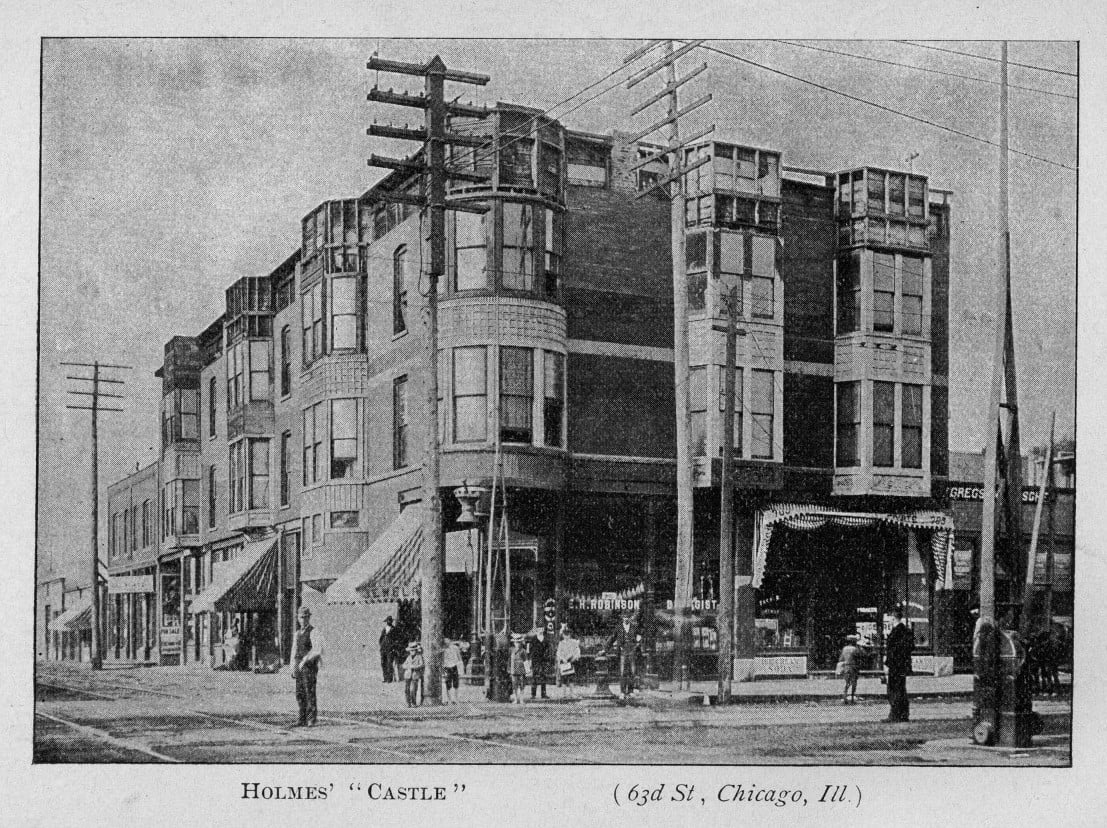
In 1886, Holmes moved to Chicago with a new wife and soon took a job at Holton's Drug Store on Sixty-third Street, where he worked for Dr. Elizabeth S. Holton. Before long, he arranged to buy the business from her, although it is doubtful that he ever actually paid for it, after which Dr. Holton and her husband mysteriously disappeared. The building had a pharmacy on the ground floor and rooms for rent upstairs. The place later became famous as "Holmes's Murder Castle," which was expanded with a third floor in 1892. The building contained a number of unusual, custom-made features that were later described as "secret rooms" and "hidden staircases."
Holmes's principal trade was not medicine but fraud. He devised increasingly elaborate schemes, funneling money from one fraudulent enterprise into another before disappearing with his pockets full and leaving fleeced creditors behind. His charades were impossible to follow, and even he himself probably could not keep track of them. When he left Chicago, he abandoned a whole series of unresolved lawsuits that were never successfully untangled.
Holmes achieved immortality, however, as a cold-blooded killer. The list of his victims includes nine people whom he killed between 1891 and 1894, and another twenty-seven whom he is believed to have murdered over the course of his career. Most of them were women, earning him the nickname "America's Jack the Ripper." Various rumors attribute dozens of other victims to him, but these claims are either unproven or have been directly disproved.
The sisters Minnie and Nannie Williams became entangled in Holmes's web, whether willingly or otherwise. They were girls from Mississippi whose father died in a railroad accident in 1872 and whose mother died soon afterward. They were approximately five and three years old, respectively, when they were orphaned. The siblings were separated, and Minnie went to live with her uncle, Dr. J. N. B. Williams of Mansfield, Texas. At the time, it was entirely acceptable to separate siblings when relatives could not or would not take them all at once. Her uncle died when she was about ten or eleven, leaving her property on both banks of the Trinity River. Fort Worth businessman John J. Massie was appointed her court-designated guardian and unofficial adviser concerning the inheritance. She converted part of the property into cash, which she used to study elocution at Mansfield College, and then went to Boston to attend the conservatory there. She dreamed of an acting career, but set her dreams aside after meeting the dazzling Dr. Holmes. She immediately fell for the polished gentleman. In 1889, she returned to Texas, where she was reunited with her sister, the quiet and shy Nannie, a devout Christian with little education, who followed her to Mississippi. Minnie supported both sisters before returning to New England to continue her acting career. When that failed, she moved to Chicago, reportedly to "become self-supporting" and put her education to use. In early 1893, she began working as Holmes's secretary at his office on Sixty-third Street. That spring, she wrote to her sister that they were engaged and invited her to come live with them. She also wrote enthusiastically to friends in Fort Worth about her plans to marry a certain "Harry Gordon." When Nannie arrived in Chicago in June, Minnie and Holmes were already living as husband and wife in the "Castle." Meanwhile, Holmes had a wife and daughter living in another Chicago suburb.
Whatever their marital status, Holmes used Minnie as a front in his various schemes. Whether she was a willing accomplice remains unclear. In any event, she soon found herself named as a defendant in several legal proceedings. Holmes moved all three of them to another apartment in the suburb of Wilmette to avoid being served with court summonses. They lived comfortably, and he told others that he would take them on an extensive tour of Europe. In July 1893, all three disappeared, though not at the same time. Nannie disappeared first, then her sister, and finally Holmes himself, but not before moving his second Chicago wife and child into the Wilmette apartment. After the Holmes story broke in newspapers nationwide, the Chicago Tribune organized a search for the sisters. It yielded only Nannie's unclaimed trunk, found at a Wells Fargo branch, but nothing was learned about the girls' fate. Wells Fargo sent the trunk to relatives in Tarrant County, who were questioned by Deputy Sheriff Bill Rea, but the girls' fate remained an unsolved mystery. Only one thing is certain: no one ever saw them alive again.
Holmes reappeared in Fort Worth in January 1894, intending to seize Minnie's inheritance, which was no longer of any use to its original owner. First, however, he stopped in Denver, where he went to collect an insurance payout for Minnie's deceased brother, who had recently died in an accident. There he also married again, this time to the much younger Georgiana Yoke, whom he may first have met when she visited the Chicago World's Fair. Once Georgiana turned twenty-five, she was due to receive a substantial inheritance from her grandmother. For a man like Holmes, that was a decisive consideration, and it undoubtedly played a role in his decision to make the woman his lawful wife before departing for Fort Worth. Meanwhile, Holmes's associate Benjamin Pitezel was operating in Fort Worth, where he had already been staying for some time and was preparing their next swindle. Holmes arrived in Fort Worth with a new wife, a new name (D.T. Pratt), and a new get-rich-quick scheme.
The remainder of Minnie's inheritance consisted of property on the southwest corner of Second and Rusk Streets (now Commerce) in Fort Worth and another parcel in Oak Cliff in Dallas. Holmes variously estimated the value of the Fort Worth property, once at $10,000 and another time as high as $40,000. Pitezel had already arranged for the property to be transferred to Holmes under yet another fictitious name. Holmes lodged his wife at the Arlington Inn and began constructing a building on the site, using various aliases to hire bricklayers and purchase materials on credit. The construction was carried out under Pitezel's name, though that too was merely a cover name. Holmes supervised construction personally and discouraged inspectors and curious onlookers from coming anywhere near it. By all accounts, the building bore a striking resemblance to the Chicago Castle, including similarly mysterious structural features. Measuring 100 by 100 feet, it was twice the size of a typical downtown lot, which was usually 50 feet wide and 100 feet deep. The building also had three stories and was nearly twice as large as the Chicago Castle. There was an artesian well at the rear, which was not unusual in urban buildings of the period. The building stood next to Greenwall's Opera House, which for years had been one of the city's landmarks. By April 1894, construction was nearly complete, and a large sign reading "No Admittance" swung on the door.
The greatest mystery remained what he actually intended to do with the building. The foremost expert on Holmes believes that the cunning swindler never intended to move to Fort Worth and settle there permanently. Instead, it was probably another business venture: create a tangible asset, mortgage it to the hilt, and disappear from town with the cash.
He might have succeeded had it not been for a misstep that brought the local law down on him. His mistake was buying Texas horses with worthless promissory notes and then selling them for cash, something he and Pitezel did repeatedly. Texans might grudgingly admire a clever trader, but in their eyes a horse thief was a far more contemptible creature. When Holmes tried to play his usual trick on the owner of the Exchange Stable on Rusk Street, the man refused to fall for it and insisted on cash payment for the matched pair of horses Holmes wanted. Moreover, Minnie Williams's friends were beginning to ask uncomfortable questions, making things too hot for both swindlers. In May 1894, Holmes and Pitezel slipped out of town just ahead of the law, leaving behind an empty building, some personal papers, and swarms of furious creditors. Holmes had been in Fort Worth for only five months, long enough to build a "castle" and enter local legend.
That legend took on a peculiar Fort Worth dimension. According to the Dallas Morning News, Holmes lived with "at least four women" during his stay in Fort Worth and was intimate with them. The newspaper called it a "rumor," provided no source, gave no names for the mistresses, and offered no explanation of how he managed to build a house, carry out numerous frauds, and keep his wife content while simultaneously pursuing all these romantic adventures. Nevertheless, Tarrant County Deputy Sheriff Bill Rea confirmed the story and told the same newspaper:
"I know of three women with whom Holmes was intimate. I have heard of no more, and I do not remember seeing him with more than one blonde, in whose company he seemed completely fascinated. The report that he had four of them on a string is, in my opinion, inaccurate."
Dallas newspapers always enjoyed feasting on scandalous tidbits about Fort Worth, but there may still have been a grain of truth to the story. An empty building was certainly a less attractive subject. Several months later, while the fate of Minnie and Nannie Williams was being actively debated, the Fort Worth Gazette dismissed the vacant structure as a "firetrap on Rusk Street." Only later, as the full extent of Holmes's crimes came to light, did local newspapers begin referring to the building as the "Fort Worth Castle."
Holmes, Pitezel, and Georgiana next appeared in St. Louis, where Holmes bought another pharmacy with worthless paper and equally worthless promises. He was ready to begin a new chapter in his life; all he needed was starting capital. Pitezel brought his family to St. Louis, and while they waited for Georgiana's inheritance to be paid out, the pair prepared the greatest swindle of their careers. Their plans were foiled, however, by local authorities, who exposed them within a month and put them behind bars. Georgiana, who was either a knowing accomplice or a naive pawn, hired an attorney to bail them out of jail, using another of Minnie's properties as collateral. Both men immediately fled the city and headed for Philadelphia.
The Pitezels soon joined Holmes in Philadelphia. The two men set about carrying out their grand plan: take out a large insurance policy on Pitezel's life and then stage his death in order to collect the payout. But the fictitious victim became a real one when Holmes murdered him. He then persuaded Mrs. Pitezel to take two of their children, Alice and Nellie, on a journey across the country, during which he killed them as well. The law eventually caught up with Holmes and took him to Philadelphia, where he stood trial for the three murders known to the authorities there.
When questioned about Minnie and Nannie Williams, Holmes expressed concern but offered no help in locating them. In the gaslight era, it was easy for a person to disappear without a trace, voluntarily or otherwise. Holmes's answers were equally suspicious. He declared that Minnie was "a great friend of his," adding: "She was unhappy in many ways. I cannot help but believe that she is still alive. God alone knows where, for she is a fugitive from justice."
When pressed further, he insisted that Minnie had only been his secretary, but that she was in love with him and jealous of her sister's affection for him. Minnie, he claimed, had killed Nannie, and he had merely helped her dispose of the body before buying the Fort Worth property from her so that she would have enough money to leave the country. No one believed this story. Philadelphia authorities were convinced that he had killed both sisters, but they could not prove it, and Holmes kept changing his account: the girls were alive, the girls were dead, Minnie had killed Nannie, Minnie had taken Nannie to England to escape prosecution for financial schemes. Like other pathological liars, Holmes was incapable of telling the truth and could not even keep his own lies consistent.
Despite everything, Holmes still had friends in Fort Worth who believed him, or at least wished the stories about the Williams sisters were untrue. While sitting in a Philadelphia jail, he corresponded with some of his creditors and suggested to one of them that he come to Philadelphia and, after Holmes's expected release in Pennsylvania, accompany him back to Fort Worth to face his accusers. Fort Worth banker J. W. Spencer actually came to Philadelphia in December 1894, visited Holmes in jail, and questioned him about the Williams sisters. Holmes offered to help if Spencer got him out of jail. The Fort Worth Gazette speculated that Holmes really meant an escape. Holmes's long shadow also fell over other Fort Worth residents who had never dealt with him personally. Local attorney William Capps, representing the heirs of the Williams sisters, went to Chicago to gather information and then to Philadelphia, where he too met Holmes in his cell. Philadelphia authorities were remarkably generous in allowing Holmes to receive as many visitors as he wished. In newspaper interviews in both cities, Capps advanced unsupported theories about all manner of things, earning the contempt of the national press. Among his rash statements was this one: "I never thought she was dead. People in Fort Worth think she is alive, but she seems very difficult to find." It was certainly not Capps's finest moment as a lawyer.
It was not until late July 1895 that local attention focused on Holmes's Fort Worth Castle as another possible crime scene, and even then all the interest came from the other side of the Trinity River. Fort Worth newspapers followed Holmes's crimes, but paid little attention to the building itself as part of the story. The Dallas Morning News pursued the matter vigorously, sending its Fort Worth correspondent into the fenced-off building twice to explore its dark corners and verify the truth of circulating rumors. The journalist discovered a house that was "a labyrinth of small rooms and narrow corridors," including a chute from the third floor to the basement, but found no secret chambers upstairs or acid baths and dissection tables in the basement. That did not prevent the newspaper from concluding that the Fort Worth Castle had been "built for murder."
Holmes's trial for the murder of Benjamin Pitezel took place under tight security in Philadelphia in late October 1895. The prosecutor was George S. Graham. Among the witnesses was Fort Worth attorney Sidney Samuels, who was questioned about Holmes's activities in Fort Worth. Although Samuels added nothing substantial to the prosecution's case, he proved to be an entertaining witness, apparently with no inhibitions about testifying under oath.
Holmes was found guilty on November 2, 1895, and sentenced to death. His attorneys filed the usual appeal, which was denied by the Pennsylvania Supreme Court. He was executed on May 7, 1896. On the scaffold, he proclaimed his innocence in every case except two murders, neither of which involved a Williams sister. Meanwhile, newspapers had nicknamed him "America's Jack the Ripper," a moniker that received renewed endorsement from the History Channel in 2018. The connection to Britain's most famous murderer was based on their overlapping periods of activity and the fact that both chose young women as their victims. Some authors even attempted to argue that they were one and the same man—that after Jack the Ripper vanished from sight, he sailed to the United States to begin a new criminal life as H. H. Holmes. Nonsense, of course, but that has never stood in the way of a good newspaper story. And because everything in the United States must be bigger and better, some authors estimated his victim count at as many as two hundred. Others claimed that he had not actually died on the gallows but had somehow escaped death and remained at large, making his ultimate fate as mysterious as that of Jack the Ripper.
Unlike Jack, Holmes had ample time to tell his own story. Publicity surrounding his trial, including a prison confession, filled newspapers across the country. Every city where he had lived had its own story of murder or fraud, beginning with Chicago, where every unsolved murder from the time of the World's Fair was attributed to him. Fort Worth authorities made a half-hearted attempt to have Holmes extradited, but Pennsylvania had the stronger claim on him. Moreover, Holmes reportedly pleaded outright not to be extradited back to Texas to stand trial for horse theft, because he knew Texas's reputation for dealing summarily with horse thieves. Joseph C. Terrell, one of Fort Worth's founding fathers, remarked that in Texas there were only two crimes that were "absolutely intolerable": horse theft and disrupting Sunday worship.
H. H. Holmes may have been dead and buried, but his ghost haunted Fort Worth for years. The Fort Worth Police Department somehow obtained his mugshot, although he had been arrested during his brief stay in the city. Nevertheless, the Morning Register reported in 1897 that the police department's "rogues' gallery" possessed a mugshot of the man the newspaper called "the most notorious devil in the history of crime." The same paper, with its penchant for tabloid journalism, wrote three years later that Nannie's head had been found "floating in Lake Michigan." In 1905, fortune teller and palm reader Professor Bentley Sage claimed that he had contacted Holmes during a spiritualist "reading." He did not disclose what he had learned, but he was evidently convinced that readers of the Telegram knew who H. H. Holmes was. In 1907, the same newspaper could still call him "the greatest villain ever to afflict Texas."
Meanwhile, the vacant building in Fort Worth remained tied up for years in litigation involving contractors, creditors, and the heirs of the Williams sisters. While the legal claims awaited resolution, it was converted into a simple boardinghouse with monthly rates of $5 for an unfurnished room or $10 for a furnished one. In 1900, all claims were finally settled, and the building was purchased by Thomas Presnall, who announced his intention to convert it into the proper Laclede Hotel after having it "thoroughly painted, papered, finished, and furnished." The somewhat dilapidated building was famous enough that newspapers on both banks of the Trinity River reported its sale. A few years later, it changed hands again and reopened as the St. Elmo Hotel. Its decline continued until World War I, when it was converted into an "isolation hospital" for women infected with venereal diseases—not out of any genuine compassion for the women, but to keep the soldiers training at Camp Bowie healthy. After the war, the hospital closed and the building once again stood vacant until Theo Cromer opened his locksmith shop there in 1932. It finally fell to the wrecking ball in the 1940s (after 1943). Considering how cheaply and hastily it had been built, it is remarkable that it lasted half a century.
Years ago, this historic corner of Second and Commerce Streets was redeveloped as an outdoor café, and the old basement space was opened for the first time in nearly a hundred years. The mysterious cellar discovered there became the subject of lively debate among local historians, who speculated whether it might have served as the scene of another round of murders. This speculation, however, overlooked the simple fact that the great devil never actually occupied the building.
All that remains to us today are hazy images in old newspapers, an old photograph, and an equally hazy connection to the man who may have been the greatest serial killer of the 19th century.