When my friend Verča asked me if I would go with her to load a foal into a horse trailer, I thought—why not, it’ll only take a moment. I had no idea that we were in for a three-hour battle with a stubborn young mare, kicking, rearing, and a lot of improvisation. Here is the whole story, along with everything I learned about transporting horses in the Czech Republic.
Verča, Fifinka, and a foal named Fantazia
Verča is a friend who keeps our horses in Hostěnice. She has her mare Fifinka there, whom she mainly uses for riding with children. Three years ago, Fifinka gave birth to a foal—Fantazia, a Welsh horse—and since then, Fantazia had been growing up at Eden, a facility where young horses are cared for in spacious paddocks and meadows.
Now it was time to bring Fantazia home to Hostěnice and gradually begin training her under saddle. Verča needed someone to help with loading, so she chose me. Honestly, I had no idea what awaited us, but it was great and I enjoyed it.
Arrival at Eden and the first encounter
When we arrived at Eden, we went straight to the paddocks. And I have to say, I was impressed by the surroundings. There were several young horses in the paddocks, including a beautiful Kladruber—it was clear that they had some truly high-quality animals there.
Fantazia knew Verča and came over to her immediately. The problem was that the foal was practically unaccustomed to walking on a lead rope, so we had to use treats to help us. But the treats also attracted the other horses in the paddock, and suddenly we had an entire herd of curious foals around us. It was more difficult than I had expected, but in the end, we managed to lead Fantazia out of the paddock and get her to the trailer.
Three hours, a broom, and a bucket of oats
And that was only the beginning.
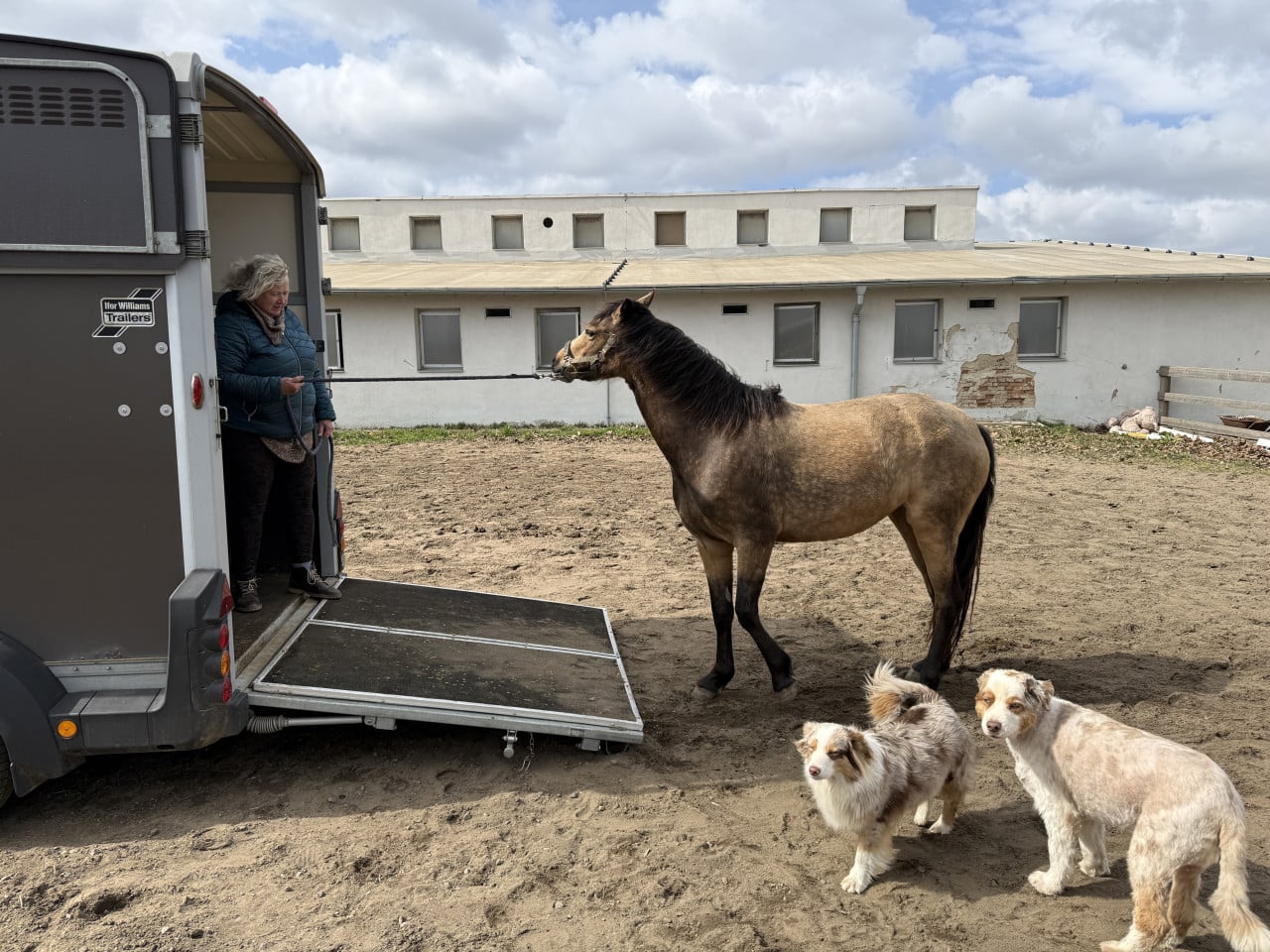
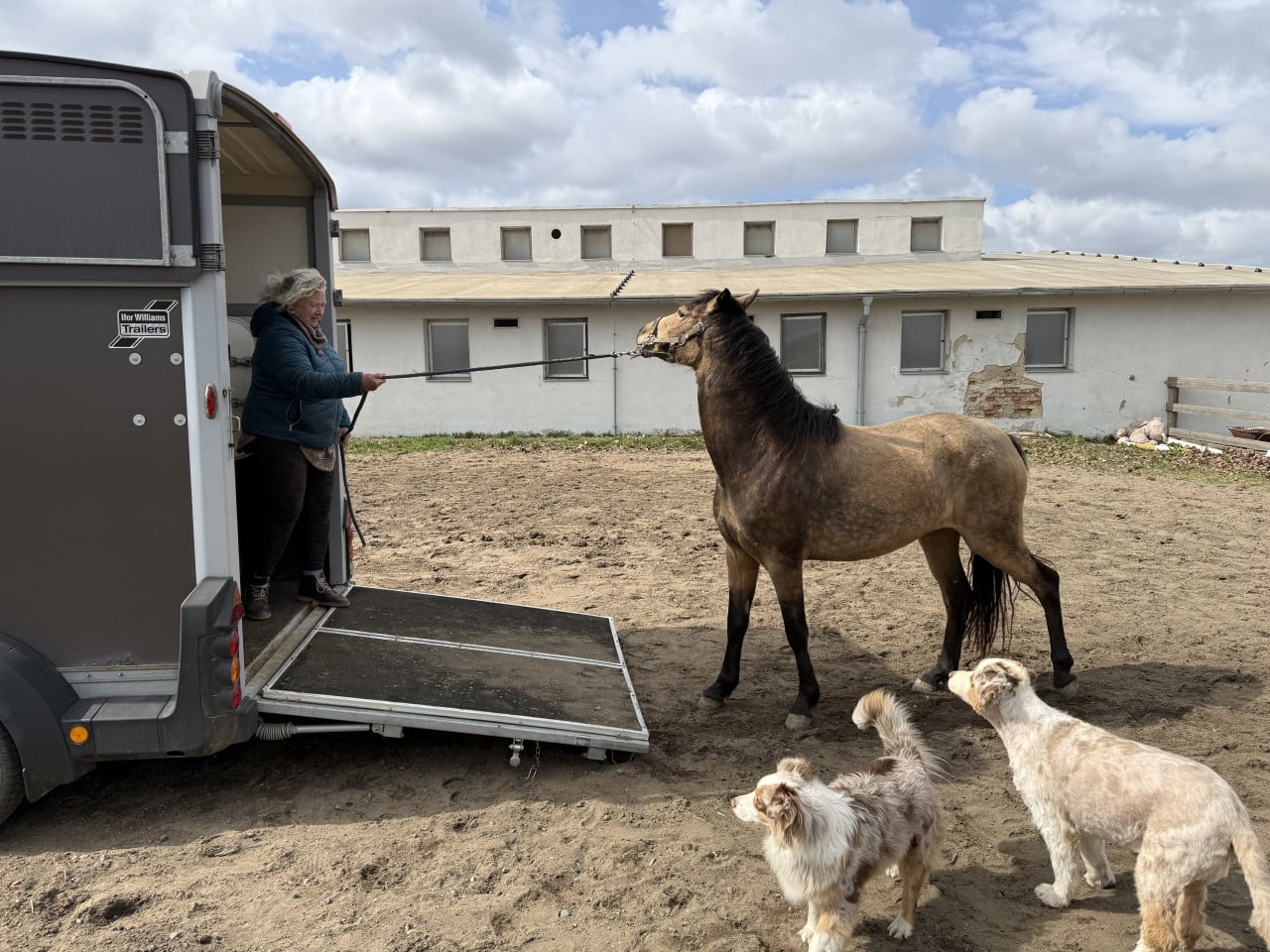
We parked the trailer—a two-horse Ifor Williams—in the parking lot beside the stables. There were paddocks with other horses all around, which turned out to be a major mistake. Fantazia kept looking at the other horses instead of the ramp and refused to even consider going inside.
She wasn’t exactly frightened of the trailer. She simply had no reason to go inside. She refused to step onto the ramp—not even with one hoof.
We tried absolutely everything. Treats and food in a bucket, a lunge line, and a broom from behind. A man from the stable came to help us, and the stable hands helped too—but nothing worked. Fantazia started kicking, charged at Verča several times, and reared up. At times it was quite dangerous, and I had to jump out of the way more than once.
One important thing I realized during all this, and which Verča reminded me of again: you simply can’t use brute force with a horse. At first, we tried the normal approach, then we used a little more force, but the result was always the same—as soon as we pulled her by the head, she immediately resisted even more. Horses are completely different in this respect from dogs, for example. You have to reach an understanding with them mentally, not physically.
After all, this is also one of the basic principles followed by professional horse transporters: loading a horse by force causes stress and increases the risk of injury—both to the animal and to the people around it. Statistics show that horses with a negative loading experience are up to three times more likely to have problems during future transport.
The turning point—the manager and the rattling oats
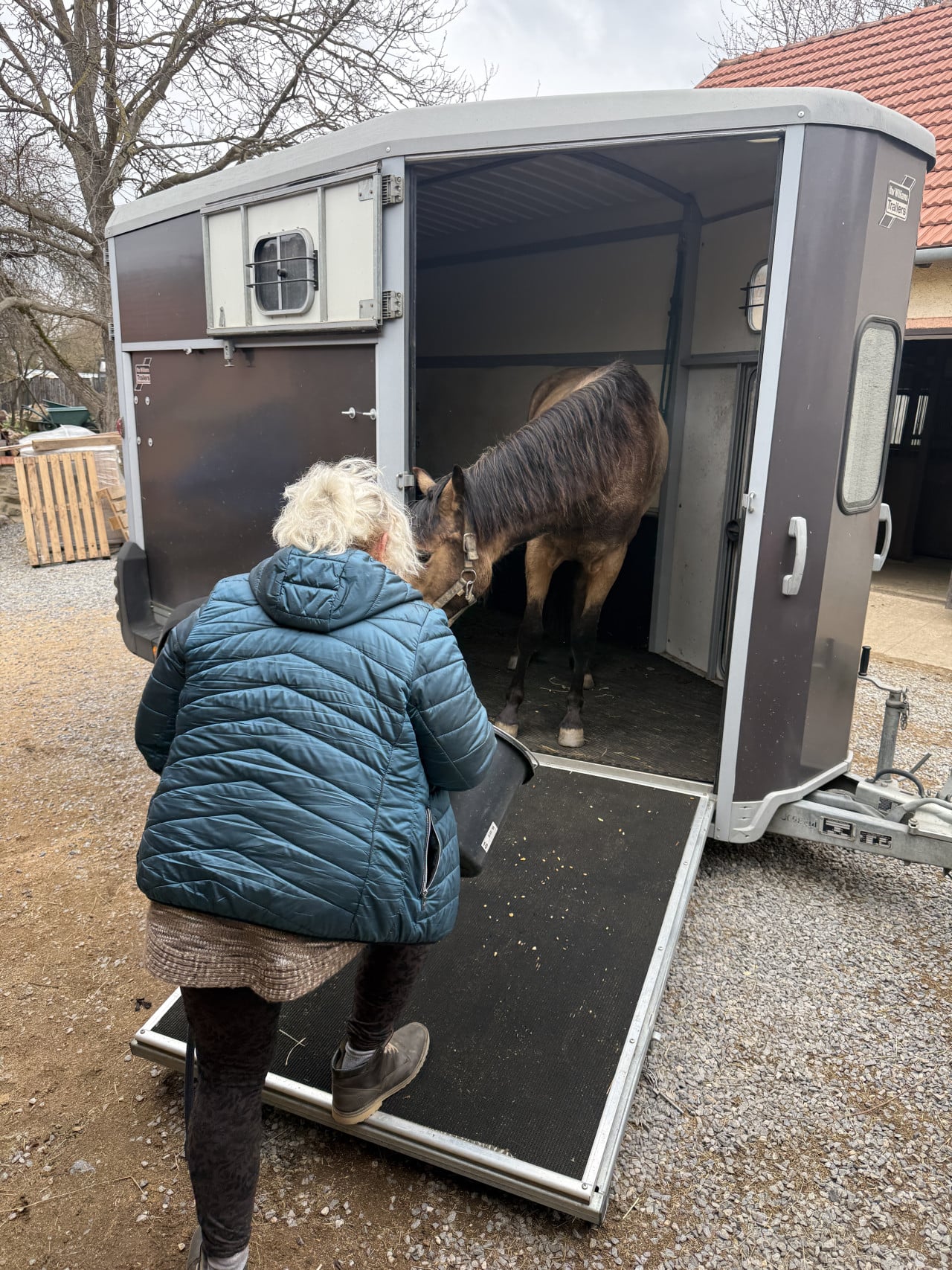
The turning point came when the manager from Eden appeared. Fantazia knew her because the woman regularly came to feed her and would always rattle oats in a bucket as she did so. To the foal, that sound meant food and safety.
Meanwhile, we moved the trailer—we backed it directly into the indoor arena. That was the second crucial step. Inside the arena, Fantazia couldn’t see any other horses, had no distractions, and most importantly, had nowhere to run. No open spaces, no friends in the paddock—just the arena, the trailer, and a bucket of oats.
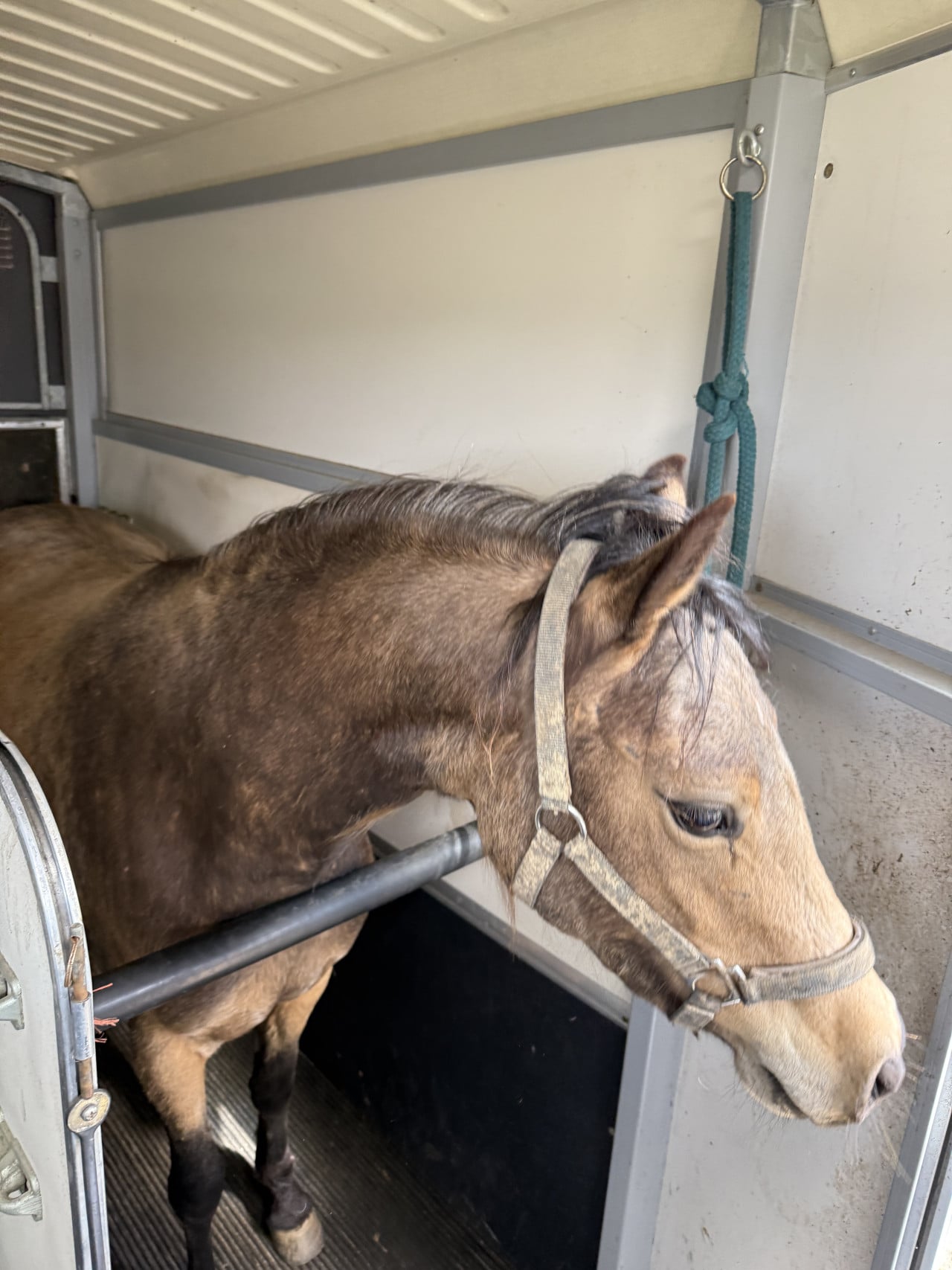
After a few attempts, we managed to get Fantazia onto the ramp with two hooves. The manager kept rattling the oats, Fantazia knew and trusted her, and slowly, step by step, she eventually went all the way inside.
As soon as she went in, we quickly closed the rear ramp and the partition so that she couldn’t back out. And that was it. After almost three hours.
Why we didn’t give up
One thing I took away from the whole day, and which I consider essential, is this: you must not give up.
When a horse discovers that resistance works—for example, that if it backs away, you let it go—it remembers. Next time, it will do it again because it knows it is a way to escape. Fantazia tried it once, backed out, and I didn’t catch her because she started kicking. She immediately realized that it worked and that she could get away with it, so she kept trying it over and over again.
If we had returned her to the paddock and said, “It’s not going to work today,” the next loading attempt would have been much worse. This applies to working with animals in general—when I ask them to do something, I repeat it until they do it. I use the same principle when training my dog Bronko.
The journey to Hostěnice and unloading
Fantazia was completely calm during the journey. We stopped once or twice to check on her—she was standing quietly, with no kicking at the walls and no major stress.
For unloading, we chose a smart approach: we opened the trailer from the side so that Fantazia could walk straight forward instead of having to back out. Horses often have trouble backing out of a trailer—they can’t see behind them, the ramp is sloped, and the whole experience is uncomfortable for them. Walking forward is much more natural.
Within ten minutes, Fantazia was outside and heading into her new stall. The acclimatization had begun.
Sára Pánková—when it really doesn’t work
Throughout the loading process, we were in contact with Sára Pánková, who, in my opinion, is one of the leading experts on horse transport in the Czech Republic. Sára not only transports horses professionally, but also trains owners of difficult horses in how to handle loading.
I have had nothing but excellent experiences with her; she once saved a horse of ours that had colic.
Unfortunately, she was attending a training course that day and couldn’t come in person. If we hadn’t managed to load Fantazia ourselves, we definitely would have contacted her. For anyone dealing with horse transport—especially a difficult horse—Sára is someone well worth contacting.
Sára’s phone number: +420 722 238 954
What I learned: a practical guide to transporting horses
This whole experience prompted me to learn more about horse transport. And I discovered that it is a surprisingly complex subject—from legislation and equipment to animal psychology.
Legislation in the Czech Republic and the EU
Horse transport is subject to stricter rules than you might expect. In the Czech Republic, it is governed by the Animal Protection Act, while within the EU it is regulated by the European regulation on the transport of live animals. A horse must not be transported if it is seriously injured, in an advanced stage of pregnancy, or has recently given birth.
The distinction between commercial and non-commercial transport is interesting. If I transport my own horse in my own trailer and nobody pays me for it, it is considered non-commercial transport. But as soon as someone offers transport for payment, they need to register with the regional veterinary authority and obtain a number of additional permits.
For journeys over 65 kilometers, the driver must have a certificate of professional competence, which can be obtained by completing a one-day course. For journeys longer than eight hours, a detailed route plan with designated stops is required. And for international transport—to Germany or Austria, for example—a veterinary certificate in the TRACES system is also needed, and it is wise to allow two to three weeks for it to be processed.
How much horse transport costs
In the Czech Republic, professional transport generally costs between 16 and 25 Czech crowns per kilometer, with both the outbound and return journeys charged. The minimum call-out fee is usually between 800 and 1,500 Czech crowns. Nighttime call-outs cost around 30% extra, while urgent cases—such as colic—can cost up to 50% more.
An important warning: the cheapest offer often means a lack of insurance or inadequate trailer equipment. Always ask for a complete quote, and don’t be afraid to ask about insurance coverage.
What to look for in a horse trailer
A specialized horse trailer is fundamentally different from an ordinary trailer. It must have non-slip flooring, sufficient interior height (at least 160 centimeters), good ventilation, and lighting.
Modern trailers from brands such as Böckmann or Ifor Williams—the brand we used to transport Fantazia—often also offer cameras for monitoring the horse during the journey, thermometers, and hydraulic ramps. According to manufacturers, a camera system reduces a horse’s stress during transport by up to 40% because the driver can continuously respond to the animal’s behavior and adjust their driving.
Preparing a horse for the journey
Most loading problems can be prevented by preparing one or two days in advance. It is a good idea to discuss vaccinations and deworming with a veterinarian. The final substantial feeding should take place four to six hours before the journey.
And here is what I learned from my own experience: the environment is crucial. If possible, load the horse in a quiet, enclosed area where it has no distractions. We made the mistake of starting in an open parking lot overlooking paddocks full of horses. As soon as we moved the trailer into the indoor arena, everything went much better.
Signs of stress during transport
During the journey, it is important to monitor the horse’s behavior. Heavy sweating, kicking the trailer walls, or unnatural postures indicate stress and require an immediate response—ideally stopping and checking the horse. The optimal temperature inside the trailer is 10 to 25 °C, and the horse should have access to water at least every three to four hours.
Interesting facts about horse transport that surprised me
While researching horse transport, I came across several facts that caught my attention. Horses in trailers naturally prefer to travel at an angle or even facing backward—with their tails in the direction of travel. Research shows that in this position, they maintain their balance better when braking and have lower levels of stress hormones. However, most European trailers carry horses facing forward because this is more practical in terms of loading and space.
Another surprise for me was how much the driver’s style matters. Sudden braking or taking corners quickly can cause muscle cramps and exhaustion in a horse because it spends the entire journey balancing on four legs on a moving floor. Professional transporters therefore drive much more smoothly than they would without a load.
And one more fact: the most common reason for professional horse transport in the Czech Republic is competitions, which account for approximately 60% of all jobs. In second place are urgent trips to a clinic, typically due to colic, followed by moves between stables.
What can I say in conclusion about this experience?
That day with Fantazia was physically and mentally demanding. Three hours of persuading a stubborn foal that kicked, reared, and tried every possible escape strategy—that is an experience I won’t forget anytime soon.
But at the same time, it was a valuable lesson. I was reminded that you can’t work with a horse using brute force. That the environment and trust are more important than any trick involving treats. And that if you don’t give up, the horse will eventually decide to cooperate—especially if you make it feel that it has no reason to be afraid.
If you are planning to transport a horse and it is not a completely routine matter, I definitely recommend contacting a professional. And if you decide to handle it yourself, be prepared for it to take time. Patience, a calm environment, and a person the horse trusts—those are the three things that will help you more than anything else.
Fantazia is now calm in her stall in Hostěnice and is slowly getting used to her new surroundings. And I know that next time, I’ll be better prepared for everything.