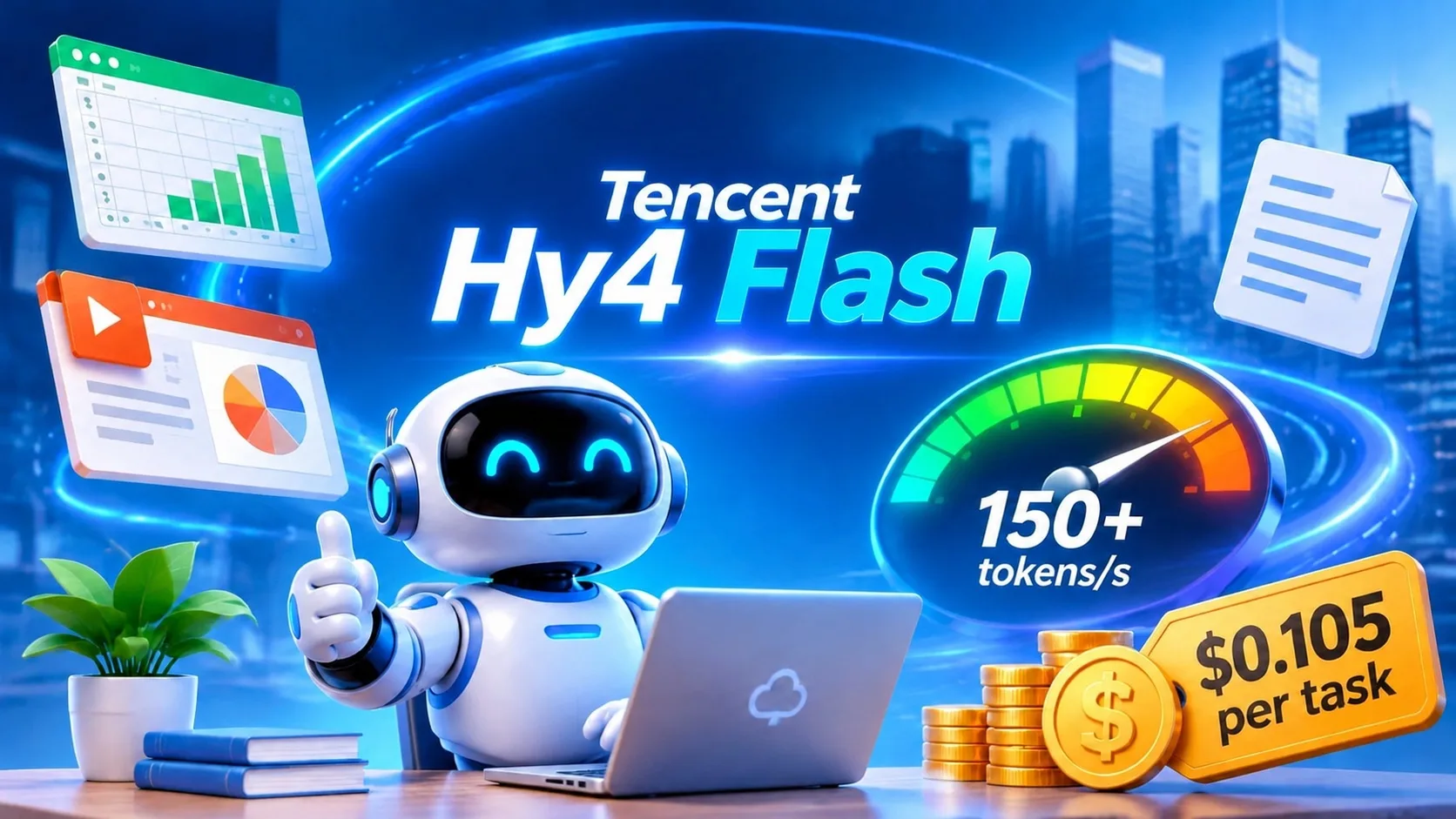
Chinese technology giant Tencent has introduced a new language model, Hy4 flash. It is not intended to break programming records or solve complex scientific tasks. The developers designed it for everyday office work, such as searching for information, creating presentations, editing documents, or fixing spreadsheets. However, the main goal was a low price. According to the company’s tests, a single task costs roughly one-twentieth as much as with the full version of the Hy4 model.
According to the company, it is the most cost-effective model in the entire Hy series to date. The system is already running in the WorkBuddy and Yuanbao applications, and developers can also find it in the TokenHub cloud service.
Changes to the model
Hy4 flash uses a so-called mixture-of-experts architecture. It has 224 billion parameters in total, but activates only about 12 billion of them when processing each token. This means the system does not have to activate its full capacity every time, significantly reducing computing requirements and costs.
Like the full-featured Hy4, the model can natively work with multiple types of input at once, including text, images, and other formats. It supports a context window of up to around one million tokens, allowing it to handle very long documents. The TokenHub documentation lists a maximum input of 960,000 tokens and an output of 64,000 tokens.
Tencent’s engineers focused heavily on speed. They optimized the model using four-bit quantization and other techniques, enabling Hy4 flash to generate more than 150 tokens per second. The company can therefore deploy it at scale and at a low cost.
The approach to evaluation has also changed. Instead of using public leaderboards, which Tencent says often have little to do with everyday work, the team created its own WorkIndex test. It is based on typical tasks that people assign to the WorkBuddy assistant and combines them with ratings from real users. It measures the actual quality of the output, response length, and the total time the model takes to complete a task.
What Hy4 flash is best suited for
Tencent recommends Hy4 flash primarily for search, document work, presentation creation, and simpler computer operation. The WorkIndex test covers eight groups of tasks, including creating and editing slides, editing documents, fixing spreadsheets, processing audio and video, and understanding images.
Hy4 flash scored 42.1 points in this test. The older Hy4 preview finished with 39.7 points, while the full Hy4 achieved 51.4 points. The new model therefore cannot match the flagship in performance, but the price difference is substantial. This is clearly illustrated by collaborative presentation editing, where Hy4 flash scored 74 points compared with 78.9 points for the full Hy4. Meanwhile, the cost per task fell from approximately 1.7 yuan to about one-tenth of a yuan, specifically 0.105 yuan.
However, Hy4 flash is not designed for complex programming, and Tencent openly acknowledges this. In Terminal-Bench 4.0, which measures the ability to work in the command line, it scored 19.2 points, while the full Hy4 achieved 44.4 points. The ratio is similar in ProgramBench, at 16 points versus 30. For users who need to solve demanding programming tasks, the company recommends the more expensive Hy4.
Pricing and comparison with competitors
The pricing is arguably the most notable part of the entire announcement. Developers will pay $0.07 per million input tokens and approximately $0.28 per million output tokens. If the model uses cached data, the price drops to $0.003 per million tokens.
Tencent has also introduced launch discounts. WorkBuddy users can use Hy4 flash free of charge until November 30, while TokenHub offers access through its API at half the regular price. The model has also appeared on the OpenRouter platform, where an introductory 50 percent discount brings the price to $0.035 per million input tokens and approximately $0.14 per million output tokens.
In its comparison with competitors, Tencent relies primarily on a blind test. It involved 85 of its own WorkBuddy users, who evaluated outputs from 259 tasks across 27 categories without knowing which model had generated each response. Hy4 flash received an average score of 2.79 out of four. Anthropic’s Claude Haiku 5.5 scored 2.81 points, making the results almost even. DeepSeek V4.1 Flash performed best among the models compared, with a score of 3.09 points.
However, the decisive difference lies in the price. A single task cost an average of 0.26 yuan with Hy4 flash, compared with 4.73 yuan for the Haiku model. Tencent’s model is therefore approximately eighteen times cheaper and about four and a half times more cost-effective than DeepSeek. With a median completion time of 6.7 minutes per task, it was also the fastest of all the tools tested. In its internal WorkIndex test, the company further states that an average task costs one-eighth as much as with the highest-priced tier of the DeepSeek V4.1 Flash model.
Tencent also published results from well-known knowledge benchmarks for the base version of the model. It scored 88.7 points in MMLU, while DeepSeek V4 Flash scored 89.7 points in the same benchmark. In the more demanding MMLU Pro, however, Hy4 flash led with a score of 71.1 points versus 68.6.
For Tencent, a group with a market value of around HK$3.5 trillion, an inexpensive model makes clear business sense. Analysts note that the long context window, support for different input types, and a benchmark built around WorkBuddy tasks all pursue a single goal. The company wants customers to direct paid workloads to its own Hunyuan models rather than to American competitors such as OpenAI or Anthropic. At the same time, this demonstrates how sensitive the entire industry is to the cost of individual tasks compared with domestic competitors such as Alibaba Cloud and Baidu. Investors are closely watching whether the enormous spending on computing capacity and research will translate into recurring revenue from the Weixin application, cloud services, and enterprise tools.
Sources: finance.yahoo.com and hpcwire.com