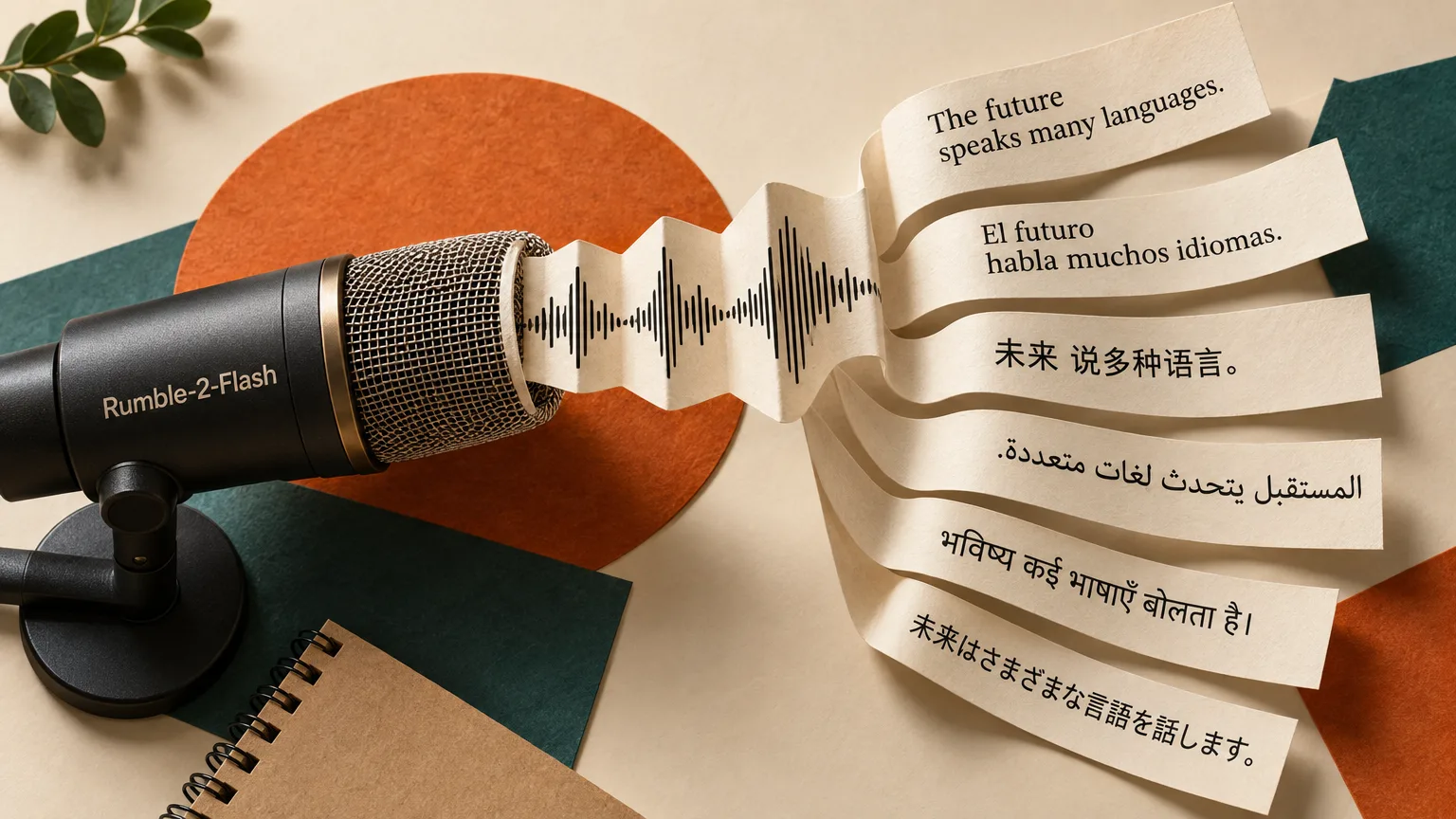
Rumble-2-Flash is a new open speech recognition model that supports more than 40 languages. It has half a billion parameters, automatically detects the language being spoken and lets users control the resulting transcript. Its weights are available under the Apache 2.0 license.
Controlling the transcript
Users can choose whether numbers appear as digits or words. They can also retain filler words and verbatim repetitions, or specify a language rather than relying on automatic detection.
Audio can be supplied as a local path, a URL or a NumPy array. The model also accepts a list of these inputs.
Multilingual and phone-call test results
In the multilingual track of the Open ASR Leaderboard, the model achieved an average error rate of 6.96% across nine listed languages, according to its creators. They say it outperformed Meta omniASR-LLM 7B and Whisper large-v3; the Meta model is 15 times larger. On the leaderboard’s English track, Rumble-2-Flash had an average word error rate of 6.6%.
The creators also published a comparison using AppTek’s phone-call benchmark, which included 302 hours of helpline calls featuring 14 English accents. Scored with AppTek’s script, Rumble-2-Flash had a word error rate of 7.86%, compared with 7.78% for NVIDIA Nemotron 3.5 Transcribe, which has 30 billion parameters.
In the same test, the creators say Rumble-2-Flash had a lower error rate than Qwen3-ASR 0.6B, at 8.7%, but a higher rate than Qwen3-ASR 1.7B, at 7.4%.
Speed depends on batch size
Throughput depends on how full the batches are. On larger Open ASR Leaderboard datasets with full batches, the model reaches more than 7,000 RTFx, according to its creators, equivalent to processing an hour of audio in approximately half a second.
A smaller model built through distillation
Rumble-2-Flash uses the Qwen3-ASR architecture. Its creators say they distilled it from their larger production model, Rumble-2: the smaller model transcribes audio itself, and the teacher model evaluates its output token by token. The student learns from its own errors.
The two models use different tokenizers. The creators say the GOLD method helped bridge that difference by merging tokens where the tokenizers split text differently. It then compares shared tokens directly and the remaining tokens by their sorted probabilities.
Availability and deployment
The weights are available in the Reson8/Rumble-2-Flash repository on Hugging Face Hub, and the model can also be used through its creators’ API. It runs in Transformers and vLLM without a modified runtime or the trust_remote_code parameter.