

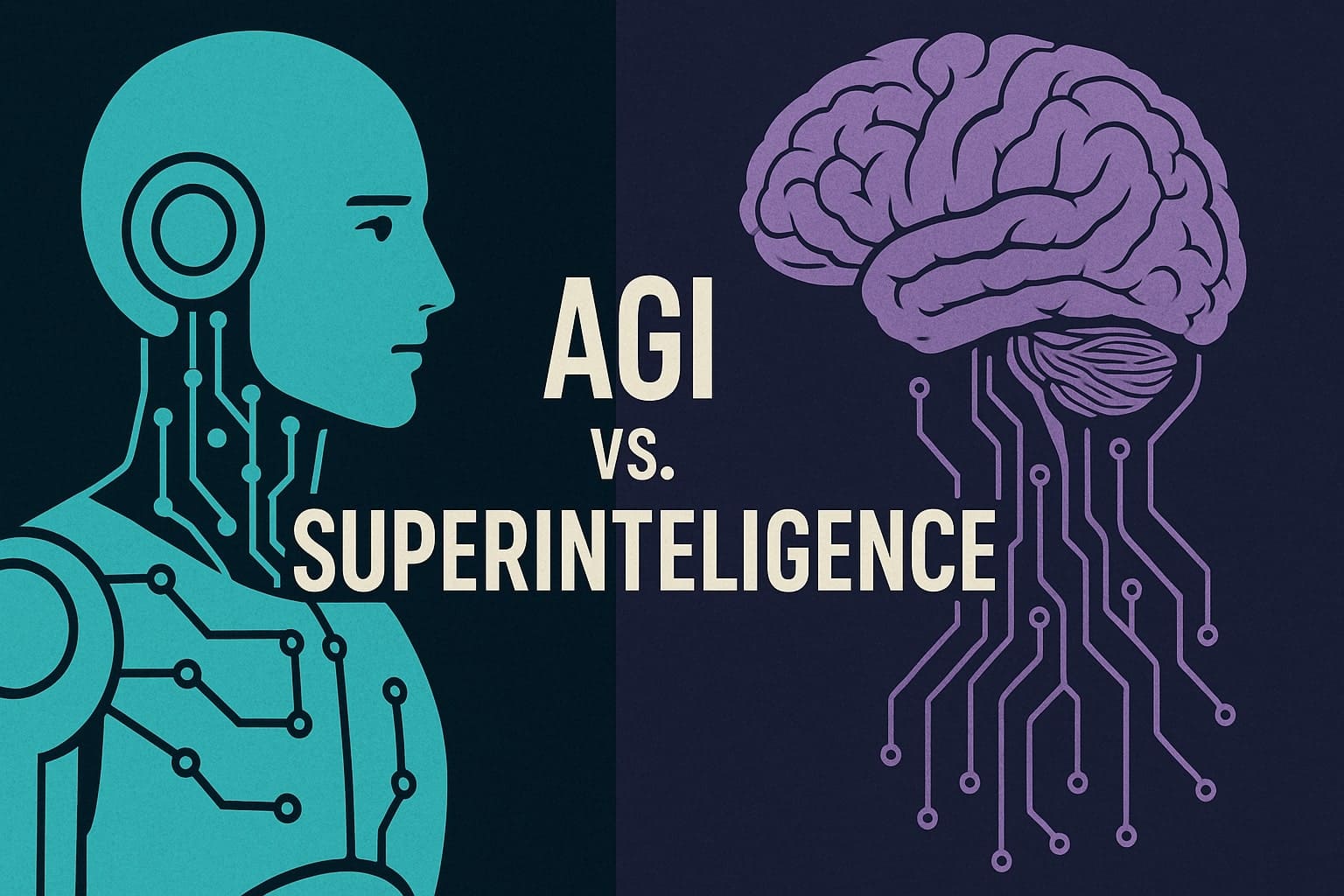
Tech Giants Are Abandoning AGI and Betting on Superintelligence by 2027
Artificial general intelligence (AGI) is so 2024. The tech industry has just stopped pretending that AGI is somewhere in the future. Now everyone is racing to create artificial "superintelligence" by 2027.
Just look at the marketing buzzwords: Microsoft claims it is on the path to "medical superintelligence." Meta launched "Meta Superintelligence Labs," with Zuckerberg pursuing the goal of "personal superintelligence for everyone." Even OpenAI CEO Sam Altman says that we are already in a "gentle singularity," which is essentially a reference to superintelligence.
Anthropic CEO Dario Amodei predicts a "country of geniuses in a data center" by 2026-2027. Superintelligence by another name, right?
The Ruthless Race for the Future
Mark Zuckerberg proved that Meta is serious about the idea of superintelligence when he spent nearly $15 billion on ScaleAI (a company essential for training new AI) and hired 8 (and counting) top researchers from OpenAI, including Trapit Bansal (co-creator of the o1 reasoning model), Shengjia Zhao (co-creator of ChatGPT and GPT-4), and Shuchao Bi (co-creator of GPT-4o's voice mode).
OpenAI naturally did not like this. Chief Research Officer Mark Chen sent an urgent internal memo that said: "I feel a visceral sense right now, as if someone has broken into our home and stolen something." Sam Altman called the move "not the craziest thing that has happened in OpenAI's history" and said that "missionaries will beat mercenaries." And, of course, OpenAI is reassessing its researchers' compensation...
In other words: we are in a ruthless, cutthroat phase of the AI race, where companies believe they are approaching a "winner-takes-all" moment and are willing to bet everything to get there.
Vinod Khosla's Vision of the Future
Vinod Khosla is an Indian-American millionaire, entrepreneur, and venture capitalist known for his influential role in the technology sector and as a major investor in OpenAI.
What happens if one of these ruthless players actually achieves superintelligence? Vinod Khosla, an extraordinarily prescient and legendary technology investor, offered this vision in a new interview with Jack Altman:
2025-2030: The Era of AI Interns. These superintelligent systems will become your colleagues. Every professional will get AI assistants smarter than Stanford graduates. AI will handle 80% of the work in 80% of all jobs.
The 2030s: Corporate Extinction. Fortune 500 companies will die faster than ever before. Someone will build a billion-dollar company with 10 employees. Superintelligent "interns" will outperform their human bosses.
2040+: Work Becomes Optional. You will work because you want to, not because you need money for rent. Humanoid robots will handle physical labor. All expertise—medical, legal, educational—will become free.
In short, Khosla is 80% certain that the real show will end with humanity never having to work again.
The Current State: Fragmented AGI
As for AGI... it is clear that we are in a phase of fragmented AGI, where we have AI systems that are superhuman in certain areas but fail at seemingly simple tasks. OpenAI's o3 illustrates this perfectly: it scored 87.5% on ARC-AGI (surpassing the 85% "AGI threshold") and can create complete business plans from a single prompt, yet it consistently fails at simple puzzles that humans solve easily. Similarly, Google's AlphaFold predicts protein structures "with accuracy down to the width of an atom," but it cannot (yet) apply this knowledge to other molecular problems.
This fragmented nature explains why companies simultaneously claim to have achieved AGI while acknowledging significant limitations. Because we may already have AGI-level capabilities in many areas, superintelligence (where AI is smarter than humans) truly is the next meaningful milestone. His biggest concern? Not deceptive AI. It is China using "good AI" (free healthcare and education) to export its politics globally. But honestly, when you hear venture capitalists (VCs) talk about the benefits of AI, they sound rather communist with all their talk of cheap goods and no jobs. The race for superintelligence is here, and the next three years will be decisive for the future of humanity.


