

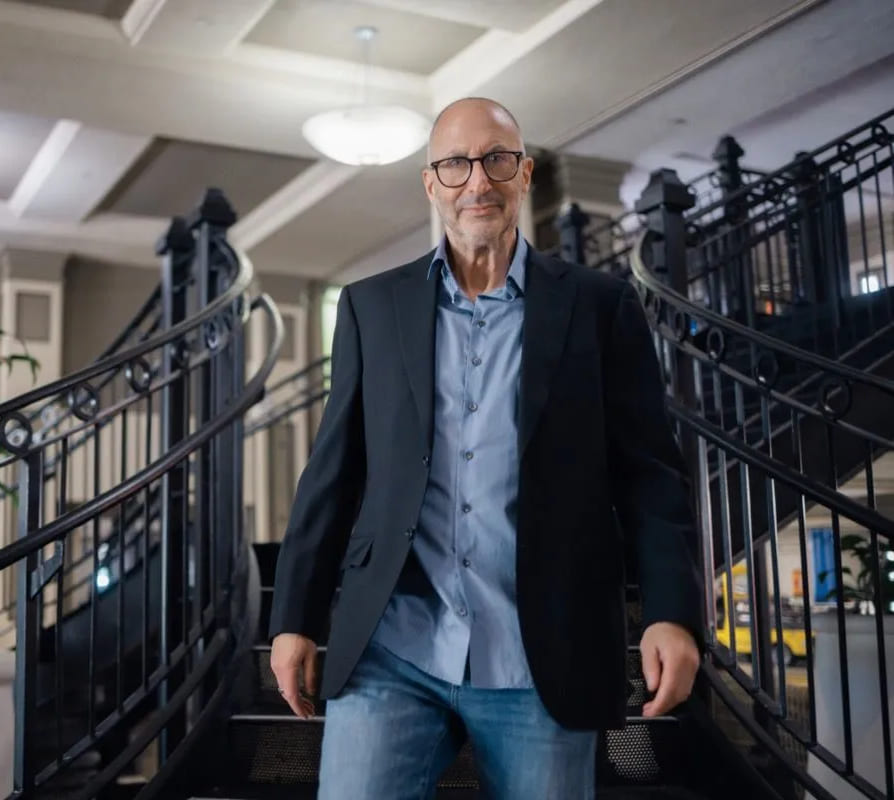
Stephen Klein, founder of the fintech startup LOYAL 3, is now focused on building Curiouser.ai. The project features an AI coach named Alice, designed to ask thought-provoking questions rather than provide direct answers. Klein openly criticizes the prevailing Silicon Valley narrative around AI, calling “agentic AI” nonsense designed to scare people and make them spend money on consulting. He warns that automation leads to commoditization, where everyone becomes average.
Klein’s career is varied and did not begin in tech. He originally studied chemistry in college, but entered advertising after graduating. He spent the following decade in senior marketing positions, traveling around the world for work. He later fulfilled his lifelong dream and was accepted into Harvard Business School. It was there that he learned how to truly learn—not to memorize, but to question, deconstruct, and rebuild.
During a finance course at Harvard, he had the idea that led to the founding of LOYAL3 in 2008. This fintech startup enabled ordinary people to invest in leading brands through IPOs, stock rewards, and fractional ownership. It was about democratizing finance, leveling the playing field, and creating opportunities—a theme that runs throughout Klein’s work.
From 2015 to 2021, Klein led marketing and innovation at Dentons, the world’s largest law firm, with more than 16,000 employees in 75 countries. His role encompassed branding, marketing, and systems design. He developed infrastructure and platforms that made it possible to share innovations globally and increase revenue. During this time, he also traveled the world speaking about the risks of AI and automation—within the firm, to clients, and to legal communities.
Klein says: “I had the opportunity to travel all over the world and speak about AI ethics. I was considered an expert on the subject, which isn’t entirely accurate. I don’t know if anyone is an expert, honestly, but I knew a lot.” He continues: “I spoke with clients and lawyers within the firm, as well as independent law firms around the world, about the ethics surrounding artificial intelligence, data bias, things that can go wrong, and what we need to watch out for.”
Today, Klein is building his own company while teaching entrepreneurship and marketing at UC Berkeley. Teaching is his passion, a way to give back, which he describes as a central part of his life. Although he spent decades in the corporate world, he did not find much fulfillment there. By contrast, his current career has genuine meaning. He works pro bono in the Bay Area, helping nonprofits with strategy and planning. One that is close to his heart is Poetic, a Dallas-based organization supporting girls who have been sexually abused. “I do a lot of work to help them with strategy, programming, funding, and so on,” he says. “That is a labor of love.”
This philosophy of meaningful work lies at the heart of Curiouser.ai, the company he now runs with a team that is 86% women. Curiouser.ai has been in development for more than two years and was designed from the outset to challenge the status quo. “We are one of the few companies dedicated to helping people think,” Klein says, in contrast to the standard AI model dominated by automation and speed. “We are an augmentation model, a partnership in which we enhance people’s ability to think critically and be more creative.”
A Challenge to Think More Deeply in the New Age of AI
A fundamental part of Klein’s personal brand involves disrupting the AI tech-bro narrative that dominates the media. According to Sam Altman, AI will soon replace entire industries and change the world beyond recognition. While most people in AI overlook the limitations and accuracy problems of automation tools, Klein continually draws attention to them. He has a growing following on LinkedIn, where he shares his views.
Klein sees it clearly: “It is unreliable. Error rates get worse as the models become more sophisticated, ranging from 30 to 70%. And AI does not think. It has no ability to imagine or create. So yes, you may save money and increase profits in the short term, but you will not create more value over the medium to long term.”
He calls it the “Hype as a Service” economy, comparing it to the dot-com bubble. Too much money, not enough sense. In recent years, Silicon Valley has been flooded with cash, with investors chasing the next ChatGPT and selling CEOs dreams of cutting costs while ignoring the people whose jobs they are replacing.
Klein’s message is clear: behind the glossy marketing, the narrative does not hold up. “Most companies that did this are already hiring people back; they are bringing them back because someone has to manage AI’s inaccuracies and quality issues.” Like politicians detached from reality, those making decisions about implementing AI tools are not the ones who work with them. Companies are realizing that AI is not a miracle solution for productivity and margins, and they are quietly backing away.
Beyond accuracy, there is the threat of commoditization, which affects everyone from large enterprises to small startups. In a recent Inside Analysis podcast, Klein explains that when everyone uses the same prompts on the same models trained on the same data, regression occurs. Innovation becomes imitation. “At any given moment, 100,000 people are entering a prompt similar to yours because companies are often alike, and they are using the identical database and identical tool. When I say regression to the mean, I mean it literally—you are becoming average.”
Alice: The AI That Asks Instead of Answering
How can someone like Klein be the founder of an AI company with such an attitude? Introducing Alice, Curiouser.ai’s flagship product. “Instead of being educated or trained to perform tasks, which is what 99% of generative AI does—perform tasks, make things easier, do tricks,” Klein explains. “Our generative AI is designed and educated to ask you questions. Her name is Alice, Alice in Wonderland, and that is the origin story. She does not slow you down. What she does is challenge you to think more deeply by asking you very profound, important epistemological questions.”
Unlike other models, Alice is not connected to the internet. Instead, she is trained in Socratic questioning, engineering design, and the “Five Whys” methodology first developed by Toyota in the 1930s. This is where Alice excels. While ChatGPT and Claude mass-produce generic content and turn marketers into clones, Alice is an alternative—an augmentation tool, a partner for brainstorming strategy, designed to deepen thinking rather than flatten it.
Klein has spoken in several interviews about his ambition to turn every CMO into the next Steve Jobs for their company. This philosophy of empowerment may have begun years ago, when Klein took a year off and taught at a high school for disadvantaged students. There, he was amazed by the genius of his students. “I began to realize, how many Mozarts are out there who were never given a piano? I think it is that simple. What if Mozart had not had that piano? Or Lewis Carroll had not had a pencil?” Perhaps that was the original seed of Alice.
Ethics in AI: From Words to Action
According to Klein, when it comes to AI and ethics, “there is no such thing.” He continues: “There is only the ethics of the people building it. In other words, does the CEO stand for certain values and principles? And what are they, and will they declare them? For most of Silicon Valley, ethics is just an inconvenient brake.” For AI to be truly ethical, ethics must be built into the process.
“You have engineers, you can have philosophers, linguists, artists, and writers, all contributing to educating and building the AI. So I would argue that ethical AI is part of a human- and organization-centered design and production process. And if you cannot have the discussion without considering whether that organization is ethical, has values, and is principled from the bottom up, it is a waste of time.”
The technology itself knows nothing about ethics. “A robot would be just as happy to go out and kill people as save lives. It does not know.” Klein points to other problems: “90% of the entire internet was essentially used by five generative AI companies to train models. That is a fact; now they are all in court.”
In a post-IP, post-regulatory world, Klein sees the solution in values. “I would argue that values and ethics will become the strategy of the future; shared values with your customers, employees, and stakeholders, who will realize that you stand for something. And it is not just a poster on the wall; it is something real. If that is true, nothing can stop you, because that is an impenetrable defense. Because as a customer, I will never, ever, ever leave you.”
Klein believes that shared values will become the defensive moat of the future. Not glossy branding or features, nor IP. But principles—real ones, lived by the company—that connect with customers. Ethics and humanity will not merely be part of the conversation—they will be the only competitive advantage.
The Future: Augmentation Instead of Automation
Klein acknowledges that we are still in the early days of AI, but we are already at a crossroads. One path leads companies to pursue speed, scale, and short-term wins—the path of automation, profitable in the short term but hollow. It is full of inaccuracies, with companies rehiring workers to “watch over” AI.
The other path is slower, harder, and many would say less profitable. It means consciously choosing a human-centered approach and developing AI to augment rather than replace. Klein has chosen this path and is betting that human nature will choose meaning over momentum.
The rapid success of China’s DeepSeek showed how quickly foundational LLM models can be replicated at a fraction of the cost, fueling a race to the bottom. Klein suggested on the Inside Analysis podcast that some American AI companies are not pushing for regulation but for financial assistance from the government—perhaps a federal bailout is already underway.
Klein does not know what will come after the correction, but he knows that only companies with substance and purpose will remain. Curiouser.ai’s mission goes deeper than money—it is about restoring human potential and childlike imagination. He points to a NASA study in which 98% of children tested as creative geniuses, but the figure drops to 1.5% among adults.
Klein wants to reverse this trend, helping people think more deeply, act more intentionally, and reclaim their creativity. Curiouser.ai’s goal is not to scale at any cost for a quick profit—it is transformation. That is why there is no free trial; at the time of writing, it costs $5 for two weeks.
He believes Alice can help more startups succeed. Currently, more than 90% of new companies fail, and if Alice helps just 1% more succeed, it could create 150,000 new jobs. He teaches the same ideas at Berkeley and applies them in his nonprofit work. Whether mentoring students, advising social organizations, or speaking about AI ethics around the world, the thread is the same: giving back and helping people.
Klein’s energy is infectious. At an age when others are thinking about retirement, he is like an ambitious teenager trying to change the world. Unburdened by greed, he is guided by three goals: “Goal number one is to change the world and elevate humanity so that we leave a better world for our children and the next generation. That is what I do and why I do it. Goal number two is to create wealth, a lot of wealth. Goal number three is to build a model diverse company that I believe in.”
While most of the AI industry is turning us into clones, Klein encourages us and believes in our potential to be creative geniuses. His approach brings hope.
Source: startups.hubspot.com


