

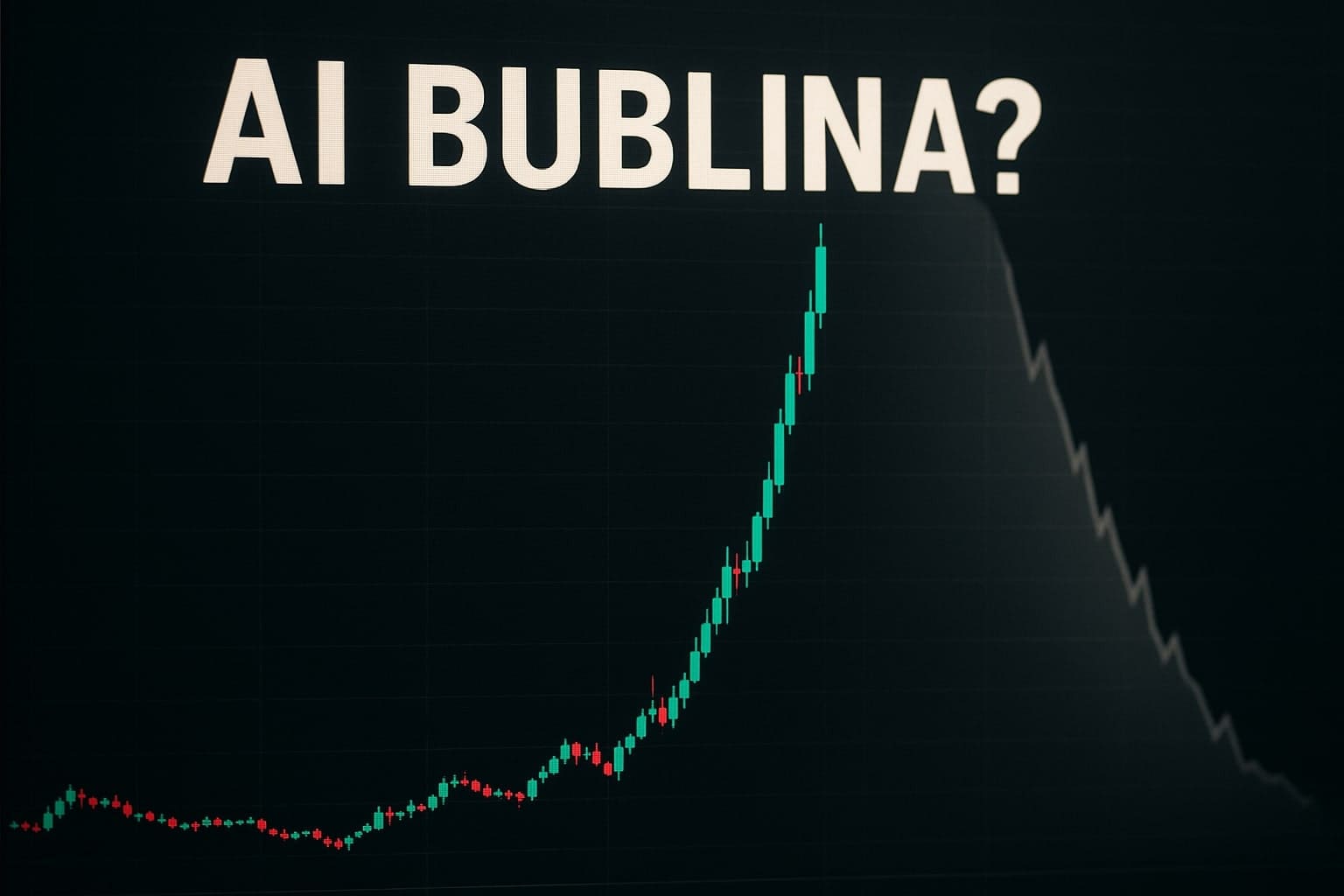
AI represents both a genuine technological revolution and an enormous financial bubble. The question is whether miraculous progress will outweigh the catastrophic costs running into trillions of dollars. According to British analyst Julian Garran, it is “the biggest and most dangerous bubble the world has ever seen,” 17 times larger than the dot-com bubble and four times larger than the 2008 mortgage crisis. Ten unprofitable AI startups have gained nearly $1 trillion in market value, while the ecosystem operates on continuous funding, with everyone except NVIDIA losing money.
Garran argues that large language models (LLMs) are commercially unsuccessful for four reasons. First, they function as enhanced word autocomplete based on statistical patterns, without genuine understanding. This limits them to narrow tasks. Second, when writing code, they merely repeat learned patterns from training data and are unable to create new solutions. Third, they have reached the limits of scaling—since the launch of GPT-4 in March 2023, no model has significantly surpassed its predecessors, despite enormous spending. Fourth, the system depends on venture capital from investors such as SoftBank or sovereign wealth funds, which subsidize the losses of everyone except chip manufacturers.
This conflict divides opinion. The bullish side, represented by investor Marc Andreessen and NVIDIA CEO Jensen Huang, sees “version 2 of the computer industry”—a transformation that will unlock unprecedented productivity. The bearish side, including writer Ed Zitron, describes a circular, debt-driven mania that will end in collapse.
The Bull Case: A Revolution in Full Swing
The bull case is based on a long-term view. Marc Andreessen argues that AI is not like the dot-com bubble, which was more of a telecommunications bubble, with too much infrastructure for too few users. Today, a product like ChatGPT is already remarkable and available to hundreds of millions of people. Engineer Martin Alderson calculated that processing input data is 1,000 times cheaper than generating output, making applications such as coding assistants extremely profitable, with high subscription margins.
Andreessen predicts that AI will turn every person into a “super PhD in every field,” leading to massive job growth and lower prices for goods and services. According to him, AI is democratizing technology faster than anything before it—ChatGPT gained 800 million users in two years, compared with 50 million internet users in 1999. The technology is already fully functional, unlike the early internet, which needed decades to improve.
NVIDIA’s Jensen Huang emphasizes exponential demand. AI is moving from simple answers to chains of reasoning, increasing computing requirements by as much as a billionfold. There are three scaling laws: pretraining, post-training, and inference. The entire global base of general-purpose computing, worth trillions of dollars, must be replaced by accelerated AI infrastructure. Huang estimates that augmenting human intelligence, which accounts for $50 trillion of global GDP, will create an annual $10 trillion market for AI tokens.
The Bear Case: A Circular Illusion
The bear case sees a financial illusion. Ed Zitron describes how NVIDIA invests in “neoclouds” such as CoreWeave, which borrow billions to buy GPUs from NVIDIA, thereby creating artificial demand. Total generative AI revenue is expected to be only $61 billion in 2025, compared with hundreds of billions in costs. Microsoft has persuaded only 1.81% of its 440 million Office users to pay for Copilot.
Ewa Szyszka and Ethan Ding warn that application costs have exploded because everyone wants the latest models, which consume 100 times more tokens for complex tasks. This creates a “token short squeeze”—companies with flat-rate subscriptions cannot cover the cost of power users, leading to service restrictions, as seen with Claude Code or Cursor.
Mathematician Terrence Tao adds that the true costs also include failed attempts, further worsening the economics. Zitron estimates that OpenAI needs more than $1 trillion over the next four years, including $300 billion for Oracle, but the available capital is insufficient.
What Comes Next? The Paradox of Revolution and Bubble
The evidence suggests a paradox: a genuine revolution financed by a generational bubble. A painful correction in the application layer is likely, even if the underlying technology remains. Futurist Peter Leyden sees a “world-historic” inflection point at which AI will amplify mental power in much the same way that the steam engine amplified physical power.
For founders and investors: Avoid merely reselling APIs; integrate your own models or lock in clients. For professionals: Unlimited access to high-end AI is ending, so prepare for usage-based pricing that could exceed $100,000 per developer per year. Track your “token spend” for better ROI.
This conflict between bulls and bears defines our era. Whether a revolution or a crash comes, chaos is part of the transition into the “AI era.” Buckle up.
Source: theneuron.ai


