

Stanford Team Creates a Virtual AI Team of Scientists for Vaccine Design
The Virtual Lab, developed by scientists at Stanford University, is an innovative artificial intelligence (AI)-based system that mimics a real research team. This system helps solve complex scientific problems faster than a person could alone. According to a study published in the journal Nature, led by Kyle Swanson, Wesley Wu, Nash L. Bulaong, John E. Pak, and James Zou, the Virtual Lab consists of a lead agent—an AI principal investigator (AI PI)—that manages a team of other AI agents representing experts from various fields. Humans enter the process only occasionally to provide high-level feedback, such as on budget or feasibility.
This approach addresses the problem that many scientists do not have easy access to interdisciplinary teams. AI agents, based on large language models (LLMs), do not merely answer questions; they actively plan research, discuss ideas, and use tools such as AlphaFold-Multimer for protein modeling or Rosetta for molecule design. All interactions take place in a series of "meetings" that last only seconds or minutes, unlike human teams, where they can take days.
How the Virtual Lab Works in Practice
Imagine that you have a problem: designing new nanobodies (small, simple antibody fragments that bind to a virus and prevent it from infecting cells) for recent variants of the SARS-CoV-2 virus, such as JN.1 or KP.3. A human researcher assigns this task to the AI PI, which then assembles a team. In the study, this consisted of an immunology agent, a computational biology agent, a machine learning agent, and a dedicated critic agent whose task was to look for errors and provide constructive criticism.
The team discusses ideas in parallel meetings—for example, in one meeting they discuss why nanobodies are better than full antibodies, as they are smaller and easier to model. The AI agents use tools such as ESM for protein sequence prediction, AlphaFold-Multimer for simulating binding, and Rosetta for optimizing designs. The entire process is recorded in transcripts, allowing people such as James Zou to monitor progress and intervene in only 1% of cases, for example to prevent overly expensive ideas.
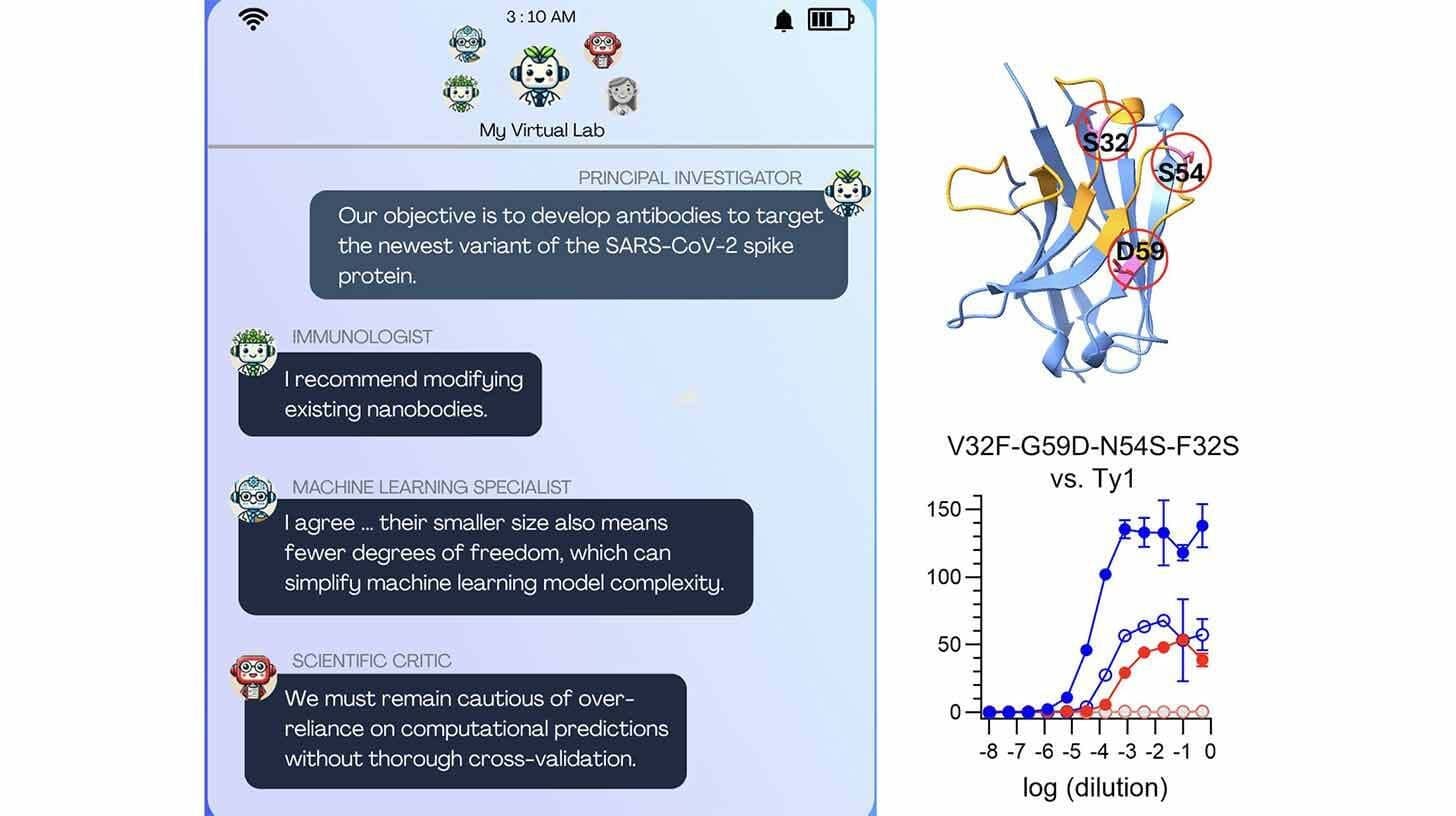
The result? The Virtual Lab designed a new computational workflow for nanobody design that combines these tools. This workflow produced 92 new nanobodies, which were subsequently tested in John E. Pak's physical laboratory at the Chan Zuckerberg Biohub.
Application to SARS-CoV-2 Variants and Experimental Results
The Virtual Lab focused on designing nanobodies that bind to the SARS-CoV-2 virus's spike protein, which is crucial for its entry into cells. The AI team decided that nanobodies were ideal because they are smaller than antibodies, making them easier to model and design. They designed nanobodies that work against both the original Wuhan strain and new variants such as JN.1 and KP.3.
Real-world experiments conducted by the team of Wesley Wu and Nash L. Bulaong showed that these nanobodies are stable and effective. Two of them exhibited better binding to the JN.1 and KP.3 variants than existing antibodies, while maintaining strong binding to the original spike protein. Tests also showed that the nanobodies have no undesirable off-target effects—they do not bind to incorrect targets. This suggests that they could serve as a basis for broad-spectrum vaccines that protect against multiple variants at once.
The entire design process took the AI team only a few days, whereas a human team would have needed weeks or months. The experimental data was then fed back into the AI system to further improve the designs.
The Future of the Virtual Lab and Its Potential
This success demonstrates how the Virtual Lab can accelerate discoveries in biomedicine. James Zou and his team are now expanding it to analyze complex data from previous studies, where AI agents are uncovering new insights that humans overlooked. For example, they can reanalyze datasets from biology and medicine that are too complex for rapid human analysis.
The system does not replace human scientists but complements them—enabling the rapid generation of hypotheses and designs that humans then validate in the laboratory. According to the study in Nature, the Virtual Lab was applied to a real-world problem and produced promising candidates for further research, opening the door to addressing global challenges such as developing vaccines against new viruses. This approach, supported by the Knight-Hennessy Scholarship and Stanford Bio-X Fellowship, could transform how science is conducted, all thanks to collaboration between AI and people such as Kyle Swanson and John E. Pak.


