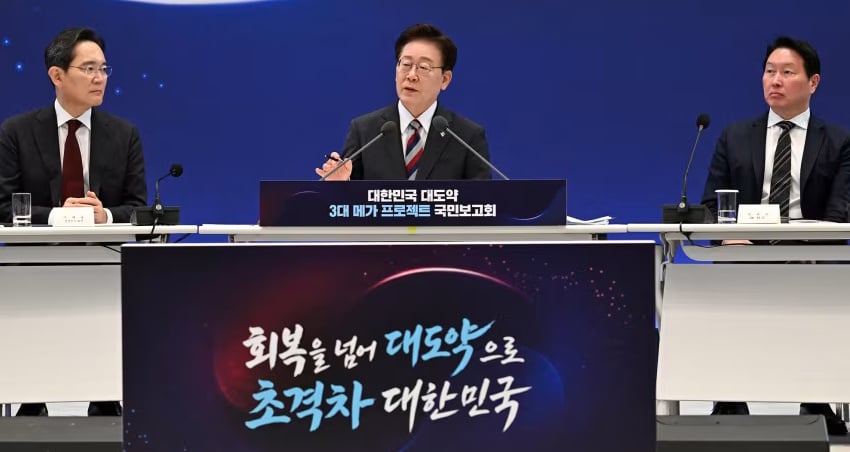
Seoul is serious—so serious that President Lee Jae-myung announced an investment plan worth at least $880 billion, flanked by the heads of Korea's two largest chipmakers. The goal is to build new chip factories and massive data centers and launch robot production. Above all, it aims to ensure that South Korea remains one step ahead of the competition in the age of artificial intelligence. "We must secure the key components of artificial intelligence faster than any other country," Lee said. Semiconductors, physical AI, and artificial intelligence data centers are, according to him, the "three axes for a great leap forward."
Three Mega Projects
The entire strategy rests on three pillars, which Seoul calls the "three mega projects." They concern semiconductors, so-called physical AI (that is, robotics), and artificial intelligence data centers.
The most expensive part revolves around memory chips. Samsung Electronics and SK Hynix, the world's two largest memory manufacturers, will invest a combined 800 trillion won together with their suppliers. With that money, they will build four new manufacturing plants in the southwest of the country, two for each company. The government will add another 81 trillion won for an HBM high-bandwidth memory packaging center in the central Chungcheong region.
The second part focuses on data centers. Companies such as SK Group, GS Group, and Naver are expected to invest 550 trillion won in large artificial intelligence data centers by 2035. These will be built outside the capital, for example in the provinces of Chungcheong and Gangwon or in both Jeolla provinces in the southwest. According to Science Minister Bae Kyung-hoon, the country is expected to have more than 18.4 gigawatts of computing capacity by 2035, while total investment in data centers is expected to exceed one trillion won.
Korea Is Rushing Just Like Everyone Else
Taiwan, China, and Japan are pouring money into new chip factories because the artificial intelligence boom is driving up demand for semiconductors. Korea, which dominates global production of cutting-edge memory chips, cannot afford to fall behind.
Samsung and SK Hynix are meanwhile enjoying a golden age. Their customers include Nvidia. The appetite for artificial intelligence chips is so great that it has created a global memory shortage, which has come to be nicknamed "RAMageddon." Prices have risen, making consumer electronics more expensive as well. For Samsung, SK Hynix, and the American company Micron, however, this is a blessing, with demand breaking records.
Industry Minister Kim Jung-kwan added that Korea intends to double DRAM memory production within five years. The government wants to accelerate construction of new plants around Seoul and bring it forward to the mid-2030s.
Robots Intended to Replace Missing Workers
The third part is physical AI—that is, robots capable of moving and working in the real world. Hyundai Motor is seeking to launch mass production of humanoid robots developed by its subsidiary Boston Dynamics. The goal is for these robotic workers to begin taking over strenuous tasks in car factories and other facilities by 2028.
Among other things, this plan is driven by an unpleasant reality. Korea's population is shrinking and its workforce is aging. Robots are not a toy for engineers here, but a response to labor shortages.
Sources: en.yna.co.kr, bbc.com and asiatechreview.com