The first time I heard the term “Moontower” (moonlight tower) was from Matthew McConaughey. He didn’t say it directly to me. He said it to a car full of teenagers in Richard Linklater’s film Dazed and Confused.
He told them there was a “party at the Moontower.” Right afterward, you see dozens of kids sharing a keg of beer and their worries beneath and atop a 165-foot-tall tower.
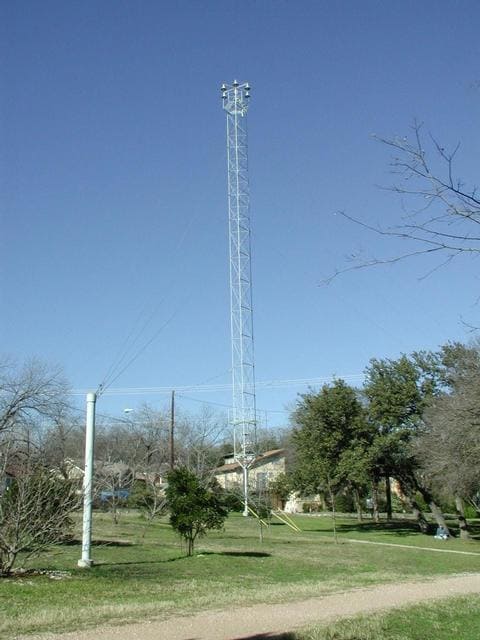
These romantically named towers, as I later learned, are a distinctive feature of Austin. There were originally 31 of them, but today only 17 Moonlight Towers, as they are properly called, remain in operation. We know that the switch was thrown and all 31 towers were illuminated, creating Austin’s first public street lighting system, on May 3, 1895. A number of other progressive cities across the country had already installed electric light towers to improve the illumination of streets and neighborhoods at night. Today, Austin is the only place where these towers still stand.
However, there are two versions of their origin. The more commonly repeated one says that Austin bought them secondhand from the city of Detroit—which was the first major city to install a tower system—in 1894.
Other historians, however, claim that they were purchased new from Fort Wayne Electric Co. of Indiana, which assembled them on site. According to one account, in addition to a cash payment of $70,000 for the towers, the city was supposed to include a narrow-gauge railroad that it had used to transport materials to the newly built Austin Dam on the Colorado River. The dam was intended to generate electricity to power the towers through dynamos installed by the Indiana company. (The documentary Last of the Moonlight Towers notes that this exchange never took place; instead, the city sold the railroad and used the proceeds to complete the payment.)
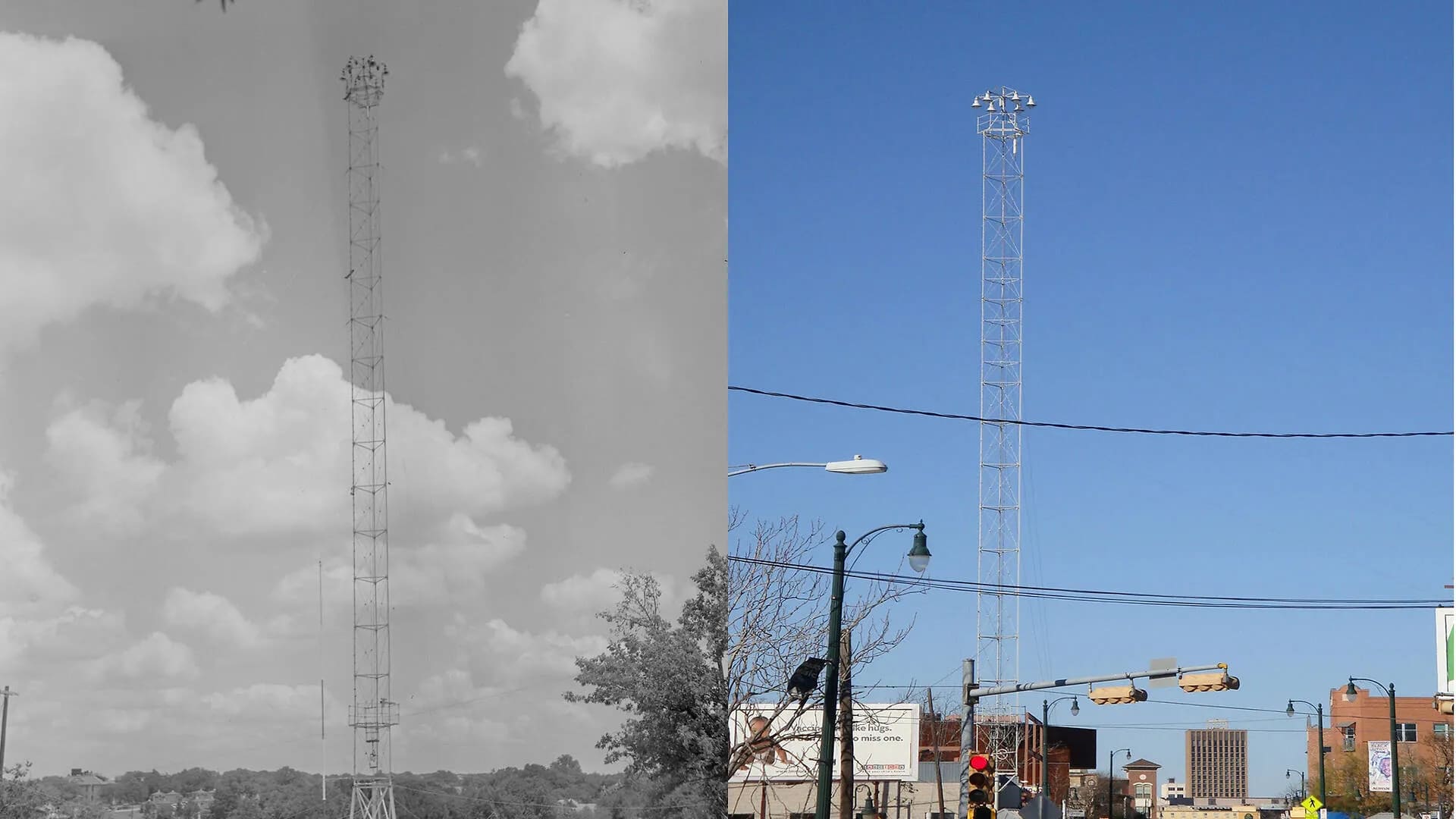
The documentary touches on both versions of their origin, but co-producer Jeffrey Kerr seems to favor the account that they were purchased new. Kerr, who has published three books on the history of Austin, believes the confusion may have arisen because the Detroit towers were made by the same company as the Austin ones. Historical photographs of the Detroit towers do indeed show a strong resemblance to the Austin models.
They were enormous: 150 feet tall (about 46 meters), and 165 feet tall once erected on their foundations (about 50 meters). They resembled slender oil derricks, but with triangular scaffolding mounted on a single pipe at the base and stabilized by guy wires. And they were heavy. Made of cast iron. And bright—at the top, they had six carbon arc lights, like stationary searchlights, which illuminated the ground beneath them more brightly than a full moon. The city fathers believed they would reduce crime and make the city safer to walk around at night and more pleasant.
The lights were installed throughout the city, in wealthy and poor neighborhoods alike (the first was built in the upscale Hyde Park neighborhood, which was then being developed as Austin’s first suburb). They produced light so bright that you could read your watch from a quarter of a mile away. Each tower illuminated about half a square mile. It was a beautiful idea—to use the moon as a model for lighting the night. The idea was to create little moons and raise them high above the city to produce the effect of an eternal full moon. How magical that sounded.
But the arc lighting was so bright that it had to be positioned high above the ground, and placing the lights atop 16-story towers, far above the trees and buildings, created broad, sharp shadows that plunged some homes into darkness and made it difficult to see when moving from light into darkness. In foggy weather, the lights illuminated the air above the fog and penetrated the cloud near the ground with an eerie blue light that frightened people. Some believe that the lights were actually purchased because of a serial killer, the Servant Girl Annihilator, who had terrorized Austin ten years earlier, although Kerr and his Last of the Moonlight Towers co-producer Ray Spivey doubt that this was the main reason.
Many people considered this nighttime illumination unnatural. If God had wanted us to have light all the time, they reasoned, He would not have created night. Some feared that the light from the Moonlight Towers would make the grass grow 24 hours a day, forcing them to mow more often. Others worried that the lights would keep people awake all night and make Austin’s workforce sleepy, tired, and irritable. Still others believed that hens would not nest and egg production would decline. Dogs would not stop barking.
Since then, of course, more modern types of bulbs have replaced the original arc lamps. Today, about half of the original Moonlight Towers remain standing, having undergone a major restoration that began in 1993 and was completed in time for their centennial. In 2014, the city approved a $3.9 million fund for their restoration and maintenance. All 17 are operational. And Austin is the only city in the world where these structures still form part of the nighttime electric lighting grid. That is truly amazing.