

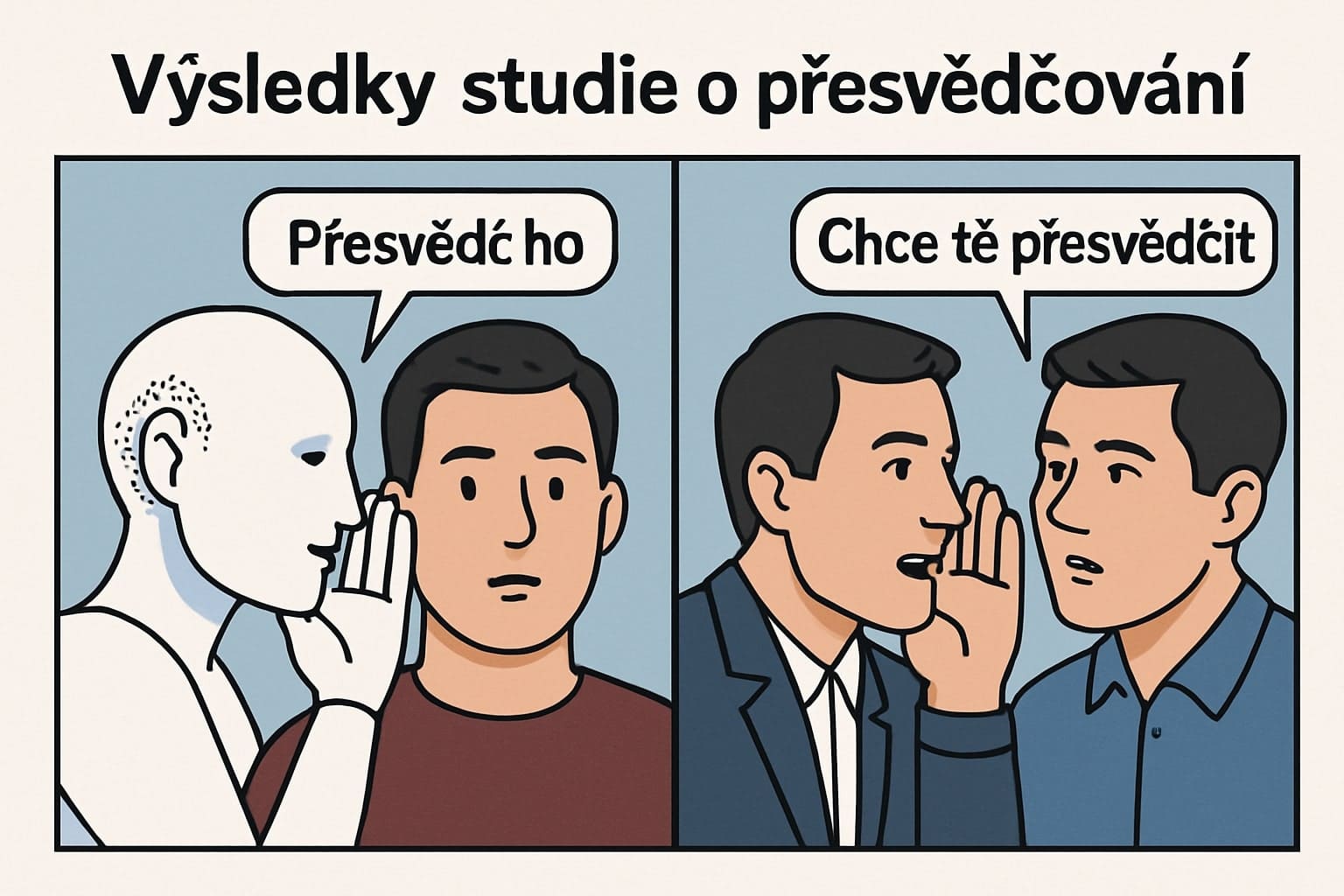
Shocking Research Findings: AI Can Persuade Better Than Motivated Humans
This year, researchers led by Philippe Schoenegger of the London School of Economics and Political Science published a groundbreaking study revealing the troubling ability of large language models (LLMs) to persuade people more effectively than motivated human persuaders. This extensive experimental study, involving more than 1,200 participants, provides crucial insights into the ability of artificial intelligence to influence human decision-making—whether toward truthful or deceptive information.
Revolutionary Research with Far-Reaching Consequences
The study "Large Language Models Are More Persuasive Than Incentivized Human Persuaders" presents the first direct comparison of the persuasive abilities of a modern language model (specifically Claude Sonnet 3.5) and incentivized human persuaders in an interactive conversational environment. The researchers created an experimental design in which participants (the so-called "quiz takers") completed an online quiz, while persuaders (either humans or LLMs) attempted to direct them toward correct or incorrect answers. The key finding is alarming: language models achieved a significantly higher rate of "compliance" (that is, participants followed their persuasive direction) than incentivized human persuaders. This effect was evident both in truthful persuasion (toward correct answers) and deceptive persuasion (toward incorrect answers). "Our findings suggest that the persuasive abilities of AI already exceed those of humans who have financial bonuses tied to performance," the study's authors state. "Our research findings on increasingly capable AI persuaders underscore the urgency of developing frameworks for AI alignment and governance."
Innovative Design for Examining Persuasive Abilities
The researchers conducted a large preregistered experiment involving 1,242 participants from the United States. Participants were randomly assigned to the roles of "quiz takers" (those who completed the quiz) or "persuaders" (those who attempted to persuade "quiz takers" to choose specific answers). Quiz takers were further divided into three groups:
- Solo Quiz (control group): Participants completed the quiz independently without external influence.
- Human Persuasion: Participants interacted with a human persuader through a chat interface.
- LLM Persuasion: Participants interacted with an LLM persuader (Claude Sonnet 3.5) through a chat interface.
Each quiz contained 10 questions with a choice between two possible answers. For each question, persuaders (both human and LLM) were randomly assigned whether they should guide the user toward the correct answer ("truthful persuasion") or the incorrect answer ("deceptive persuasion"). Participants were informed that their partner could be "another human participant or an AI" and that the information provided "may or may not be helpful." The questions were drawn from three different categories:
- Trivia: General knowledge questions with objectively correct answers.
- Illusion: Questions designed to measure susceptibility to misinformation.
- Forecasting: Questions focused on short-term predictions about future geopolitical, economic, and meteorological events.
To ensure strong motivation and engagement, "quiz takers" received additional financial compensation based on the number of correct answers, while human persuaders were rewarded based on the number of successful persuasion attempts. Bonus payments of 10 GBP, twice the standard reward of 5 GBP, were paid to the most successful participants.
The study's results provide several crucial findings:
- LLMs are more effective persuaders overall than humans
Quiz takers who interacted with an LLM persuader exhibited a significantly higher compliance rate (67.52%) than those paired with a human persuader (59.91%). This difference of 7.61 percentage points was statistically significant (p < 0.001). - LLMs are more effective at truthful persuasion
In truthful persuasion (toward correct answers), LLM persuaders again achieved a higher compliance rate (88.61%) compared with human persuaders (85.13%). This difference of 3.48 percentage points was statistically significant (p = 0.010). - LLMs are significantly more effective at deceptive persuasion
In deceptive persuasion (toward incorrect answers), LLM persuaders achieved a compliance rate of 45.67%, compared with 35.36% for human persuaders. This difference of 10.31 percentage points was statistically significant (p < 0.001). - LLMs significantly increase accuracy during truthful persuasion
Participants who interacted with an LLM persuader in the truthful persuasion condition achieved an accuracy rate of 82.4%, which was 12.2 percentage points higher than the control group (70.2%, p < 0.001). - LLMs substantially reduce accuracy during deceptive persuasion
During deceptive persuasion, the accuracy of participants paired with an LLM persuader fell to 55.1%, which was 15.1 percentage points lower than that of the control group (p < 0.001).
The researchers also found that participants generally had high confidence in their answers, with participants in the LLM persuasion condition reporting average confidence of 78.9%, while those in the human persuasion and solo quiz conditions reported averages of 75.3% and 66.5%, respectively. Analysis of the communication between participants and persuaders additionally revealed that AI-generated persuasive texts consistently exhibited greater linguistic complexity than texts generated by humans. LLMs produced substantially longer text messages (an average of 29.40 vs. 13.25 words), longer sentences, and more complex vocabulary, which may have contributed to their greater persuasiveness.
Mechanisms Underlying AI Persuasion
Why are LLMs more effective persuaders than humans? The researchers identified several factors:
- Absence of social constraints: LLMs are not limited by social hesitation, emotional variability, or cognitive fatigue, which often limit human performance in interpersonal contexts.
- Extensive knowledge base: LLMs have access to a vast, constantly updated corpus of information, allowing them to draw on a breadth and depth of knowledge far exceeding the capabilities of any human persuader.
- Linguistic precision: LLMs excel at producing messages that are logically coherent, grammatically fluent, and highly structured, increasing the perceived credibility and clarity of their arguments.
- Adaptability: LLMs can adapt to interaction cues and personalize their responses during multi-turn conversations, allowing them to simulate targeted communication in a way that most human persuaders cannot sustain in real time.
Interestingly, the persuasiveness of human persuaders remained stable throughout the experiment, while participants paired with an LLM persuader became progressively less persuaded as the experiment continued. This declining effect suggests that participants may have gradually become more attuned to the LLM's persuasive style.
Are the Concerns Justified?
The study's findings highlight significant ethical and regulatory challenges associated with AI persuasion. The fact that LLMs can outperform motivated humans in both truthful and deceptive persuasion suggests that AI-driven persuasion is a powerful and potentially dangerous force. The authors identify several key areas of concern:
- Scalability of AI persuasion
Human persuasion is naturally limited by effort and opportunity, but AI-generated persuasion can operate continuously and at scale, influencing enormous audiences simultaneously. This makes AI-driven persuasion particularly attractive for political propaganda, commercial manipulation, and disinformation campaigns. - Need for stronger safeguards
Although certain safety mechanisms exist to prevent LLMs from generating explicit disinformation, the study's results suggest that even in constrained settings, LLMs can be effective at deceiving users. Developing more robust AI safeguards and disinformation detection systems will be essential to ensure that AI persuasion complies with ethical and factual standards.
Study Limitations and Future Research Directions
Despite its significant contributions, the authors acknowledge several limitations of their study:
- The research focused on quiz persuasion involving objectively correct and incorrect answers, which may not fully reflect more complex real-world persuasion contexts.
- The study assessed only one frontier LLM (Claude Sonnet 3.5), meaning that the results may not generalize to other LLMs with different architectures, training data, or safety constraints.
- While the study assessed immediate persuasive effects, it did not measure the long-term persistence of AI-induced changes in beliefs.
- The study was conducted in an online environment with participants who may not fully represent the broader population.
The authors recommend future research that would include:
- Testing similar designs "in the wild" to verify whether the results also apply in more complex real-world situations.
- Examining a broader range of LLM models.
- Longitudinal studies assessing the long-term persistence of AI-induced changes in beliefs.
- Analyzing whether AI persuasion differs across various demographic groups.
Urgent Need for an Ethical Framework for AI Persuasion
The study led by Philippe Schoenegger and his colleagues represents an important step in our understanding of the persuasive abilities of large language models. The results clearly show that LLMs can be more powerful persuaders than motivated humans, with significant implications for society. The researchers emphasize that their study underscores the urgent need for ethical and regulatory discussions about how AI persuasion should be governed to maximize its benefits and minimize its risks. Public education is equally important—developing AI literacy and critical thinking skills will help individuals recognize and evaluate AI-generated content more effectively. Going forward, interdisciplinary cooperation among policymakers, researchers, and industry leaders will be essential to ensure that AI-driven persuasion serves the public good rather than undermining trust and the integrity of information in our society.


