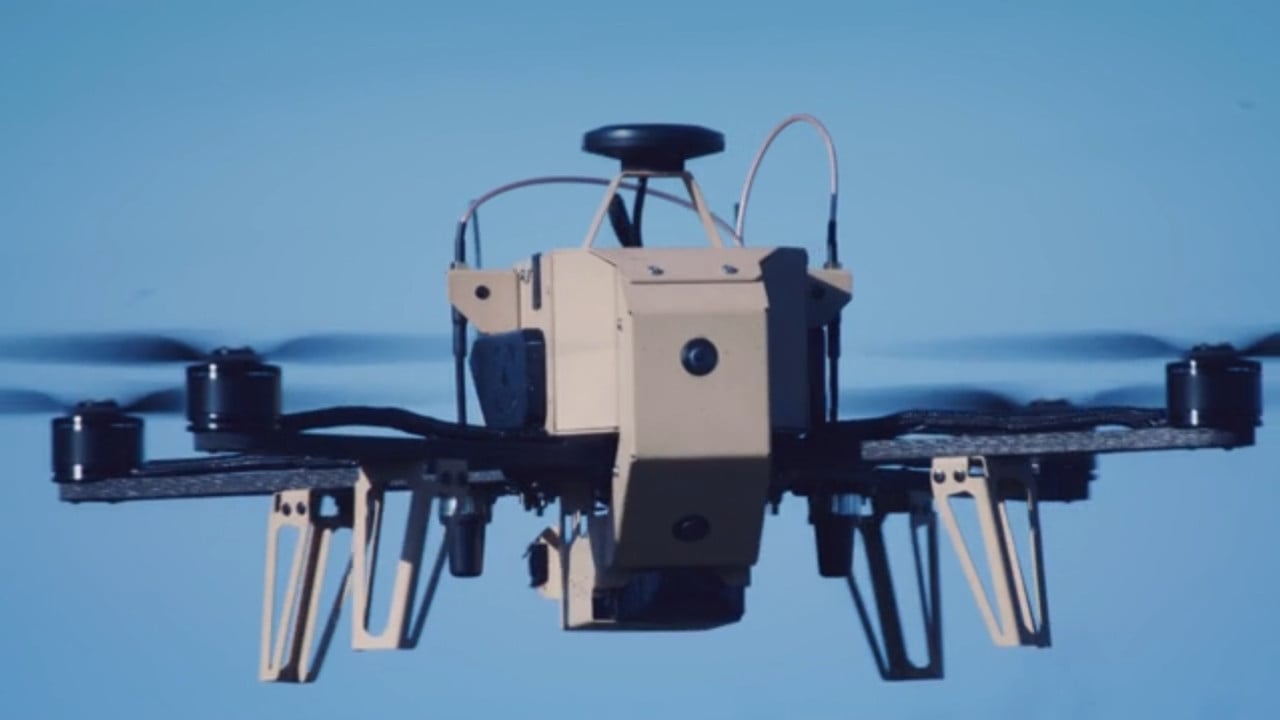
At a secret military base in central California, a simple command is issued: "Send one ground vehicle to checkpoint ALPHA. Carry out a kinetic strike with two drones. Destroy the blue truck 500 meters east of the airfield and confirm." No human then pulled the trigger. No pilot flew a drone. AI handled it on its own.
Scout AI
Scout AI is a startup based in Sunnyvale, California, that has decided to go where OpenAI or Anthropic are afraid to tread. While tech leaders wage internal battles over whether to work with the Pentagon at all, Scout AI is taking its own approach: building a foundation AI model specifically for defense. CEO Colby Adcock puts it bluntly: "We need to bring next-generation AI to the military." The company has secured four contracts with the U.S. Department of Defense and is also collaborating with Hendrick Motorsports on the NOMAD project.
At the heart of the entire system is a platform aptly named Fury Orchestrator. This is not conventional software with preprogrammed "if A, then B" commands. Fury works as a large language model (LLM) combined with what is known as a Vision-Language-Action architecture, or VLA for short.
What does that mean in practice? A commander issues an order in natural language, just as they would speak to a soldier. Fury understands the command, breaks it down into individual tasks, and coordinates an entire fleet of drones across different manufacturers and platforms. Ground vehicles, drones, naval systems, and aerial systems can all be controlled from a single location.
During a demonstration in February, it worked like this: a large model with more than 100 billion parameters received the order and, like an orchestra conductor, began issuing instructions to smaller models with about 10 billion parameters running directly on the drones and ground vehicle. These then controlled movement, navigation, and ultimately the attack. The entire sequence of actions took place within minutes. The truck was destroyed.
A Major Breakthrough
Existing autonomous systems operated on the basis of rigidly programmed scenarios. Did they encounter a situation that was not in the code? They stopped or failed. Fury can adapt. If a drone cannot see the target, it can send a reconnaissance drone ahead. If it encounters an obstacle, it looks for a way around it. It behaves like a soldier.
Fury also operates without relying on GPS or a cloud connection, needs only a single camera, and works in real time. These are capabilities the military desperately needs on the modern battlefield. The war in Ukraine has shown how inexpensive commercial drones can change the course of a conflict. Scout AI is responding to that lesson and taking it to the next level: drones that not only fly, but think for themselves and coordinate with one another.
And this is where the troubling part begins. Professor Michael Horowitz of the University of Pennsylvania warns that large language models are inherently unpredictable. When an AI agent fails while ordering pizza online, it is funny. When it fails on the battlefield, the consequences are deadly.
Arms control experts are sounding the alarm. The line between a weapon under human control and a fully autonomous system is blurring faster than international standards can be established. The Pentagon officially insists that a human will remain in the decision-making chain. But how long will this rule hold when AI makes decisions faster than the human brain?
Scout AI claims that Fury "keeps humans at the center." Yet during the February demonstration, no human pulled the trigger. A person only issued a verbal command. The AI did the rest on its own.
A New Era of Warfare the World Is Not Ready For
Big tech companies are wrestling with ethical dilemmas. Anthropic employees are protesting cooperation with the Pentagon. OpenAI is facing internal resistance. Meanwhile, Scout AI calmly demonstrates live demolitions and secures government contracts. This is the new reality: commercial AI technology, the same kind that powers chatbots and email assistants, is being turned into weapons. And it is happening faster than most of us realize.
Should a machine be allowed to decide on its own to destroy a target? And if so, who bears responsibility when it makes a mistake? The world is only beginning to search for answers to these questions. But Scout AI is convinced that the future of warfare will not wait.
Sources: wired.com and newatlas.com