

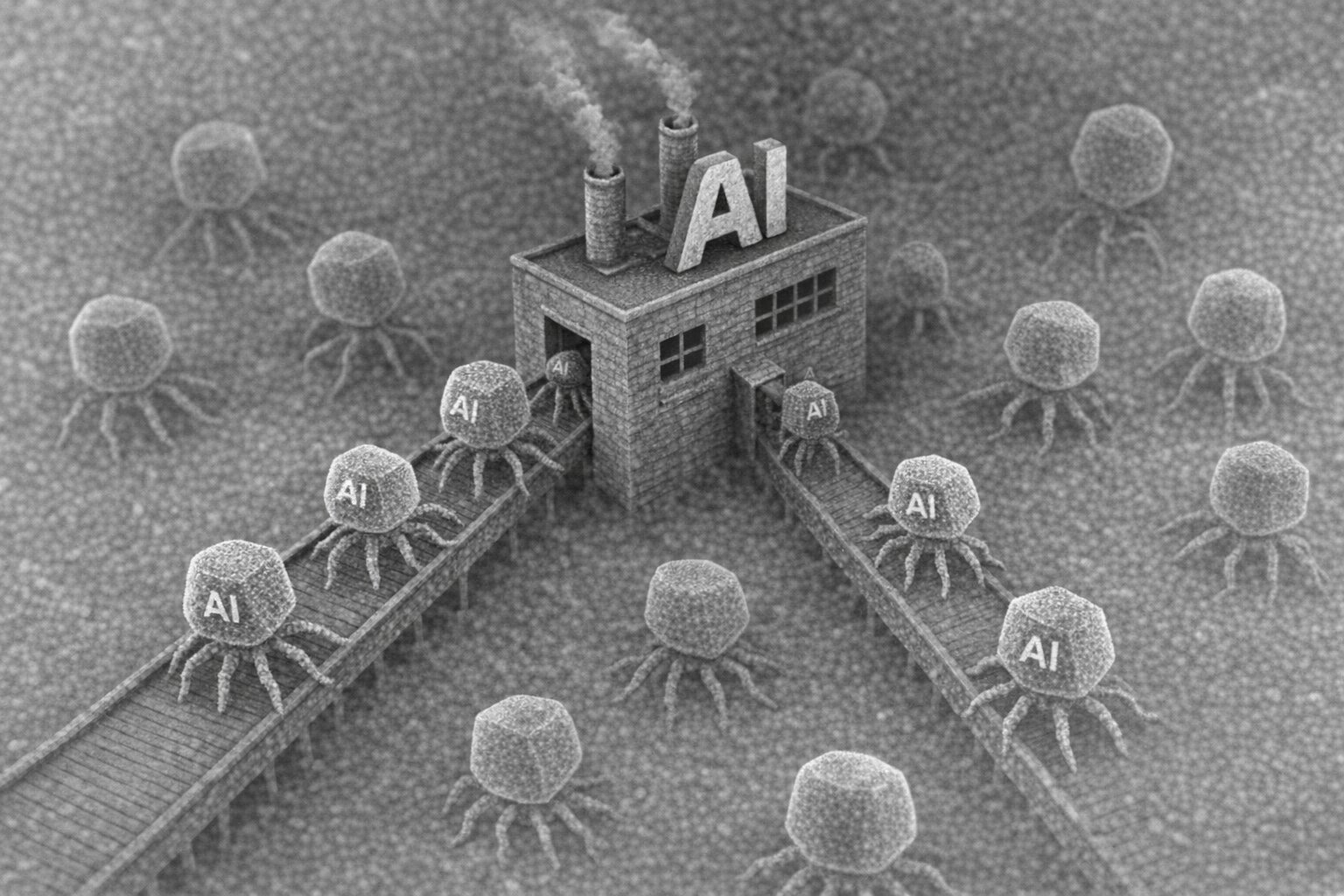
Scientists are now using artificial intelligence—computer systems that learn patterns from data—to write entire viral genomes completely from scratch in the laboratory. At the same time, a study led by Microsoft demonstrated that artificial intelligence tools can redesign known toxins so that they slip past standard DNA synthesis safety checks. These AI-created viruses are bacteriophages, meaning viruses that attack bacteria rather than humans, so they serve as safe test cases but also as a clear warning.
Why Experts Are Concerned About AI-Generated Viruses
The work revealing how proteins designed by artificial intelligence can slip past genetic safety checks was led by Bruce J. Wittmann of Microsoft Research. He works as a senior applied scientist and focuses on tools that improve the reliability of DNA screening for laboratories and synthesis companies. These projects rely on genomic language models, which are artificial intelligence tools that predict likely stretches of DNA in a sequence. Once these models are trained on thousands of sequences, they can design entirely new genomes that still resemble natural viral families. This creative ability makes it harder for experts to predict how a machine-designed virus or protein will behave in real-world experiments.
Bacteriophages as Medical Tools
In a recent preprint, scientists used these models to design hundreds of candidate phage genomes and successfully grew 16 functional viruses. Because each phage attacks only specific bacteria, doctors hope that customized mixtures could treat stubborn infections without harming beneficial microbes or human cells. Clinical reviews describe patients with antibiotic-resistant infections who improved after experimental phage therapy when standard drugs failed.
Scientists use the term dual-use research for powerful technologies like these, which can help or harm depending on the intent. The same algorithm that optimizes drug droplets for asthma inhalers could reveal recipes for more effective aerosolized chemical or biological attacks. The models are considered capable, especially when tested on real-world health data rather than controlled examples. Scientists argue that carefully restricting genomes and toxins in training data is a fundamental safety barrier.
How AI-Generated Viruses Bypass Screening
Many DNA synthesis companies screen nucleic acids, the genetic molecules that carry hereditary information, and flag customer orders that match pathogens or toxins. Bruce J. Wittmann’s team demonstrated that advanced protein design tools can rewrite dangerous proteins as new sequences that still function but evade standard screening filters. Working with several DNA suppliers, they developed new algorithms that focus on protein structure and function, significantly improving the detection of these disguised sequences.
These fixes are now being integrated into commercial scanning processes, turning a hidden weakness into a defense plan against AI-assisted design. Effective DNA synthesis screening—automated checks of gene orders and customers—gives authorities a chance to stop dangerous projects before the material is produced. The International Biosecurity and Biosafety Initiative for Science supports screening standards so that companies and regulators assess genetic orders according to similar criteria.
Global Efforts to Establish Safety Standards
A federal framework ties research funding to nucleic acid screening and encourages agencies to prioritize laboratories that purchase DNA from verified suppliers. Under this policy, suppliers are expected to screen every order, assess customers, report suspicious requests, and retain records for years. Future administrations may modify or replace these expectations, but they demonstrate how governments can turn safety guidelines into specific purchasing requirements. Similar requirements could eventually apply to developers of highly capable artificial intelligence, linking access to public contracts with documented testing and clear internal safeguards.
The International Biosecurity and Biosafety Initiative for Science brings companies and regulators together to update screening standards in response to changes in artificial intelligence and synthetic technologies. One important partner is the International Gene Synthesis Consortium, whose members commit to screening sequences and customer identities using a harmonized protocol. The United Kingdom has established an artificial intelligence safety institute that tests models, evaluates risks, and shares methods for reducing misuse. Tessa Alexanian, a scientist involved in the study, described the approach as intentionally flexible. She said, “This managed-access program is an experiment, and we are very eager to evolve our approach.”
Practical Limitations of Biological Weapons
Despite all the concerns, a wide gap remains between digitally designing a genome and reliably engineering contagious viruses that spread among humans. Recent work with phages focused on small bacterial viruses that are far simpler than the complex pathogens responsible for diseases such as influenza or COVID-19. Even with good designs, scientists still need highly secure facilities, careful oversight, and months or years of experimentation to produce stable and predictable organisms. Experts are concerned because advances in automation, DNA synthesis, and modeling are lowering these barriers and reducing the effort required to attempt dangerous projects.
AI-Generated Viruses and the Future
More scientists are now advocating biosecurity—policies that prevent the misuse of biological tools—by combining better training data choices with simple output screening. Some proposals go further, suggesting environmental monitoring that checks wastewater, air filters, or hospital samples for genetic traces of unauthorized production. At the same time, these artificial intelligence tools could accelerate the discovery of antibiotics, vaccines, and customized phage therapies that save patients when drugs fail. Many experts see a shared responsibility for funders, journals, companies, and universities to require safety assessments whenever powerful artificial intelligence tools are applied to biological work. The study was published in the journal Science.


