


Imagine a small model with 8 billion parameters called Orchestrator, which acts like a conductor in an orchestra full of tools and intelligent models. This creation from researchers at Nvidia and the University of Hong Kong solves complex tasks, such as those from Humanity's Last Exam (HLE), where it achieved a score of 37.1%, while GPT-5 scored only 35.1%. And all that at 2.5 times lower cost! No giant model, just smart coordination.
Why are small models more powerful than large ones?
Orchestrator is no lone hero—it calls on tools such as the Tavily search API for web searches, a Python sandbox for running code, or specialized models such as Qwen2.5-Math-72B for mathematics. During training, it uses reinforcement learning with rewards for correct results, low costs, and adherence to user preferences. For example, on the FRAMES benchmark, it outperformed GPT-5 with a success rate of 76.3% at just 30% of the cost.
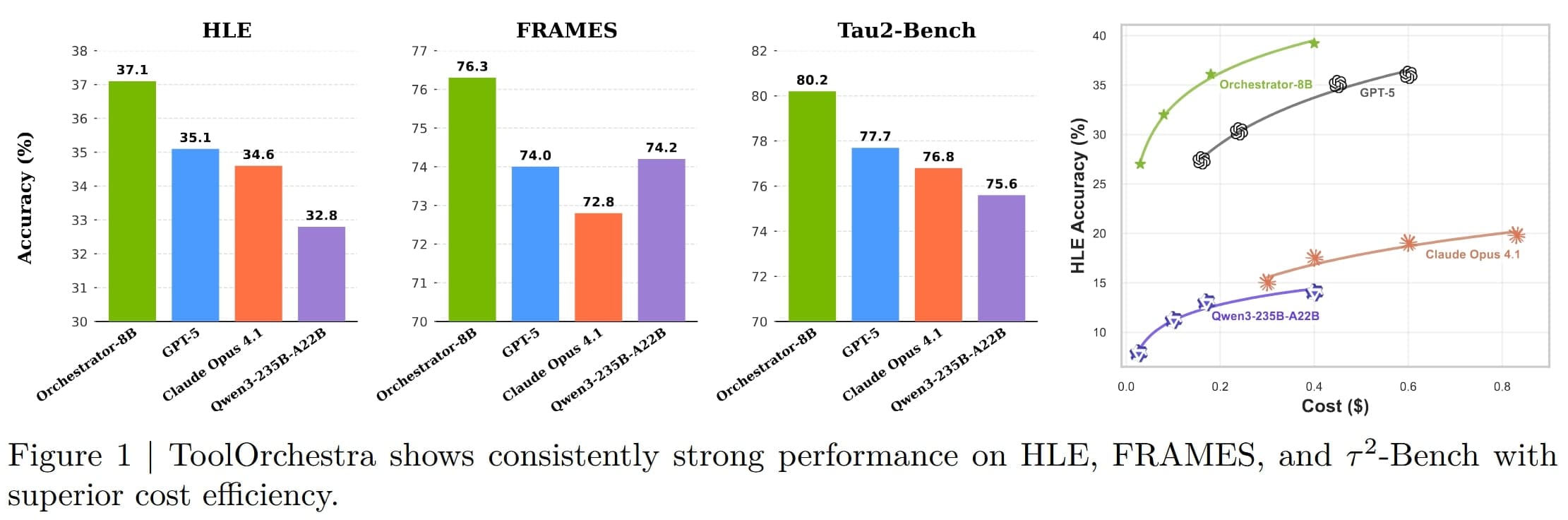
In each round, Orchestrator reasons, selects a tool—such as GPT-5-mini for coding or Llama-3.3-70B-Instruct for more general tasks—and then processes the response. The researchers created the ToolScale dataset with thousands of examples from fields such as finance, sports, and medicine, where the model learns to coordinate up to 50 rounds of interactions. The result? On τ²-Bench, it achieved 80.2%, while calling GPT-5 in only 40% of cases, yet still performed better than GPT-5 alone.
Customization for everyone
Users can set their preferences—for example, prioritizing local search over internet search for privacy reasons. Orchestrator adapts accordingly, making it flexible even with unfamiliar tools such as Claude Opus 4.1 or DeepSeekMath-7b-Instruct. The entire system is designed to be fast and inexpensive, with latency measured in minutes and costs in cents. You can read the detailed report at arxiv.org.


