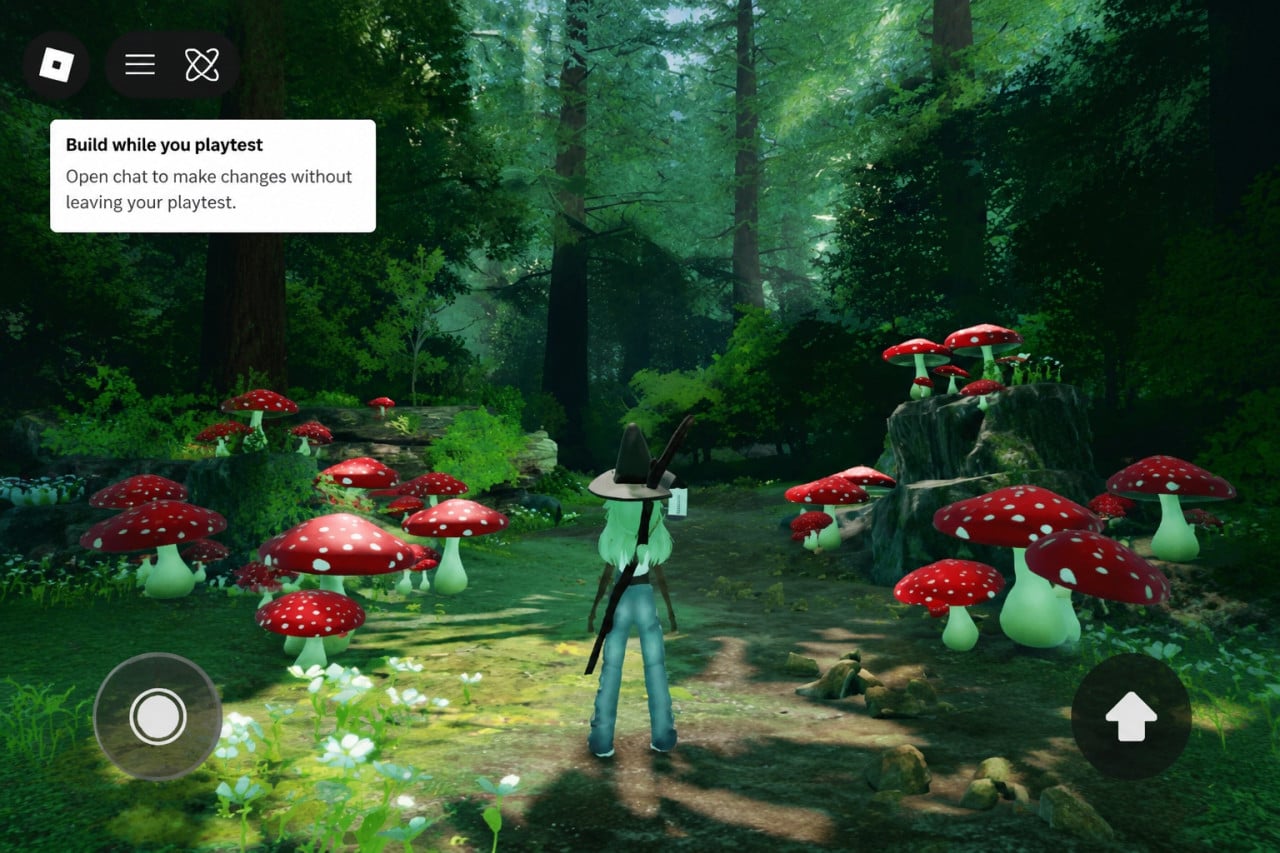
Roblox wants absolutely anyone to be able to build their own game. Even from a phone and without a single line of code. The company has introduced a tool called Build, which turns a written idea into a playable game directly in the mobile app. Testing will begin on July 28 in New Zealand and gradually expand to other countries.
Everything in One App
The user writes what they want, and artificial intelligence builds the foundation of the game. In its demonstration, Roblox used a prompt along the lines of “let's make a cozy adventure game in a dense forest with environmental obstacles.” The tool uses this to generate a starting point that can be further developed, tested, shared with friends, or published right away.
Build can put together game mechanics, environments, characters, visual style, and sound. All in one app. It is powered by a combination of open and proprietary Roblox models trained on a vast collection of three-dimensional objects and game data. This allows it to create functional 3D items and even entire scenes that fit into a game already in progress.
The tool builds on Roblox Studio, an editor that creators have been using for years. It shares the same backend, models, and chat history. This means work can be started in Build on a phone and completed using Studio's advanced features. Or, conversely, a task can be launched in Studio and its progress monitored from a mobile device.
Features and Availability
Users in New Zealand will be the first to receive selected features, including the ability to publish a game. The open alpha will launch there on July 28. The tool will reach other countries over the following months as Roblox fine-tunes its core features and expands its capabilities.
During testing, Build will be available to verified users aged nine and older. However, games created in Build will only be publishable worldwide by verified users aged sixteen and older. Before a creation appears in children's catalogs or featured selections, it will undergo the same enhanced review process as every other game on the platform. The basic version will be free, while more demanding creators will pay extra for advanced features.
A Flood of Junk
The company is well aware of what many people will think. If artificial intelligence allows anyone to churn out games, the platform risks becoming flooded with worthless content. Roblox therefore explicitly stated in its announcement that its game discovery systems highlight titles with long-term player retention, a category that AI-generated junk does not fall into. The quality of games on the home page is said to remain unchanged. If no one plays a game, no one will find it either.
Not all reactions have been enthusiastic, however. The tool's marketing slogan, “write, refine, test, and share,” has raised doubts. Experts point to two issues. First, whether games created this way will have any artistic value at all. Second, how Roblox will police copyright infringement. Many developers remain skeptical and argue that, for now, artificial intelligence can at most speed up routine work behind the scenes, such as writing scripts, but cannot devise an actual game on its own.
What Else the Company Is Preparing
The company has promised a whole suite of tools for professional creators that will launch in the coming months. These include a testing assistant that will uncover bugs before the first player encounters them. An analytics assistant will also be added, which users can ask questions in ordinary language and which will retrieve data without lengthy searches through reports. A third assistant is intended to suggest experiments for increasing engagement, retention, and revenue.
Roblox previously launched so-called procedural models that generate 3D objects with adjustable parameters from text or images. Alongside them is Cube, the company's foundational 3D model, which turns a prompt into finished objects, ranging from simple props to vehicles that actually drive and weapons that fire. A model capable of building entire editable and playable 3D scenes from a single prompt will be added soon.
The shift toward so-called vibe coding—describing software in ordinary language and letting artificial intelligence write the rest—is gaining increasing traction in the gaming industry. Other companies have introduced similar tools, such as Google with its Genie 3 model and Microsoft with its WHAM technology. The head of Epic Games has publicly praised generative artificial intelligence and criticized the dismissive stance of competing platforms, including Steam.
Sources: gamerant.com and businessinsider.com