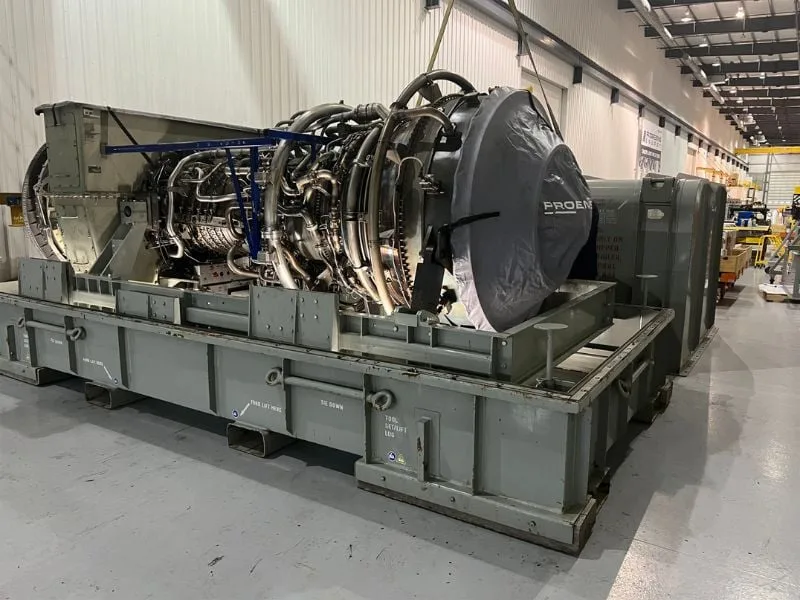
American companies building data centers for artificial intelligence have found an unexpected source of electricity. They are buying engines from retired aircraft, having them converted to run on gas, and using them to generate their own power. The reason: Both a connection to the power grid and new turbines require years of waiting, and none of the companies has that much time. Engineering firms remove engines from old aircraft and turn them into stationary generators. A large proportion of these machines are located in aircraft graveyards in Arizona’s Sonoran Desert. According to the newspaper, data center operators are buying them up as quickly as manufacturers can convert them.
Seven-year wait for a grid connection, two years for engines
For companies stuck in the queue for electricity, the key consideration is how quickly an energy source can become operational. Audun Martinsen, an analyst at Rystad Energy, put it very simply to the newspaper: It is about obtaining energy as quickly as possible. According to him, converted aircraft engines could enable a data center to begin operating in about two years.
By comparison, connecting one hundred megawatts to the power grid in Northern Virginia, which is home to an enormous number of data centers, takes about seven years, according to the International Energy Agency. The situation is hardly better for new gas turbines. An executive at Mitsubishi Power, one of the world’s largest manufacturers of power equipment, told Bloomberg last week that most production capacity would not become available until around 2031.
The delays are already costing some operators contracts. Microsoft withdrew in October from its role as the main customer of Nscale’s data center in Loughton, England. The local power utility had said that it would not be able to provide sufficient energy until the early or mid-2030s at the earliest.
Bill Kleyman, head of Apolo, a company specializing in infrastructure for artificial intelligence, described to the newspaper how the industry’s mindset has changed. In his view, just a few years ago, a conventional data center operator would have dismissed such an idea as nonsense. Today, developers are almost obsessively monitoring how quickly they can obtain energy and are searching for creative solutions.
Musk led the way
Elon Musk’s xAI is among the companies already using aircraft engines. In the state of Mississippi, the company installed eight converted turbines that help power its Colossus 2 data center in nearby Memphis. The New York newspaper discovered this from state permits and satellite images. The units are supplied by ProEnergy, which converts a General Electric engine of the type commonly found in Boeing aircraft.
The example of xAI clearly illustrates the price the surrounding area pays for this speed. The permits allow the turbines to emit carbon monoxide at twice the rate permitted for the other turbines at the site. The limit for volatile organic compounds is a quarter higher. The environmental organization Southern Environmental Law Center has therefore challenged the permit xAI received from the Mississippi authorities. It claims that the manufacturer failed to demonstrate compliance with standards for substances such as formaldehyde and accuses the company of underestimating the expected emissions. Local communities also oppose the older turbines because they believe this approach undermines efforts to promote cleaner energy.
In 2025, OpenAI also deployed gas turbines at the first site of its Stargate project in Abilene, Texas. It is being built by Denver-based startup Crusoe, which specializes in data centers for artificial intelligence. In April, it ordered thirteen converted units from ProEnergy.
Crusoe also tried a different approach. Boom Supersonic, a startup developing a supersonic passenger aircraft, began selling a version of its engine as a power plant for data centers. Crusoe negotiated a deal with it for 29 gas turbines worth $1.25 billion, but ultimately withdrew from it in September. A company spokesperson said at the time that it still planned to use the turbines.
Pressure from the White House and concerns about air quality
Politicians are also putting pressure on operators. President Donald Trump is urging data centers to generate their own electricity and not rely on the grid. In August, he even said they were required to build their own energy sources. Public opposition also plays a role. People object to data centers drawing electricity from local grids and contributing to higher household bills.
The stock of retired machines is enormous. In January, the U.S. Energy Information Administration estimated that the engines from four thousand retired military aircraft stored at a single desert base near Tucson could generate 40,000 megawatts. That is more than the combined capacity of all power plants in Arizona.
Aircraft engines do, however, have their weaknesses. They burn fuel less efficiently than turbines designed specifically for modern gas-fired power plants and cause more air pollution in their surroundings. A larger number of them is required to generate the same amount of electricity. Some experts therefore warn that this is more likely to be a short-term solution and that questions of efficiency and environmental impact could become significantly more important within a year or two. Until then, data centers will even make use of an engine that once carried a Boeing across the ocean.
Sources: techcrunch.com, business-standard.com and nytimes.com