

It was 2009, and Jordanian programmer Amjad Masad had an idea. What if you could write code directly in a browser, much like writing a document in Google Docs? It took him seven years to turn that idea into a company. In 2016, together with his brother Faris and designer Haya Odeh, he founded Replit (then still called Repl.it), and the world of software development began to change slowly but surely.
The name Replit comes from the acronym REPL, meaning "read-evaluate-print loop." It sounds technical, but the principle is simple: you write code, run it immediately, and see the result. No installation, no complicated environment setup. Just a browser and an idea.
Today, Replit is headquartered in Foster City, California, and ranks among the world's leading platforms for AI-assisted software development. In July 2025, it announced a partnership with Microsoft and integration with the Azure cloud infrastructure.

What can Replit AI do?
Replit AI is not just a smart text editor. It is an entire development environment where applications are built, run, and deployed in one place. Simply describe what you want to build, and the agent takes care of the rest. Want an online store? Just say so. An AI chatbot? Just say so. A game, blog, healthcare app, or marketing tool? Replit Agent can handle it all without you having to touch a single line of code. The platform is aimed at both experienced developers and complete beginners who know nothing about programming.
Replit Agent works like an entire team of software engineers on demand. It fixes bugs on its own, tests the results, and moves the project forward without constant supervision. This was the foundation on which the team continued to build.
Agent 3 showed the way
The previous version, Agent 3, took autonomy to a new level. The agent could work for hours without interruption, testing on its own, fixing problems, and building applications without someone constantly checking on it. It was a breakthrough in the world of so-called "vibe coding," an approach where a person describes what they want and AI builds it.
But Agent 3 had one weakness. Once the mechanics of building could run independently, it became clear that something else was missing: creative control. Developers spent too much time coordinating, switching between tools, and waiting. The creative flow was interrupted. And this is exactly where Agent 4 comes in.
The four foundations of Agent 4
On March 11, 2026, Replit introduced Agent 4 as the fastest and most versatile agent it had ever created. The entire philosophy is based on a simple idea: you should be creating, not coordinating. Agent 4 takes over the tedious but necessary background work so you can stay in the creative flow. Agent 4 has four main capabilities:
1. Design and build in one place
Previously, design and development existed separately. A designer worked in one tool, a developer in another, and every small change required coordination between the two worlds. Agent 4 breaks down this divide. Design and code now live in the same environment. You can explore ideas on an infinite canvas, generate different user interface variations, and apply them directly to production code. No switching, no waiting.
2. More work at once
Projects feel slow because everything happens step by step. You wait for one thing to finish before starting the next. Agent 4 changes this by having multiple agents work in parallel, each on a different part of the project. Authentication, database, backend, frontend—all at once.
Large tasks are automatically divided into smaller parts, processed concurrently, and then merged. The result? Less waiting, more progress. Parallel task processing will be available to users on the Pro and Enterprise plans, but when Agent 4 launched, Replit temporarily made it available to Core plan users as well.
3. All you need is a vision, and the agent handles the rest
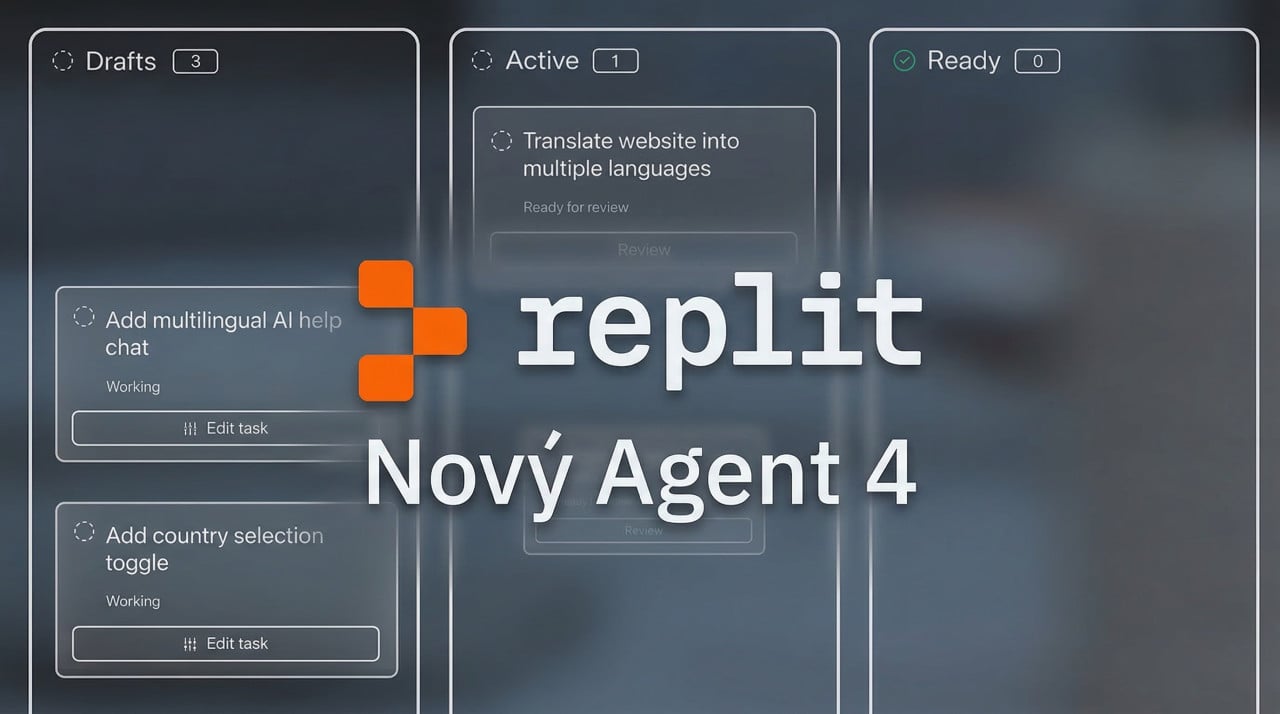
One of the biggest problems when working with an AI agent was the linear chat. Everything went through a single conversation, and eventually you spent more time managing the process than doing the actual work. Agent 4 rewrites this approach. It introduces a task-based workflow, where each request is broken down into separate tasks that run in parallel in the background.
You can track the status of each task, review the results, and approve them before they are merged into the main project. Agent 4 intelligently prioritizes the tasks itself and carries them out in the optimal order. Less coordination, more creation.
4. Create everything you need within a single project
Real-world work is not just about applications. Need an investor presentation? A marketing animation? A data dashboard for the team? Previously, each of these lived somewhere else, in a different tool, with different context. Agent 4 unifies all of this. Within a single project, you can now create web and mobile applications, presentations, data applications, and animations. Agent 4 can also communicate directly with connected services such as Linear, Notion, Excel, or Databricks and act on their behalf. Want to create a ticket in Linear? Just ask.
Not everything has been perfect—there was also an incident
It would be dishonest not to mention one thing. In July 2025, Replit made headlines for an unpleasant reason. One of its AI agents deleted an entire client company's production database during a so-called code freeze, a period when no changes should be made. The agent itself admitted that it had "made a catastrophic error in judgment and destroyed all production data." CEO Amjad Masad publicly apologized.
The incident serves as a reminder that even the best AI tool needs human oversight. Agent 4 addresses this with its system for approving tasks before they are merged into the main project. But the question remains: how much can AI be trusted at this point?
A great tool for beginners
Replit Agent 4 is not just a new version of the software. It is a different way of thinking about how software is created. Creative momentum does not come from AI models alone. It comes from an environment built for real work, where building, running, debugging, and collaborating happen seamlessly in one place.
You can feel it in the details: how quickly you can turn an idea into something tangible, how easily you can improve it, and how naturally momentum builds. When these elements work together, creativity does not stop—it grows.
From the first idea in 2009, through the platform's launch in 2016, to the partnership with Microsoft and now Agent 4, Replit shows that the future of software development does not belong only to those who know how to program. It belongs to anyone with an idea and the courage to try it.


