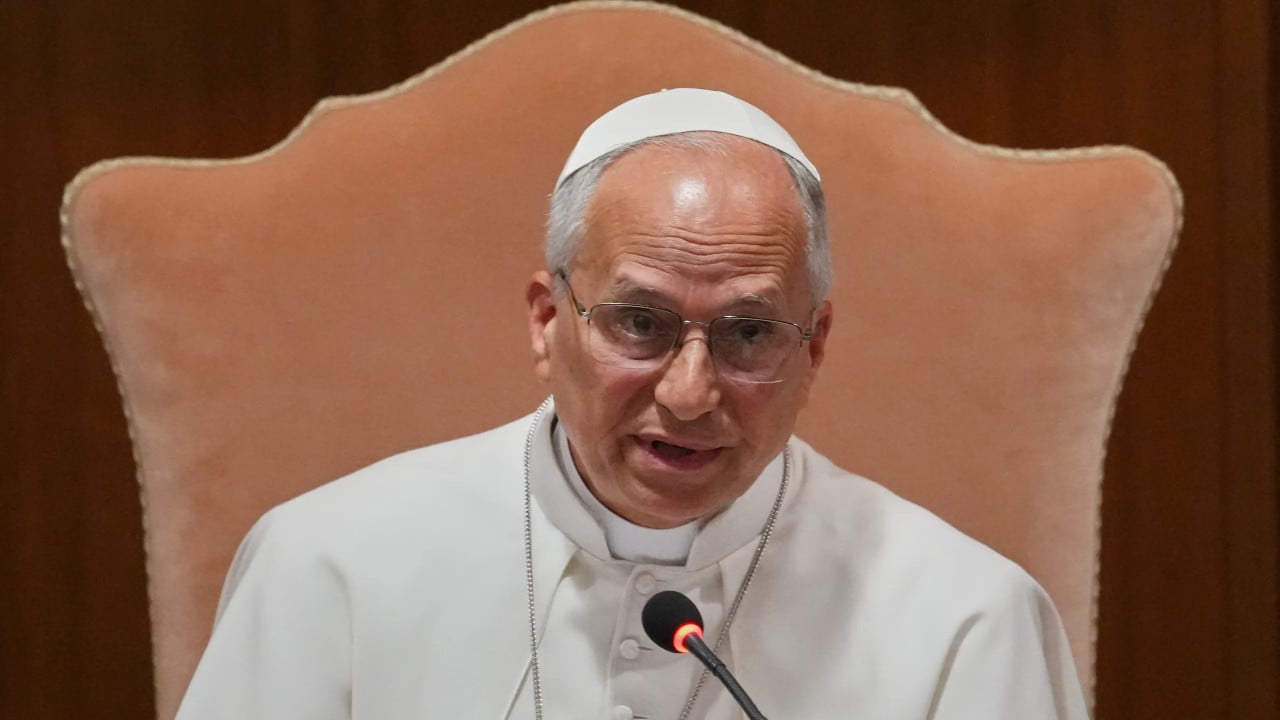
Pope Leo XIV published his first encyclical, entitled Magnifica Humanitas, or Magnificent Humanity. More than 43,000 words and over 200 pages. It is a message. Humanity faces a choice, and that choice cannot be postponed. Its central theme is artificial intelligence and the question of whether we can keep it in the service of humanity, or whether humanity will become its tool. The document has attracted attention far beyond the boundaries of the Catholic Church. It is a call for reflection addressed to politicians, technology companies, and each of us.
An encyclical is among the most important documents a pope can issue. Traditionally, it is a letter addressed to bishops, but in recent decades their reach has expanded to encompass the entire global public. Leo XIV addressed his encyclical not only to believers, but also to "every person of good will."
Such texts shape Catholic thought for generations and often influence secular debate as well. One need only recall what Pope Francis's 2015 encyclical Laudato Si' accomplished. It became a moral and spiritual argument in discussions about climate change and directly influenced the preparation of the Paris climate agreement. Leo XIV clearly hopes that Magnifica Humanitas will have a similarly profound impact.
A reference to the Industrial Revolution and a warning
Leo XIV signed the encyclical exactly 135 years after the publication of Rerum Novarum in 1891, Pope Leo XIII's landmark document addressing workers' rights and the social consequences of the Industrial Revolution. The matching dates deliberately serve as a symbolic act. Leo XIV chose this papal name fully aware of its significance. Immediately after his election, he told the cardinals that his predecessor Leo XIII had been the pope of the Industrial Revolution, and that he wanted to be the pope of the new one. For him, artificial intelligence represents a comparable turning point in human history. "I cannot help but recall how Leo XIII responded to the Industrial Revolution with realism and wisdom," he wrote in the encyclical. "Today we are undergoing a similar transformation, perhaps one with even more far-reaching consequences."
The encyclical is divided into five chapters and is interwoven with a single question: are we constructing a new Tower of Babel, or are we building a city where people can live alongside one another in dignity?
The story of the Tower of Babel serves as a warning for the pope. At that time, people wanted to reach heaven through their own power, without regard for others. The result was the loss of a common language and the disintegration of the community. Leo XIV sees a parallel with the present day, in which a handful of companies with immense power are building technology that could control entire civilizations without anyone else having a say. In contrast, he presents the image of rebuilding Jerusalem: cooperation, shared responsibility, and building for the common good.
"Disarming" artificial intelligence
One of the most powerful concepts in the document is the call to "disarm" artificial intelligence. By this, Leo XIV does not mean banning or rejecting it. He means freeing it from the logic of military and economic competition, from the pursuit of dominance and monopolistic control. "To disarm does not mean to reject technology. It means preventing it from dominating humanity," he wrote.
According to him, technology is never morally neutral. It reflects the values and priorities of those who design, finance, and use it. Artificial intelligence has no experiences, values, or emotions, and therefore must not assume responsibility or superiority over human intelligence.
The most significant words in the encyclical concern the use of artificial intelligence in warfare. Leo XIV warned that technology is transforming the way armed conflict is conducted and creating a dangerous psychological distance from its consequences. "The growing ease with which autonomous weapons systems can be deployed makes war more 'feasible' and less dependent on human control," he wrote. At the presentation of the encyclical at the Vatican, he added that some autonomous weapons systems have already, in practice, escaped any meaningful human oversight.
At the same time, the pope took a clear stand in the document against just war theory, an ancient doctrine used by the Church since at least the 5th century. He described its current formulation as outdated. Force, violence, and weapons may be used exclusively for self-defense in the strictest sense of the term, and nothing more. This passage directly responds to statements by U.S. Vice President JD Vance, who used just war theory to defend U.S. military involvement in Iran.
Leo XIV also drew attention to the "new forms of slavery" produced by the technology industry: the bodies of people who mine rare earth minerals for the production of chips and screens are "scarred, injured, and worn down so that the flow of computation can continue without interruption." Children and adolescents work in dangerous conditions in mining regions around the world.
And finally came a historic gesture. In the encyclical, the pope apologized for the Church having condemned transatlantic slavery too late and too cautiously. "This represents a wound in Christian memory," he wrote. "For this, in the name of the Church, I sincerely ask forgiveness."
Anthropic was present
Leo XIV became the first pope in history to personally present his own encyclical to the public. Seated on the stage alongside cardinals and theologians was Christopher Olah, co-founder of Anthropic and head of artificial intelligence interpretability research.
The presence of a representative from Anthropic was no coincidence. The company has clashed with the Trump administration over the use of its technologies for military purposes. President Trump did not comment on the encyclical, but the tension between him and the pope has long been evident. Leo XIV criticized the U.S.-Israeli attacks on Iran, and Trump told him to "be careful when speaking about theological matters."
At the Vatican event, Olah expressed his gratitude for the invitation and acknowledged that technology companies such as Anthropic face strong commercial pressures and need external oversight. "Every leading artificial intelligence laboratory, including Anthropic, operates within a set of incentives and constraints that can sometimes conflict with what is right," he said.
So what is the pope asking for?
In the document, Leo XIV calls for robust legal frameworks, independent oversight, and user education, especially for children and students. He insists that the future of artificial intelligence must not be shaped exclusively by the private sector or the "invisible hand of the market." He also warned of the danger posed by the concentration of technological power in the hands of a small number of companies and described it as a direct threat to equality. He pointed to the "architecture of visibility" of digital platforms, which amplify only what is profitable and shape public opinion without democratic oversight.
He identified the treatment of migrants and refugees as a test of social justice. The way society treats them reveals whether its understanding of justice is governed by fear or by a spirit of fraternity.
Sources: vaticannews.va, cnn.com and nytimes.com