

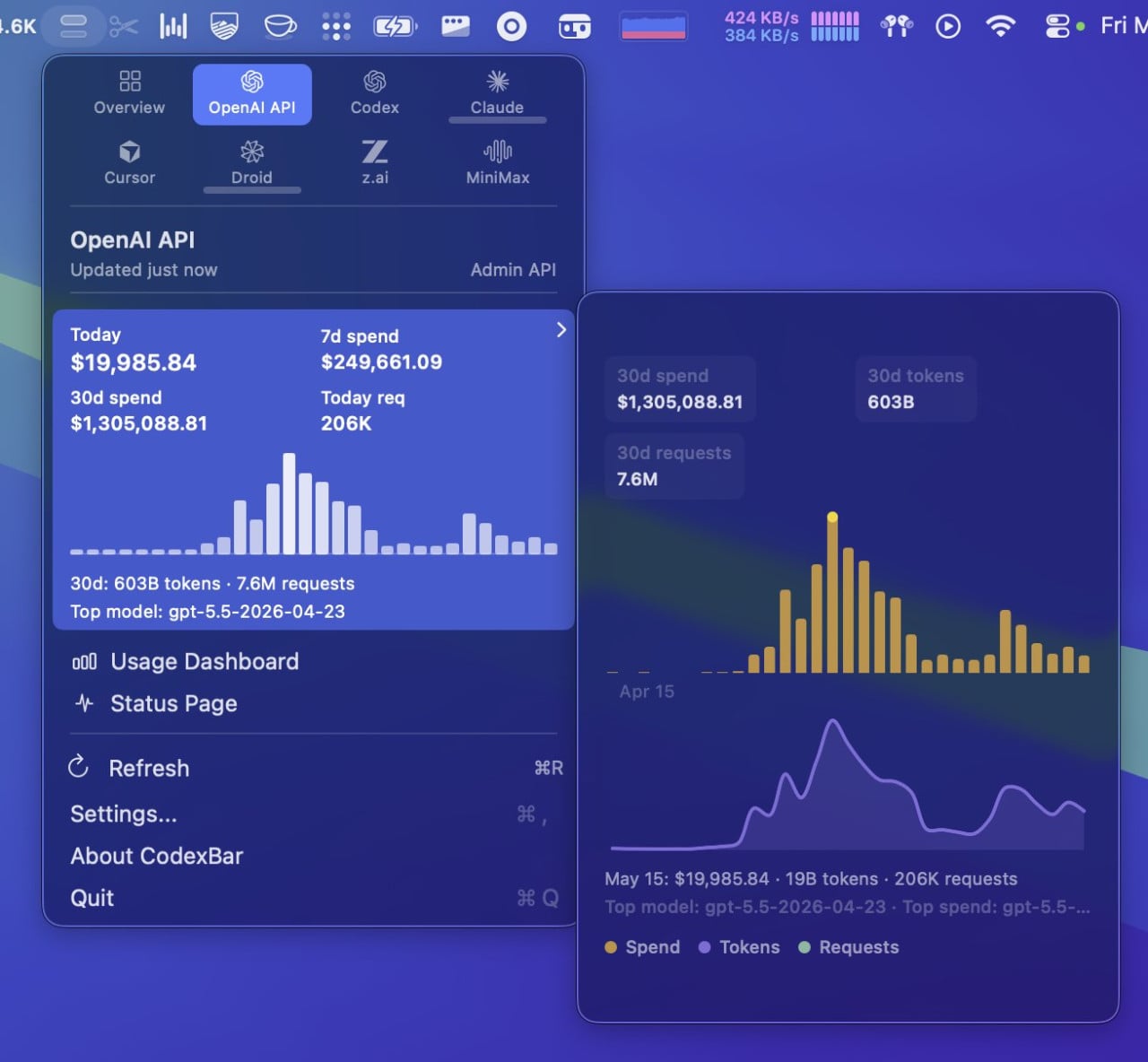
Peter Steinberger published a screenshot from his OpenAI API spending dashboard. The image shows spending of $1,305,088.81 in a single month. Reactions on the social network X came quickly. “Someone is burning enough tokens to fund a small startup,” one user wrote. Others wondered whether the same amount of money could fund an entire team of engineers. Steinberger promptly replied: “I’m building several startups in parallel.”
But who exactly is Steinberger, and why did his spending cause such a stir?

Peter Steinberger is an Austrian and the founder of PSPDFKit, whose PDF rendering technology ran on more than a billion devices. After thirteen years, he sold the company and stopped programming for three years. He returned in November 2025. One evening, he sat down and, in about an hour, wrote code that connected WhatsApp to the Claude AI model. He named the project Clawdbot, published it on GitHub under the MIT license, and went to bed. By morning, he had received 800 messages on Discord, and the project had gained 9,000 stars on GitHub on its first day.
Today, it is called OpenClaw, and it is the fastest-growing open-source project in GitHub’s history. It surpassed 250,000 stars in 60 days, beating React, which took thirteen years to achieve the same milestone.
In February 2026, Steinberger announced that he was joining OpenAI. Sam Altman called him a “genius” on X and wrote that he would “lead the next generation of personal agents.” OpenClaw, meanwhile, was transferred to a foundation and remains open-source. At the time, Steinberger was paying $10,000 to $20,000 a month out of his own pocket to run the servers. He received offers from Meta, Google, and others. He chose OpenAI. “I want to change the world, not build a large corporation,” he wrote on his blog at the time.
603 billion tokens, 100 agents, and three people
When Steinberger posted a screenshot on Friday from CodexBar, his tool for tracking spending across various AI coding tools, it showed a figure of $1.3 million over 30 days. A total of 603 billion tokens and more than 7.6 million requests, all handled by approximately one hundred concurrently running Codex instances. And all of it was managed by a team of three people.
The latest CodexBar update renders API costs wayyyy nicer. https://t.co/lJ4dxNHwzG pic.twitter.com/fCkWutJGzT
— Peter Steinberger 🦞 (@steipete) May 15, 2026
Of course, he did not have to pay. As an OpenAI employee, he receives computing capacity as a benefit. “A perk from OpenAI that supports OpenClaw,” he wrote. When asked whether the company charged him for the tokens, he replied simply: “Of course not.”
The dominant model on his account was GPT-5.5. And as he himself pointed out, the entire bill would have been 70 percent lower if he had not been using Codex’s so-called “Fast Mode,” which consumes tokens much faster than standard operation. Steinberger described how his team actually uses autonomous development. Agents continuously scan the code for security vulnerabilities, write fixes, review pull requests, and remove duplicate bug reports. Some agents open new PRs based on the project’s vision, while others monitor performance benchmarks and report regressions directly to Discord.
Agents “participate” in meetings. They listen to what the team is discussing and immediately open PRs for features that are still only being talked about. “All that automation allows us to run the project very leanly,” Steinberger wrote. But commenters immediately pushed back: a project with a monthly bill of $1.3 million can hardly be considered lean.
Can such consumption be justified?
Community reactions quickly split into two camps. Some admire Steinberger and see his approach as a glimpse into the future of software development. He himself says he is asking a research question: “How would we build software if tokens were not a constraint?”
The other camp is at times sharply skeptical. One of the most widely shared comments on Tom's Hardware calculated that $1.3 million a month could employ 70 experienced engineers full-time. “There’s no chance that three people with unlimited access to Codex can outperform seventy equally competent engineers who also use AI,” the comment said. “That’s just stupid.”
Steinberger’s case is not unique. According to Business Insider, a phenomenon known as tokenmaxxing is spreading through Silicon Valley. Essentially, it is a competition to see who can consume more tokens. OpenAI and other companies reportedly maintain internal leaderboards for spending on computing capacity. Access to free computing power, meanwhile, is becoming one of the tools used in the battle for talent. Steinberger’s case merely showed what this looks like in practice when that benefit is made available without limits.


