OpenAI Updates: Agent, Safety, and Philanthropy
Imagine your chat assistant not only answering questions, but also browsing the web, running code, creating presentations, or planning purchases for you. This is the reality OpenAI introduced on July 17, 2025, when it announced several key updates. These changes combine advanced artificial intelligence capabilities with practical applications in everyday life and business. Let’s take a closer look at how OpenAI connects research, action, and safety, all while emphasizing its nonprofit mission.
ChatGPT Agent: Combining Research and Action
OpenAI introduced the ChatGPT agent as a new model in the OpenAI o3 family that combines the strengths of deep research and Operator. This agent enables ChatGPT to think and act independently, using its own virtual computer to complete complex tasks. For example, you can ask: "Check my calendar and prepare a summary of upcoming meetings based on current news." The agent then intelligently browses websites, filters results, requests secure login, runs code to analyze data, and even creates editable presentations or spreadsheets.
The agent integrates capabilities from previous tools: Operator could navigate websites by clicking and typing, while deep research excelled at synthesizing information. Now it all works in a single system, where the agent switches between reasoning and action. It uses a visual browser to interact with websites, a text browser for simple queries, a terminal to run code, and access to external data through connectors such as Google Drive. Everything takes place within the context of your conversation, and the agent can ask for additional details or wait for your confirmation before important steps such as making a purchase.
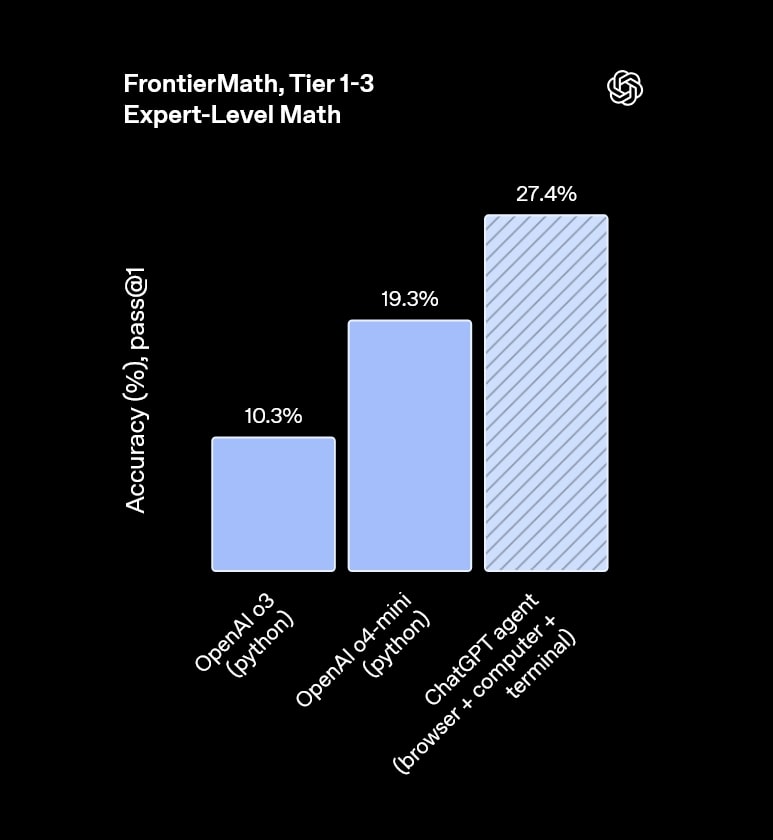
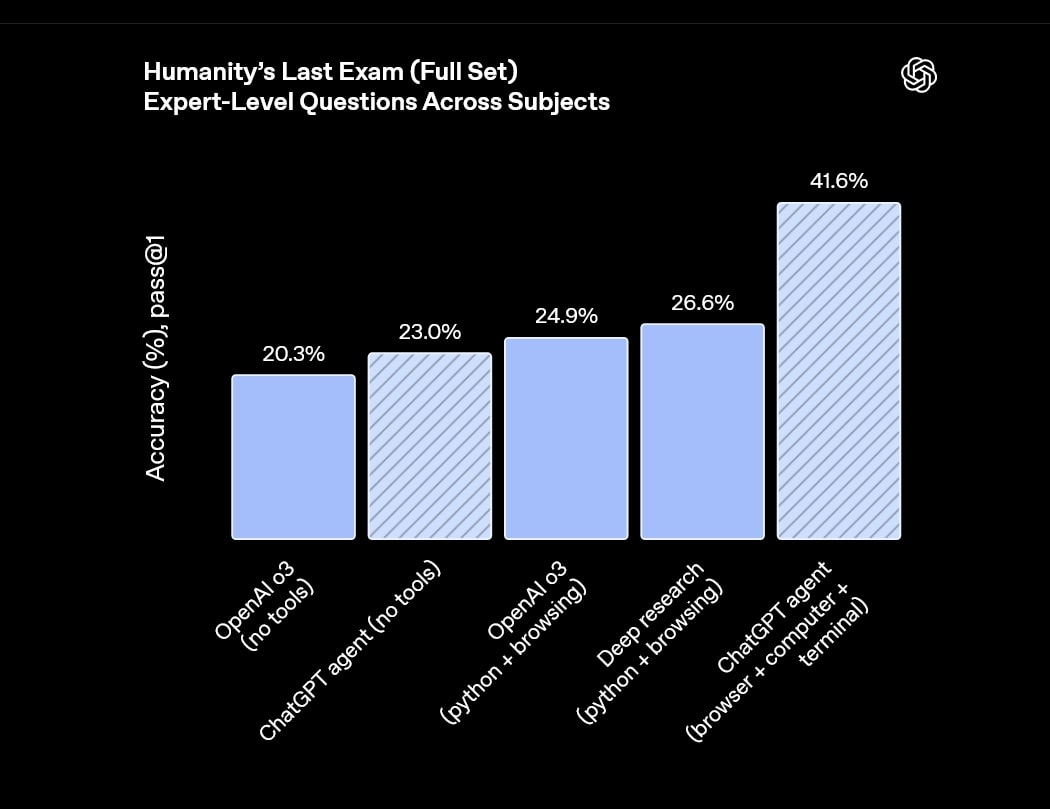
This agent is available to Pro, Plus, and Team users, who can activate it through the tools menu in "agent mode". Pro users have a limit of 400 messages per month, while others have 40, with the option to purchase additional credits. OpenAI plans to expand availability to Enterprise and Education in the coming weeks, while the older version of Operator will soon be discontinued. The agent achieves state-of-the-art results on benchmarks such as Humanity’s Last Exam, with a success rate of 41.6% (up to 44.4% when run in parallel), FrontierMath with 27.4% accuracy, and DSBench, where it surpasses human performance in data analysis.
System Card for the ChatGPT Agent
Alongside the agent, OpenAI published a detailed safety card (System Card) describing risks and safeguards. The agent is classified as having high capability in biological and chemical domains under the Preparedness Framework, which activates additional safety measures. OpenAI has no evidence that the model could help a novice cause severe biological harm, but it is taking a cautious approach.
Key safety features include protection against prompt injection (manipulation through instructions hidden in web content), requiring user confirmation before actions with real-world consequences, such as sending emails, and active monitoring. The agent refuses risky tasks such as bank transfers, and users can delete browsing data with a single click. OpenAI has also launched a bug bounty program for reporting biological risks and is collaborating with biosafety experts, including through a workshop with governments and academics.
Nonprofit Commission Report
OpenAI published a statement from its board of directors regarding the report by an independent commission for the organization’s nonprofit arm. The commission was convened in April 2025 to gather insights from stakeholders and provide recommendations on how OpenAI’s philanthropy can address long-term systemic challenges. The report reflects the commission’s independent conclusions and included input from community leaders and frontline practitioners.
The board expressed its appreciation for the expertise and emphasized its commitment to listening and building in partnership with those on the front lines of change. OpenAI’s nonprofit arm remains committed to its mission of ensuring that artificial general intelligence benefits all of humanity, and the report will help shape how resources are directed toward areas such as health, science, education, and public services, particularly in California.
Invideo AI: An Example of OpenAI Model Use
OpenAI also shared a case study about Invideo AI, an Indian startup that uses models such as GPT-4.1, gpt-image-1, and text-to-speech to create professional videos from simple ideas. The system functions as a multi-agent team: OpenAI o3 plans the content, GPT-4.1 writes scripts, search models add context, moderation ensures safety, gpt-image-1 generates visuals, and text-to-speech provides the voiceover.
According to co-founder Sanket Shah and Head of Product Anshul Khandelwal, this enables users to create videos for marketing, sales, or social media in minutes rather than hours. Invideo AI optimizes content for platforms such as TikTok, resulting in 10x faster production and double the revenue for many users. Each month, it helps more than 50 million users create over 7 million videos, and the team plans to expand with each new OpenAI model.
These updates show how OpenAI is pushing the boundaries of artificial intelligence toward practical, safe, and beneficial applications. If you are a ChatGPT user, try the agent right now—it could save you a lot of time!