The Trump administration ordered all federal agencies to immediately stop using Anthropic products. And that very same evening, Sam Altman, the CEO of OpenAI, announced that his company had just signed a contract with the Pentagon. The timing? Questionable, to say the least.
Anthropic and Its Red Lines
For months before things came to a head, Anthropic had been engaged in difficult negotiations with the Pentagon. The Department of Defense wanted access to the Claude artificial intelligence system for "all lawful purposes" without exceptions. Anthropic, however, insisted on two conditions: no mass surveillance of American citizens and no fully autonomous lethal weapons without human oversight.
That sounds reasonable, doesn't it? But the Pentagon saw things differently. On Wednesday evening, it delivered its "last and final offer" to Anthropic. On Thursday, CEO Dario Amodei responded that the company "could not in good conscience accept" the agreement.
On Friday afternoon, Trump described Anthropic on his Truth Social network as a company full of "radical left lunatics" and ordered a six-month transition period to end cooperation with it. Secretary of Defense Pete Hegseth went even further: he designated Anthropic a supply-chain security risk. This designation is commonly used for foreign adversaries, not American companies. Anthropic called it an "unprecedented action" and announced that it would challenge it in court.
This week, Anthropic delivered a master class in arrogance and betrayal as well as a textbook case of how not to do business with the United States Government or the Pentagon.
— Secretary of War Pete Hegseth (@SecWar) February 27, 2026
Our position has never wavered and will never waver: the Department of War must have full, unrestricted…
OpenAI Came Up with Its Own Deal
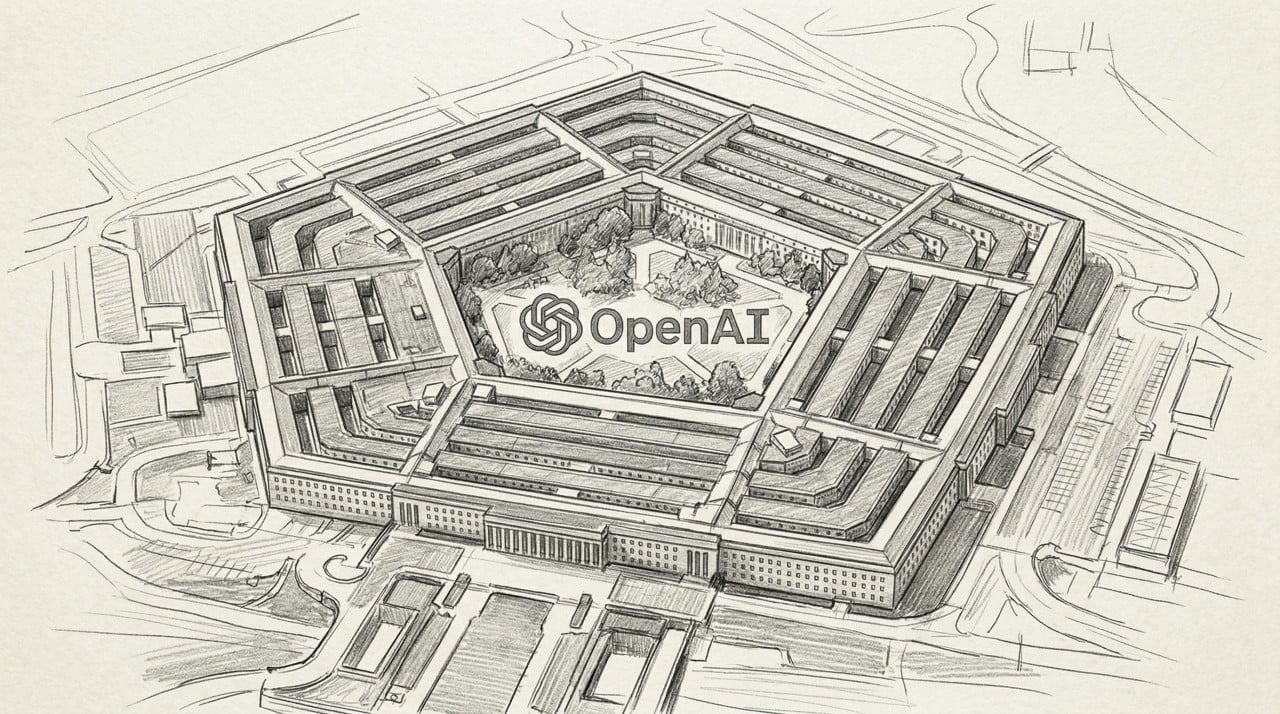
A few hours after Trump's attack, Altman posted a message on X: OpenAI had reached an agreement with the Pentagon. The company's models will be deployed on the Department of Defense's classified networks. What's more, Altman claimed that the agreement contains exactly the safeguards Anthropic had fought for in vain. "Two of our most important safety principles are a ban on mass domestic surveillance and human accountability for the use of force, including autonomous weapons systems," Altman wrote. The Pentagon reportedly agrees with these principles, and they are enshrined directly in the contract.
OpenAI also added a third red line that Anthropic did not have: a ban on automated high-stakes decisions, such as social credit systems. Altman himself, however, admitted that the agreement was "definitely rushed" and that "the optics don't look good." So why did he sign it? "We really wanted to de-escalate the situation and thought the offer was a good one," he explained on X.
Tonight, we reached an agreement with the Department of War to deploy our models in their classified network.
— Sam Altman (@sama) February 28, 2026
In all of our interactions, the DoW displayed a deep respect for safety and a desire to partner to achieve the best possible outcome.
AI safety and wide distribution of…
What Exactly the Contract Says and How the Safeguards Work
In its blog post, OpenAI explained why it believes its agreement is safer than any previous contract for deploying artificial intelligence in a classified environment.
The key is a multi-layered approach. The models are deployed exclusively through the cloud, not on edge devices. This makes it technically impossible to connect them directly to autonomous weapons systems. OpenAI retains full control over its safety stack, and vetted company employees will be directly involved in operations. The contract also explicitly references current laws on surveillance and autonomous weapons as they exist today, meaning that even a future change in the law would not open the door to circumventing them.
Critics, however, did not remain silent. Analyst Mike Masnick pointed out that the contract references Executive Order 12333, which the NSA has historically used to monitor communications intercepted outside the United States, even when they involved American citizens. OpenAI dismissed this as a misunderstanding: "Deployment through cloud APIs ensures that our models cannot be directly integrated into weapons systems or sensors," explained Katrina Mulligan, head of national security partnerships.
Employee and Market Reactions: Who Won?
Ironically, while OpenAI celebrated the contract, the market reacted differently. Anthropic's Claude app jumped to second place in the U.S. App Store on Saturday, immediately after the agreement was announced. People clearly appreciated that Anthropic stood by its principles.
More than 60 OpenAI employees and over 300 Google employees signed an open letter supporting Anthropic even before the agreement was finalized. The letter warned: "The Pentagon is negotiating with Google and OpenAI to achieve what Anthropic refused. It is trying to divide each company by making it fear that the other will give in."
OpenAI took a clear position on Anthropic's designation as a security risk: it disagrees with the action and made that clear to the government. Altman also called on the Pentagon to offer the same terms to every company in the industry and expressed hope that the situation with Anthropic would be resolved amicably.
Sources: theguardian.com and techcrunch.com