After eight decades of futile effort, one of geometry’s most famous unsolved mysteries has fallen. It was solved by a chatbot.
OpenAI announced that its language model had disproved the so-called Erdős conjecture on distances between points in the plane, also known as the unit distance problem. The proof was reviewed by a group of nine external mathematicians. And their verdict was unequivocal: this is the first time artificial intelligence has independently solved a problem central to an entire field of mathematics.
“No previous AI-generated proof has come remotely close to meeting these standards,” wrote Timothy Gowers, a mathematician at the University of Cambridge and a Fields Medalist, in a commentary commissioned by OpenAI.
The unit distance problem
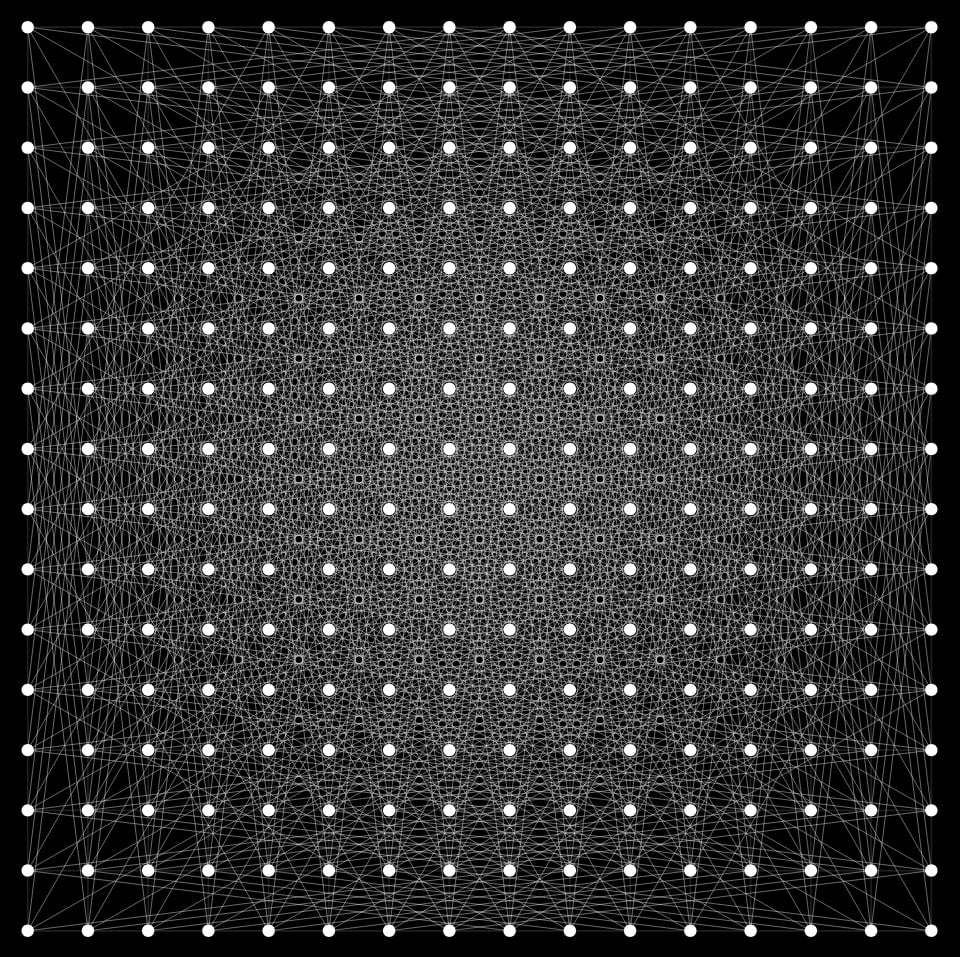
In 1946, the legendary Hungarian mathematician Paul Erdős posed a seemingly simple question: if you arrange n points in the plane, how many pairs of points can be exactly one unit apart? Try it yourself. Draw nine dots. The goal is to create as many pairs of points as possible that are exactly one centimeter apart. Arrange them in a row and you have eight such pairs. Draw a three-by-three grid and you get twelve pairs.
Erdős claimed that the best possible arrangement grows only slightly faster than the number of points itself. For 80 years, no one was able either to prove or disprove it. Yet almost all experts assumed that Erdős was right. The best upper bound available at the time, established by Spencer, Szemerédi, and Trotter in 1984, stated that the number of pairs could not exceed approximately n to the power of 4/3. But the best available lower bound—that is, the best configurations actually constructed—could not close this gap.
How did the OpenAI model reach its conclusion?
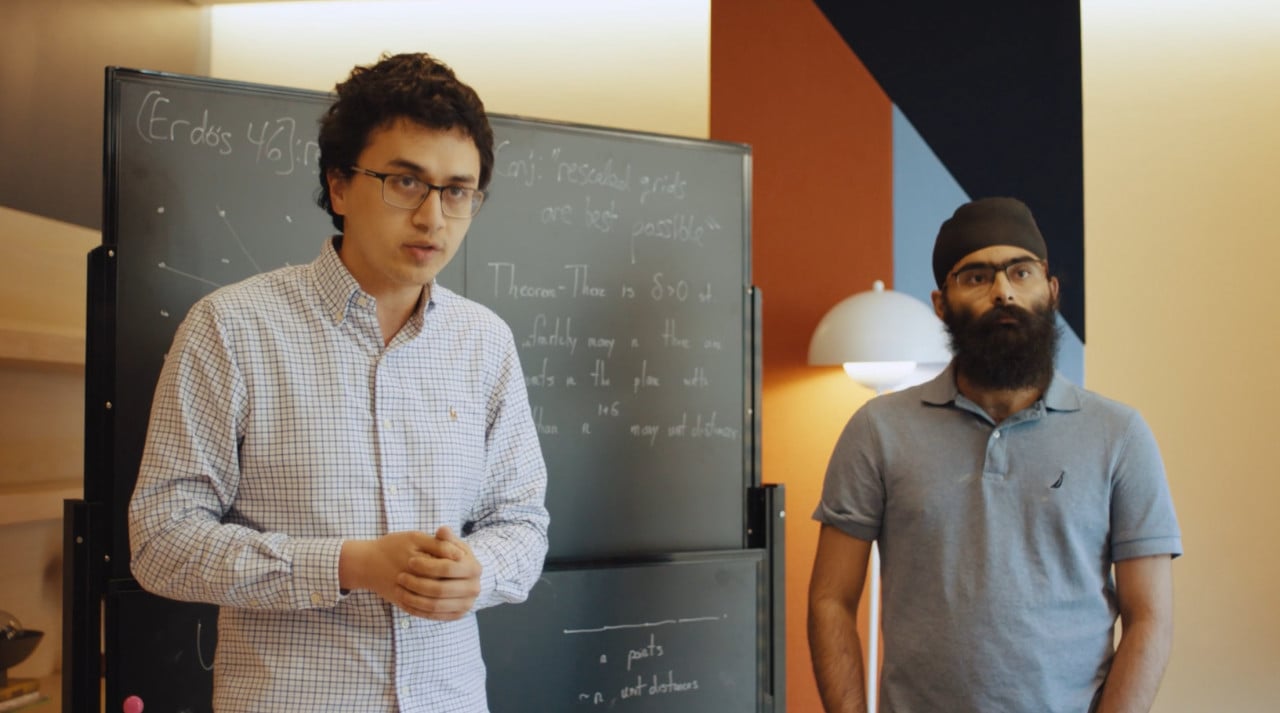
OpenAI mathematicians Mehtaab Sawhney and Mark Sellke gave the problem to an internal language model trained for general reasoning. They did not help it step by step or steer it toward the subject. On its own, after hundreds of pages of calculations and logical steps, the model arrived at a result. And the result was surprising. The model did not find confirmation of Erdős’s conjecture. It disproved it.
It constructed an infinite family of point configurations that achieve at least n^(1+δ) unit-distance pairs for some fixed positive δ. In other words, it showed that there are arrangements of points that perform substantially better than had been assumed for decades.
At first glance, the contribution may seem modest. Princeton researcher Will Sawin subsequently refined the result and determined that the exponent δ = 0.014. The number may be small, but the advance it represents is enormous. For the first time in history, someone has constructed an arrangement whose performance grows polynomially faster than Erdős’s conjecture predicted. This literally disproves it. “It is an amazing experience when a machine gives you something back that really resembles my own way of thinking,” Sawhney said.
Algebraic number theory in a geometric problem
What exactly did the model do? Instead of a simple square grid, it constructed a more complex structure existing in a higher dimension and exploiting special mathematical symmetries. It then developed a way to map this multidimensional structure back onto the plane as a kind of “shadow projection.” The resulting configuration is not a grid. It cannot be easily drawn, even on a large sheet of paper.
The key tools come from algebraic number theory, specifically from the theory of so-called class field towers and the Golod–Shafarevich theorem. This is mathematical machinery that no one had previously connected with this geometric problem.
The model did not discover entirely new mathematical tools. It used existing methods. But no one before it had combined and applied them to the unit distance problem. “The model did not invent anything fundamentally new that no one saw coming,” says Sébastien Bubeck, the mathematician leading mathematical research at OpenAI. “It simply showed itself to be an amazing mathematician.”
Why did people fail to see it for 80 years?
Harvard mathematician Melanie Wood Wood is certain of the answer. People were wrong in their assumption, not in their mathematics. The vast majority of experts believed that Erdős was right and devoted their energy to finding a proof of his conjecture rather than disproving it. Those who attempted to disprove it would probably have abandoned the path through complex algebraic geometry before completing it because they saw no promising sign of success.
But AI works differently. “AI has an advantage: it is not just that it can try all known methods,” says Jacob Tsimerman of the University of Toronto. “It can keep playing longer and in more dangerous waters without becoming discouraged.” If the same group of mathematicians had been assembled and asked to look for a counterexample, they probably would have found it. “Perhaps people should spend more time playing devil’s advocate,” Wood says.
The proof passed the strictest test
This time, OpenAI proceeded cautiously. And for good reason. Seven months ago, then-OpenAI vice president Kevin Weil announced with great fanfare on X that GPT-5 had solved ten previously unsolved Erdős problems. The result collapsed within a few days. It turned out that the model had merely found solutions that already existed in the literature. Demis Hassabis of Google DeepMind mocked the announcement, and competitors cheered. Weil subsequently deleted his post.
This time, OpenAI contacted mathematicians in advance. Among them was Thomas Bloom, the mathematician who had described Weil’s earlier claim as a “dramatic misrepresentation of reality.” Bloom now stands behind the new result. Nine leading mathematicians wrote an accompanying verification study. Timothy Gowers stated that he would recommend the result for publication without hesitation in the Annals of Mathematics, one of the world’s most prestigious mathematics journals. “This is the only genuinely interesting result that AI has autonomously produced so far,” says Daniel Litt of the University of Toronto.
Impact on mathematics and AI research
Sawhney and Sellke work at OpenAI, testing whether advanced models can contribute to research at the frontier of knowledge. The model that solved the problem is not a specialized mathematical tool. It is a general-purpose model trained for complex reasoning. Mathematicians point out that without human involvement, the result would not have been as convincing. People played a role in cleaning up, verifying, and interpreting the AI’s output. “Humans still play a crucial role in discussing, digesting, and refining this proof and in exploring its consequences,” wrote mathematician Thomas Bloom.
But there has also been a serious criticism. Wood pointed out that the model did not address related existing work in its output or give it credit. “If we mathematicians failed to notice similar ideas in the literature and give them credit, it would be professional misconduct,” she says. Meanwhile, Litt is cautiously optimistic. The unit distance case appears to have been one of those instances where experts simply overlooked a relatively straightforward solution. “I think we are only beginning to discover that such cases are not as rare as we thought.”
And Bloom adds with a touch of exaggeration: “AI is helping us explore more fully the cathedral of mathematics that we have been building for centuries. What other treasures, invisible to us, are waiting around the corner?”