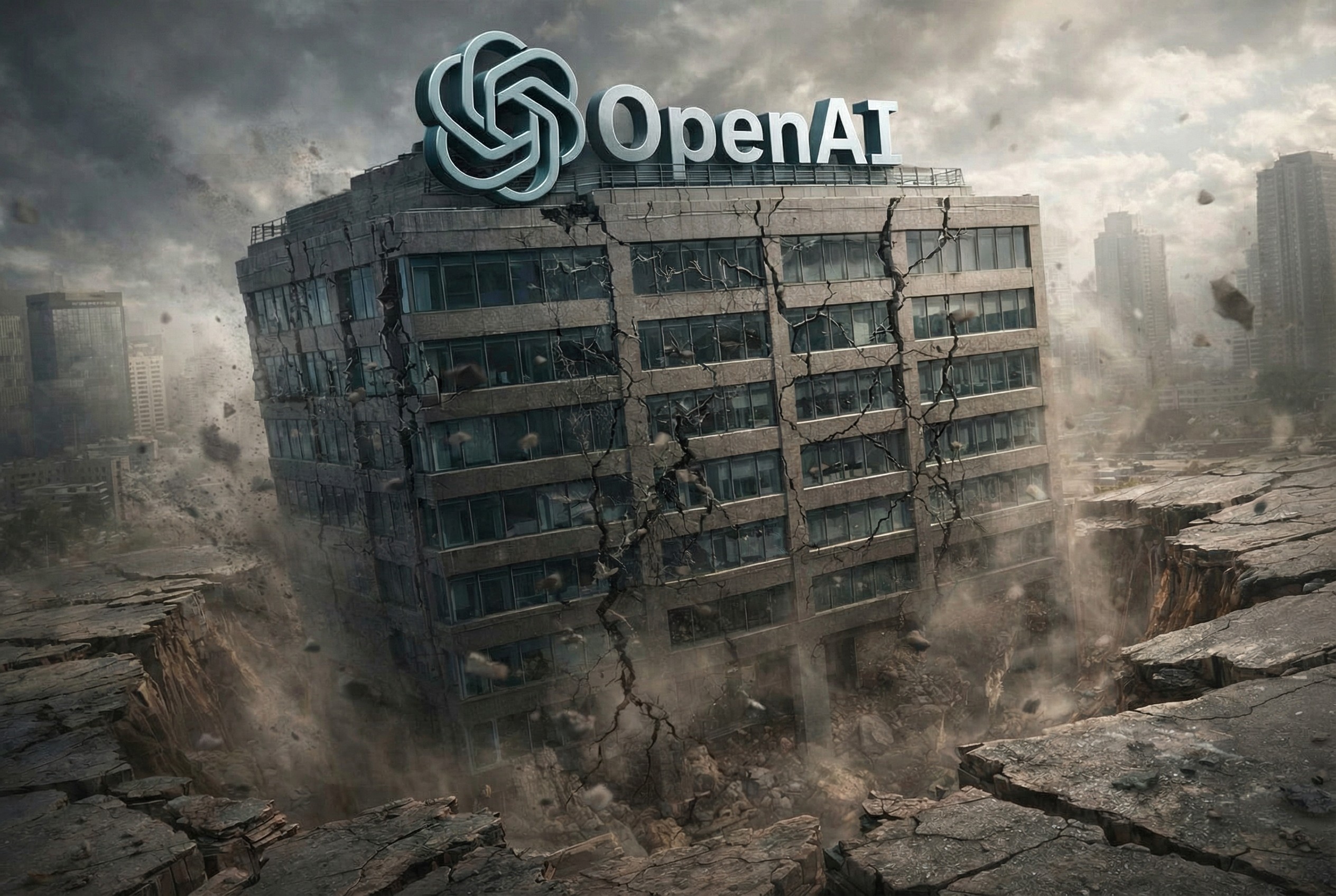
Financial expert Sebastian Mallaby, who works as a senior fellow at the independent think tank Council on Foreign Relations, predicted in an essay for The New York Times that OpenAI could run out of money within the next 18 months. He is no opponent of artificial intelligence—on the contrary, he is very optimistic about it. According to him, it usually takes companies decades to successfully deploy new technologies, but in the case of AI, astonishing progress has been made in just three years. Nevertheless, he sees OpenAI as the weak link in the entire industry.
Mallaby argues that competitors such as Google, Microsoft, and Meta have an enormous advantage. These companies make huge amounts of money from other activities and can pour hundreds of billions of dollars into AI development. OpenAI has no such safety net. The company became famous by launching ChatGPT more than three years ago, but it is now struggling with enormous expenses that could bury it.
Enormous expenses and low revenue
OpenAI has committed to spending more than $1 trillion (approximately CZK 23 trillion) by the end of the decade. This is an astronomical sum that the company plans to invest in scaling its models and infrastructure. In 2025 alone, it burned through more than $8 billion (about CZK 184 billion). Although OpenAI has raised a record amount of funding as a private company, it is still bleeding money and seeking additional capital.
Users are not particularly willing to pay for ChatGPT subscriptions, and the company is only beginning to explore other ways to make money, such as advertising. Mallaby points out that even if OpenAI backs away from some of its commitments or pays with overvalued shares, it will still need enormous sums. In his view, capital markets may not provide such a rescue, no matter how enticing the potential rewards from AI may be.
Competition and possible endgame scenarios
According to Mallaby, once OpenAI runs out of money, it could be absorbed by a wealthy rival such as Microsoft, Amazon, or another deep-pocketed player. This scenario would mean that OpenAI would become merely a footnote in AI history, despite having sparked the entire frenzy around ChatGPT. Mallaby emphasizes that OpenAI's collapse would not represent the failure of artificial intelligence as a whole—only the end of the industry's most hyped company.
Other experts agree that 2026 could be decisive for OpenAI. The company's CEO, Sam Altman, declared a "code red" late last year and doubled down on ChatGPT to keep pace with its biggest rival, Google. One venture capital investor with a stake in an OpenAI competitor compared the situation to the story of WeWork. The shared-office company collapsed like a house of cards and went bankrupt in 2023 after years of chaos, during which it squandered billions of dollars on leases and property purchases.
Is the future of AI at risk?
The artificial intelligence industry is pouring tens of billions of dollars into demanding models and the infrastructure that powers them. Investors still believe in a revolution that could generate enormous profits, but actual profitability remains many years away for most companies. The question is: who will ultimately benefit? Companies such as Google and Meta have stable businesses elsewhere, while OpenAI is betting everything on a single card.
Mallaby is convinced that OpenAI will leave a lasting legacy even if it ceases to exist. Its failure, he says, would not mean the end of AI, but merely serve as a warning about the risks of excessive enthusiasm. The industry has made remarkable progress in a short period of time, but OpenAI could be the company that pays the price for its rapid rise.
Sources: nytimes.com and finance.yahoo.com