
Anthropic is tracking how artificial intelligence affects the real world. Its latest report from January 15, 2026, introduces a new way of measuring this impact. It focuses on conversations from the Claude.ai chatbot, a tool for everyday users, and from its API, which is used mainly by companies. Everything is done in a way that protects user privacy. Previous reports examined occupations, wages, and countries, but now Anthropic has added five basic metrics that it calls economic primitives. These primitives help answer questions such as whether AI actually speeds up work, which tasks it is best suited for, and how it is changing occupations.
These primitives are as follows: task complexity, skill level, purpose (work, education, or personal use), AI autonomy, and success rate. Claude itself estimates each primitive based on conversations from November 2025, primarily with the Claude Sonnet 4.5 model. For example, complexity measures how many years of education a person needs to perform a task or how long it would take without AI. The data obtained shows that AI primarily helps with more complex tasks.
Faster tasks thanks to AI?
The Claude.ai data shows that more complex tasks receive the greatest speedup. If a task requires a high school education (12 years), Claude speeds it up 9-fold. For tasks at the college degree level (16 years), the speedup is as much as 12-fold. On the API, which handles business tasks, the speedup is even greater. This means that AI currently helps people with higher levels of education the most, such as white-collar workers.
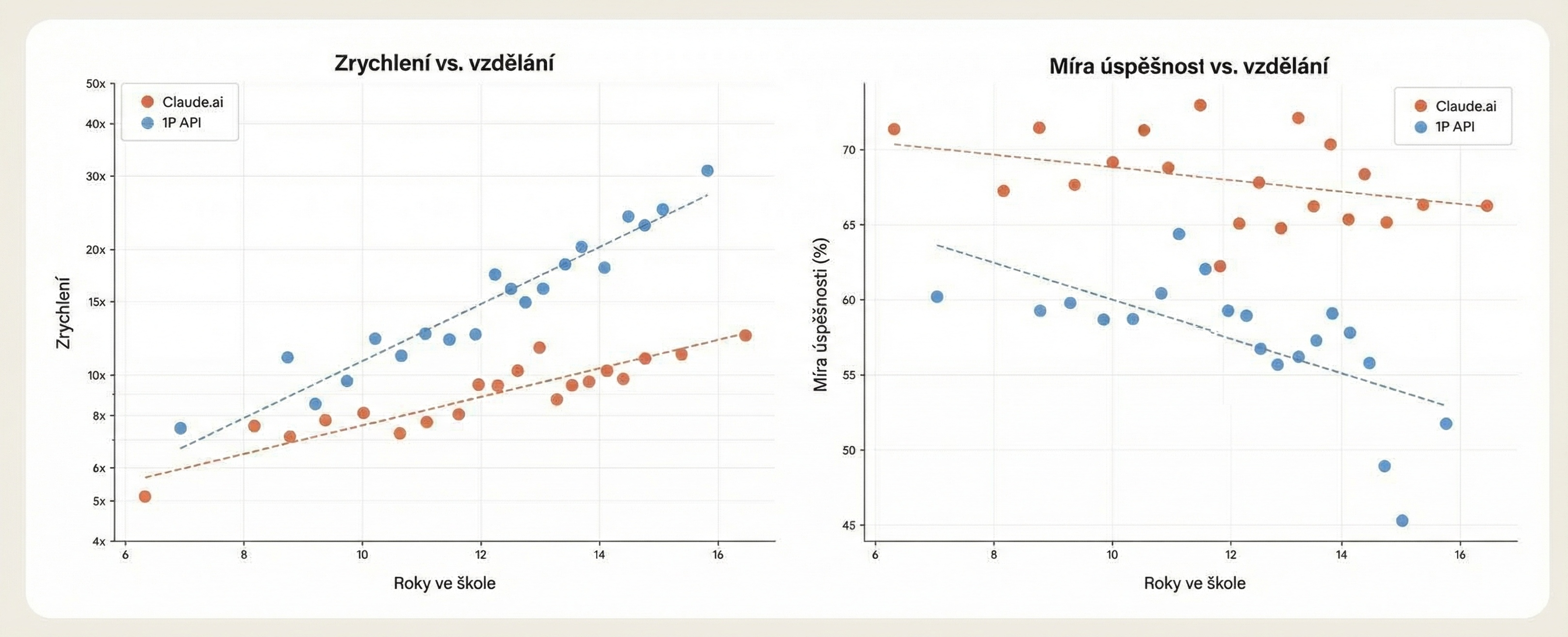
When the success rate is taken into account, the trend remains, but weakens slightly. Claude successfully completes college-level tasks in 66% of cases, compared with 70% for simpler tasks below the high school level. Nevertheless, the speedup outweighs the decline in success rate for more difficult tasks. For example, the report’s charts show that the success rate decreases with task length—Claude achieves a 50% success rate on tasks that would take a person 19 hours on Claude.ai, but only 3.5 hours on the API.
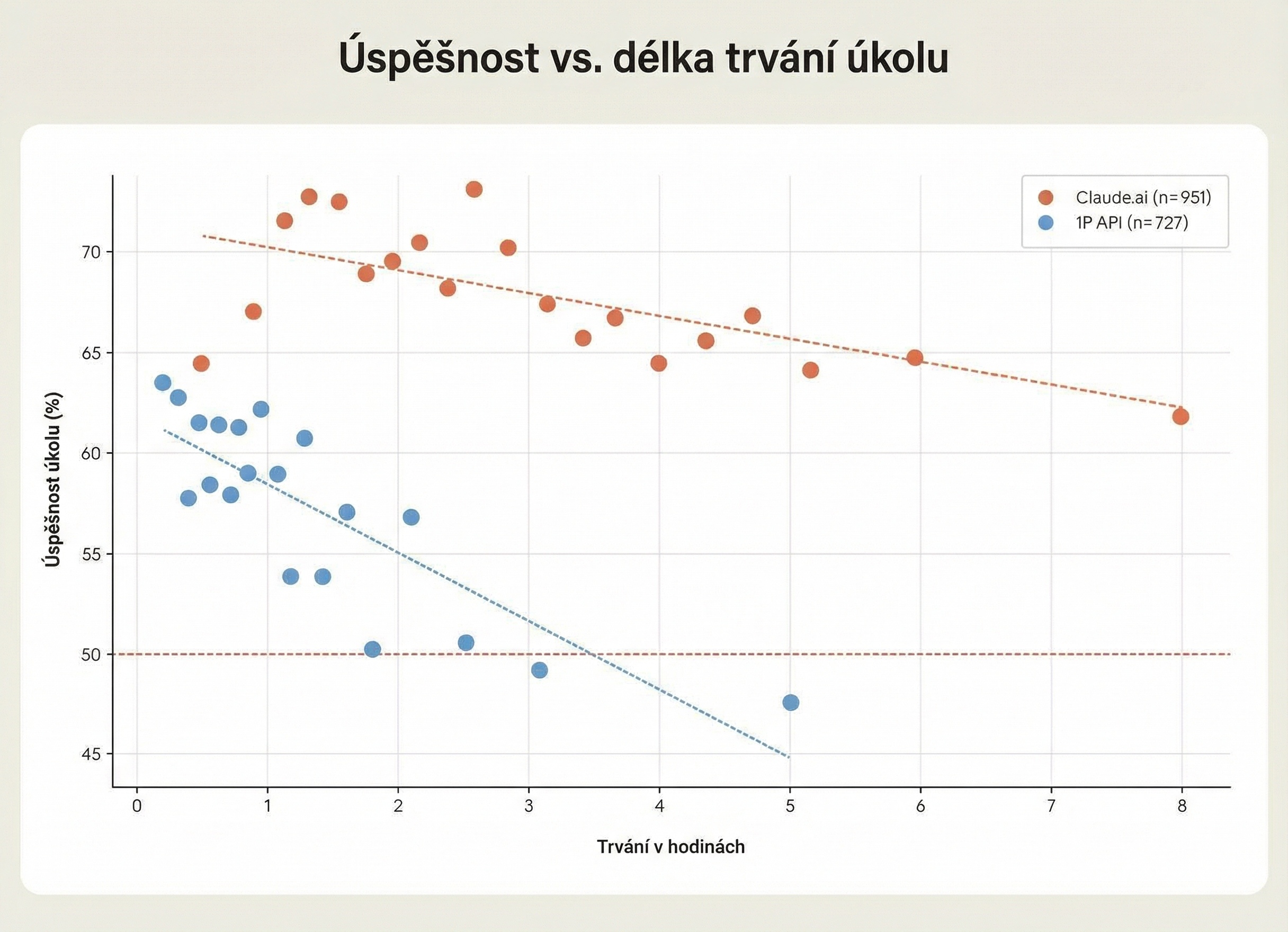
A comparison with measurements from METR (an organization that tests AI on long tasks) offers an interesting perspective. METR says that Claude Sonnet 4.5 achieves a 50% success rate on 2-hour tasks, but in Anthropic’s real-world data, this time is longer because users divide tasks into smaller parts and correct errors.
Differences between countries and occupations
Claude usage varies according to countries’ wealth. In wealthier countries with higher GDP per capita, AI is used more for work or personal matters. In poorer countries, educational uses, such as schoolwork, predominate. Claude.ai data shows more personal conversations in wealthy countries, while in less wealthy countries it is used mainly for studying. This is consistent with a Microsoft study that links educational use with lower incomes. Anthropic is working with the Rwandan government and the company ALX on programs in which people begin by learning about AI and then receive access to Claude Pro for one year so they can transition to broader use.
For occupations, Claude was found to cover 49% of tasks in the average job when data from the entire year of 2025 is included. However, this changes after accounting for success rates and the time required for each task. For example, occupations such as data entry clerks or radiologists are affected more than the number of tasks alone would suggest. Teachers or software developers, on the other hand, are affected less. Claude focuses on tasks requiring an average of 14.4 years of education, which is higher than the economy-wide average of 13.2 years.
If AI were to replace these tasks, it could lead to a decline in skill requirements across many occupations, such as technical writers, travel agents, or teachers. Only a few occupations, such as property managers, would see the opposite. But this is only an estimate—the labor market may adapt.
Overall impact on the economy
Anthropic’s earlier estimate projected that AI would increase U.S. labor productivity growth by 1.8 percentage points per year. The primitives now confirm this based on speedup, but after accounting for success rates, the figure falls to 1.2 percentage points for Claude.ai and 1.0 for the API. Even so, this would return productivity growth to the level seen in the late 1990s. And models such as Claude Opus 4.5 are now even better.
Updates to earlier measurements show that Claude usage is concentrated: the top 10 tasks account for 24% of conversations on Claude.ai, mainly in computer and mathematical fields. Augmentation (collaboration with AI) now exceeds automation (full takeover) by 52% to 45%, but automation is slowly increasing. Geographically, the United States, India, Japan, the United Kingdom, and South Korea lead, while usage within the United States is becoming more evenly distributed among states.
This data helps explain how AI affects work unevenly and is useful to researchers and policymakers. The full report is available on Anthropic’s website.