NVIDIA has announced the beta release of the open-source Newton Physics Engine, developed jointly with Google DeepMind and Disney Research. This tool is now part of NVIDIA Isaac Lab and helps researchers and developers create robots capable of moving through challenging environments. Newton can simulate complex actions such as walking on snow or gravel, as well as handling objects such as cups and fruit. Its flexible design works with various types of physics solvers, ensuring that skills learned in simulation can be safely transferred to the real world.
This engine is already being adopted by leading laboratories and universities, including the ETH Zurich Robotic Systems Lab, the Technical University of Munich, and Peking University. Other adopters include robotics company Lightwheel and simulation engine company Style3D. Newton is built on the NVIDIA Warp framework and OpenUSD, enabling accurate simulation of the complex movements of humanoid robots with many joints and the need to maintain balance.
Isaac GR00T N1.6: Human-Like Reasoning for Robots
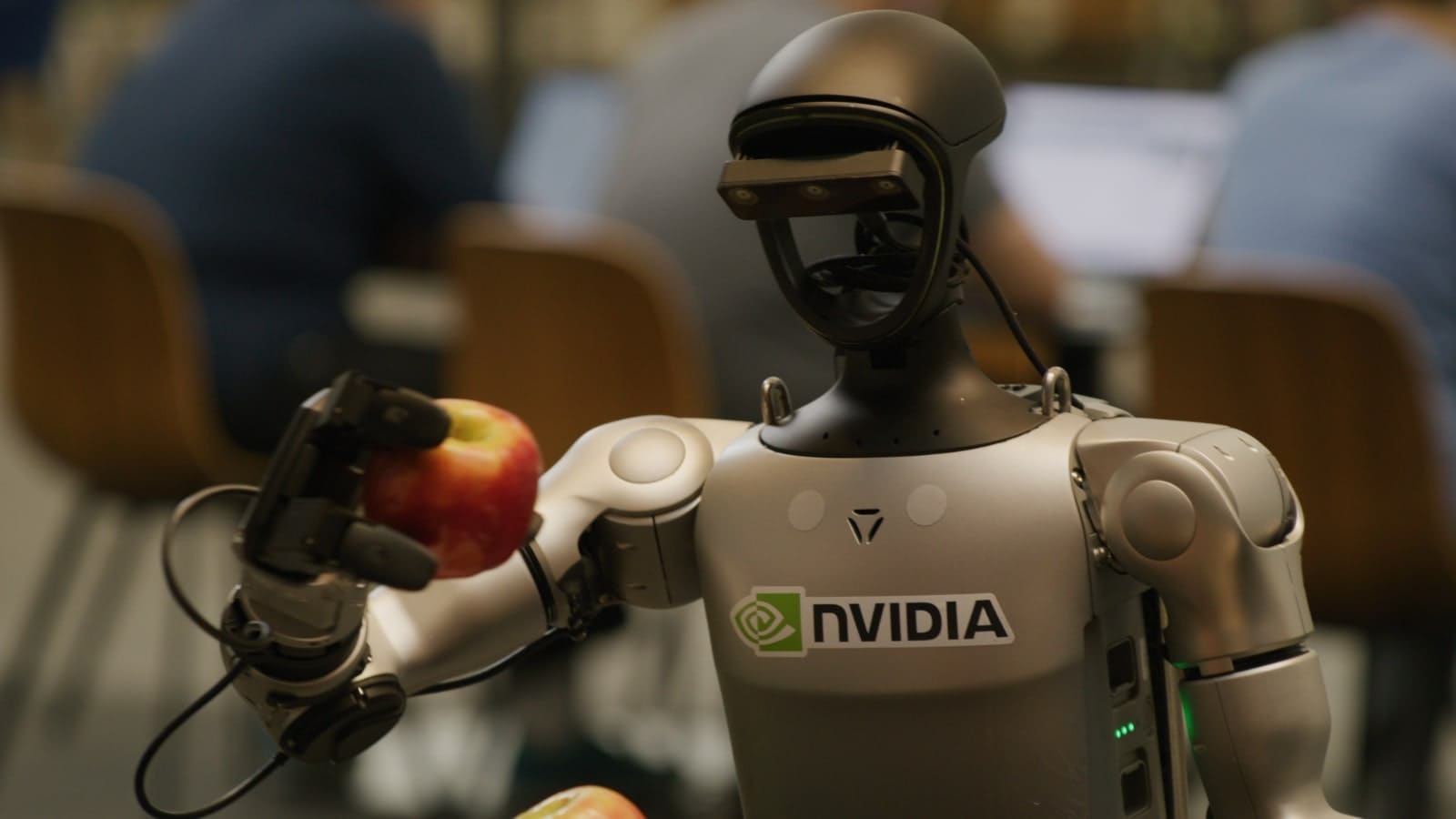
The new version of the open NVIDIA Isaac GR00T N1.6 model gives robots human-like reasoning capabilities. This model integrates NVIDIA Cosmos Reason, an open model for visual and language reasoning in physical AI. It functions as the robot's "deep-thinking brain," capable of breaking down ambiguous instructions into specific plans and using prior knowledge and common sense to address new situations.
The Cosmos Reason model has been downloaded more than one million times and tops the Physical Reasoning Leaderboard on Hugging Face. It is available as an NVIDIA NIM microservice for easy deployment. Isaac GR00T N1.6 enables humanoid robots to move and manipulate objects simultaneously, simplifying tasks such as opening heavy doors. Developers can fine-tune the model using the open NVIDIA Physical AI Dataset on Hugging Face, which contains thousands of synthetic and real-world trajectories and has been downloaded more than 4.8 million times.
Companies testing this model include AeiROBOT, Franka Robotics, LG Electronics, Lightwheel, Mentee Robotics, Neura Robotics, Solomon, Techman Robot, and UCR. These companies are using it to build general-purpose robots capable of performing a wide range of tasks in real-world environments.
Cosmos World Foundation Models: Generating Training Data
NVIDIA has updated its open Cosmos World Foundation Models, which help generate diverse data for training physical AI models. These models have been downloaded more than three million times and can create videos based on text, image, or video prompts. The new Cosmos Predict 2.5 version combines three models into one, reducing complexity and increasing efficiency. It supports longer videos of up to 30 seconds and outputs from multiple cameras for richer simulations.
Another model, Cosmos Transfer 2.5, is 3.5 times smaller than the previous version but delivers faster, higher-quality results. It generates photorealistic synthetic data from 3D scenes and inputs such as depth, segmentation, or high-resolution maps. These tools address the lack of data in robotics and make it possible to scale model training for complex tasks.
New Workflows and Infrastructure for Robots
NVIDIA introduced a new workflow for teaching robots to grasp objects in Isaac Lab 2.3, built on the NVIDIA Omniverse platform. This workflow trains robots with multi-fingered hands in a virtual world using an automated curriculum that gradually increases task complexity. It changes factors such as gravity, friction, and object weight, preparing robots for unpredictable situations. Boston Dynamics used this approach to improve manipulation capabilities in its Atlas robots.
Together with Lightwheel, NVIDIA is developing Isaac Lab - Arena, an open framework for evaluating robot skills in simulation. This tool makes it possible to test robots across thousands of scenarios without having to build a system from scratch. To support these technologies, NVIDIA announced new infrastructure, including NVIDIA GB200 NVL72 with 36 NVIDIA Grace processors and 72 NVIDIA Blackwell GPUs, NVIDIA RTX PRO Servers for every stage of development, and NVIDIA Jetson Thor for real-time processing on the robot.
Companies adopting NVIDIA Isaac and Omniverse technologies include Agility Robotics, Boston Dynamics, Disney Research, Figure AI, Franka Robotics, Hexagon, Skild AI, Solomon, and Techman Robot. Research institutions such as Stanford University, ETH Zurich, and the National University of Singapore are using these tools to advance robotics. Rev Lebaredian, vice president of Omniverse and simulation technology at NVIDIA, emphasized that these updates provide developers with three key components: Isaac GR00T as the brain, Newton for body simulation, and Omniverse as the training environment.
Source: nvidia.com