

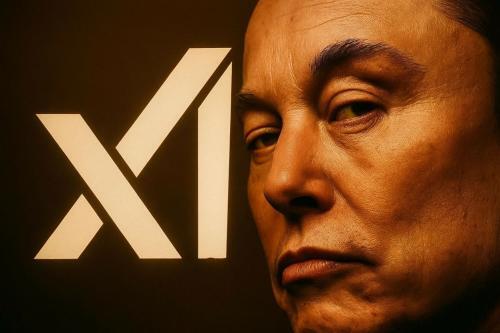
Elon Musk is used to building things that others consider impossible. Rockets land back on the launch pad, electric cars drive themselves. But his AI company xAI has found itself in a situation that would make even his most die-hard fan hesitate. Of the original 12 co-founders, only three remain at the company today. And Musk himself has admitted that the entire project was built incorrectly from the start.
"xAI was not built right the first time around, so it is being rebuilt from the ground up," Musk wrote on the X platform. He also compared it to Tesla, which he said went through a similar process. But this time, the pressure is much greater and time is running out.
xAI was not built right first time around, so is being rebuilt from the foundations up.
— Elon Musk (@elonmusk) March 12, 2026
Same thing happened with Tesla.
A Series of Departures from xAI
Around the turn of the year, 11 senior engineers, including two co-founders, left xAI. At the time, Musk described it as a reorganization necessary for a larger company. Then February came, bringing the departures of Jimmy Ba and Tony Wu, two more co-founders. Toby Pohlen, who was supposed to lead the ambitious Macrohard project, left the company only a few weeks after his appointment.
Another blow came last week. Zihang Dai and Guodong Zhang, co-founders responsible for image generation, among other things, announced their departure. "Last day at xAI. It has been a wild ride over the past three years, but I am looking forward to the next chapter," Zhang wrote on X.
The result? Only three people remain from the original twelve-member founding team: Manuel Kroiss, Ross Nordeen, and Musk himself. For a company trying to compete with OpenAI and Anthropic, that is very thin ice indeed.
The Problem of AI Coding
Why are they leaving? Part of the answer lies in an area where xAI is significantly lagging behind: AI-assisted coding tools. Musk himself called an all-hands meeting where he openly admitted that Grok Code cannot compete with Anthropic's Claude Code or OpenAI's Codex.
And that is a serious problem. AI coding tools are currently the biggest business in the entire industry. Whoever loses here stands to lose a lot of money. In August, xAI released the "Grok Code Fast 1" model, which promised lightning-fast speed. But users quickly discovered that the company had sacrificed depth of reasoning in favor of speed. The result? Grok finished a distant third behind both of its main rivals.
Musk believes he can close the gap by mid-2026. Whether he can pull it off, however, is a multibillion-dollar question.
New Blood from Cursor
To salvage the situation, Musk recruited talented people from elsewhere. Andrew Milich and Jason Ginsberg are joining xAI from the startup Cursor, one of the hottest names in AI coding. Cursor itself is in talks over a valuation of around $50 billion. The fact that two of its key people are moving to xAI suggests that direct access to proprietary language models and computing resources is more attractive to them than working with third-party models.
Musk went even further. He admitted that xAI had previously rejected or failed to even invite many talented people for an interview. "My apologies," he wrote on X, announcing that he and head of recruiting Baris Akis were reviewing the company's interview history and reaching back out to promising candidates. An honest gesture, albeit a little late.
Many talented people over the past few years were declined an offer or even an interview @xAI. My apologies.@BarisAkis and I are going through the company interview history and reaching back out to promising candidates. https://t.co/tvhipa1lu1
— Elon Musk (@elonmusk) March 13, 2026
SpaceX IPO and Pressure to Deliver Results
There is another major factor behind all this chaos: SpaceX is preparing to go public. Musk merged xAI with SpaceX in a transaction valued at $1.25 trillion. SpaceX was valued at $1 trillion and xAI at $250 billion. Meanwhile, Tesla converted its investment in xAI into a small stake in SpaceX. But an IPO brings public scrutiny. Investors will want to see numbers, growth, and a clear strategy. An AI division that is losing founders, falling behind the competition, and grappling with controversies over deepfake content on Grok is not exactly a story that sells well on the stock market.
Grok also ran into trouble after enabling the easy generation of non-consensual sexual images and child sexual abuse material. The scandal attracted the attention of lawmakers in several countries and prompted an investigation in the EU. That is exactly the kind of headline no one wants before going public.
Macrohard on Ice
Musk has a much bigger ambition in reserve than mere coding tools. The Macrohard project is intended to create an AI agent capable of doing anything an ordinary office worker can do on a computer. According to Musk, the name is "a humorous nod to Microsoft." But the project is currently on hold, and its leader, Toby Pohlen, left only a few weeks after being appointed.
Musk has now revealed that Macrohard is a joint project between xAI and Tesla. Tesla is developing a complementary agent called "Digital Optimus," with xAI's language model intended to direct Tesla's agent as it performs tasks. It is an ambitious vision, but one that so far exists mostly on paper.
Sources: wsj.com and futurism.com


