

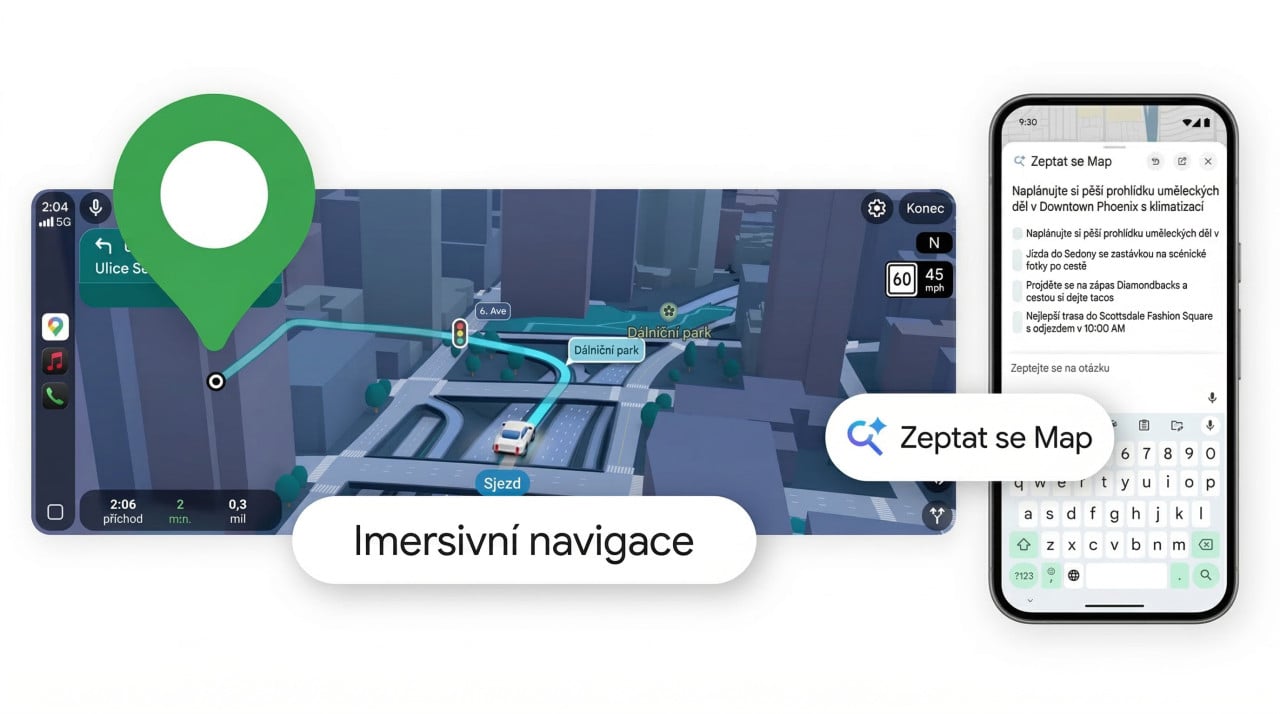
Google has radically reshaped what we expect from a navigation app. Two new tools have the potential to change how we move around the world. They are called Ask Maps and Immersive Navigation, and both are powered by Gemini AI. If you thought Google Maps was just a smart map with voice directions, this update will convince you otherwise.
Ask Maps: The end of searching, the beginning of conversation
Think about how many times you have sat in your car wondering: "Where nearby can I charge my phone without having to wait in line for coffee?" Or: "Where is the cheapest gas station nearby?" These are exactly the kinds of questions that Google Maps could not answer until now. You had to search through reviews, click from one place to another, and hope someone had mentioned what you needed in the comments.
Ask Maps changes all of that. The new feature, accessible via a button directly in the app, allows you to ask complex, natural questions and receive specific answers. It works like a conversation, not a keyword search.
Google has backed it with some truly powerful computing resources. The app draws on a database of more than 300 million places and reviews from a community of over 500 million users. This is an enormous source of information that Gemini can now search and process meaningfully within seconds. Planning a trip? You could ask: "I'm taking the kids to the Macocha Gorge. Can you recommend some fun stops along the way?" Maps will provide a route, estimated arrival times, and tips from real people, such as how to find a hidden hiking trail or where to get free admission.
Personalization that may surprise you a little
Ask Maps knows who you are. Or more precisely, it knows what you have searched for in the past and where you have been. If you ask: "My friends are coming from downtown, and we want to meet after work. Do you know a cozy place with a table for four at seven?" and you have regularly visited vegan restaurants in the past, Maps will automatically recommend places with vegan options. Without you having to mention it.
Google calls it personalization. Critics may call it something else. In any case, it is a feature that works based on your search history and saved places. Those who want to can take full advantage of it. Those who do not will at least have a smart guide without the personal context. Ask Maps has been available in the US and India since March 12 and is also planned to expand to Europe.
Immersive Navigation: A map that looks like the real world
The second major new feature is visual. And it is a big one. Google itself describes it as the biggest update to the navigation interface in more than a decade. Miriam Daniel, vice president of Google Maps, summed it up simply: "Our goal was to take the guesswork out of driving." Immersive Navigation provides a full 3D view of your route. Buildings, overpasses, terrain—all are displayed as they actually look. Gemini analyzes Street View imagery and aerial photographs to make the visualization as accurate and up to date as possible.
But it is not just about better-looking graphics. The app now highlights lanes, pedestrian crossings, traffic lights, and road signs at exactly the moment you need to see them. Approaching a complicated intersection? Maps will show it to you in advance, with enough time to prepare. Voice directions have also undergone a major transformation. Instead of the robotic "Turn right in 200 meters", you will hear something like: "Pass this exit and take the next one toward Ostrava." More natural, clearer, more human.
The end of last-mile stress
Anyone who has ever driven around their destination unable to find the entrance or parking lot will appreciate this. Google Maps now offers a preview of your destination before departure using Street View imagery. You will see what the place looks like, where the entrance is, where to park, and which side of the street to look on. As you approach your destination, the app highlights the building entrance, the nearest parking lot, and the side of the street you are on. From the final turn all the way to the door, without unnecessary confusion.
A new feature also shows drivers the trade-offs involved in choosing alternative routes. A longer journey with less traffic, or a faster one with tolls? Maps now tells you directly, without requiring you to guess. And every second, it processes more than 5 million traffic updates from around the world, so the data is truly fresh.
Alerts about accidents and roadworks arrive in real time, thanks to a community of drivers who submit more than 10 million reports every day.
When will it arrive here?
Immersive Navigation is rolling out gradually. It has been available in the US since March 12 and will expand to additional countries and eligible iOS and Android devices, CarPlay, Android Auto, and vehicles with Google built-in over the coming months.


