Chinese startup Moonshot AI launched the Kimi K3 model and within days found itself facing the kind of problem most companies would envy. Demand for the new model surged so sharply that the company had to suspend sales of new subscriptions. Its servers were running at the limit and computing capacity was insufficient. It is the world’s largest open model, with 2.8 trillion parameters, and in tests it is closing in on the best that American labs currently have to offer. And that has also shaken the stock markets.
Moonshot unveiled Kimi K3 at an artificial intelligence conference in Shanghai. The company described it as the first open 3T-class model, meaning it has nearly three trillion parameters. It also features a one-million-token context window and the ability to process images directly within the model’s core. The company plans to release the model weights—its internal settings, which anyone can download and modify—on July 27.
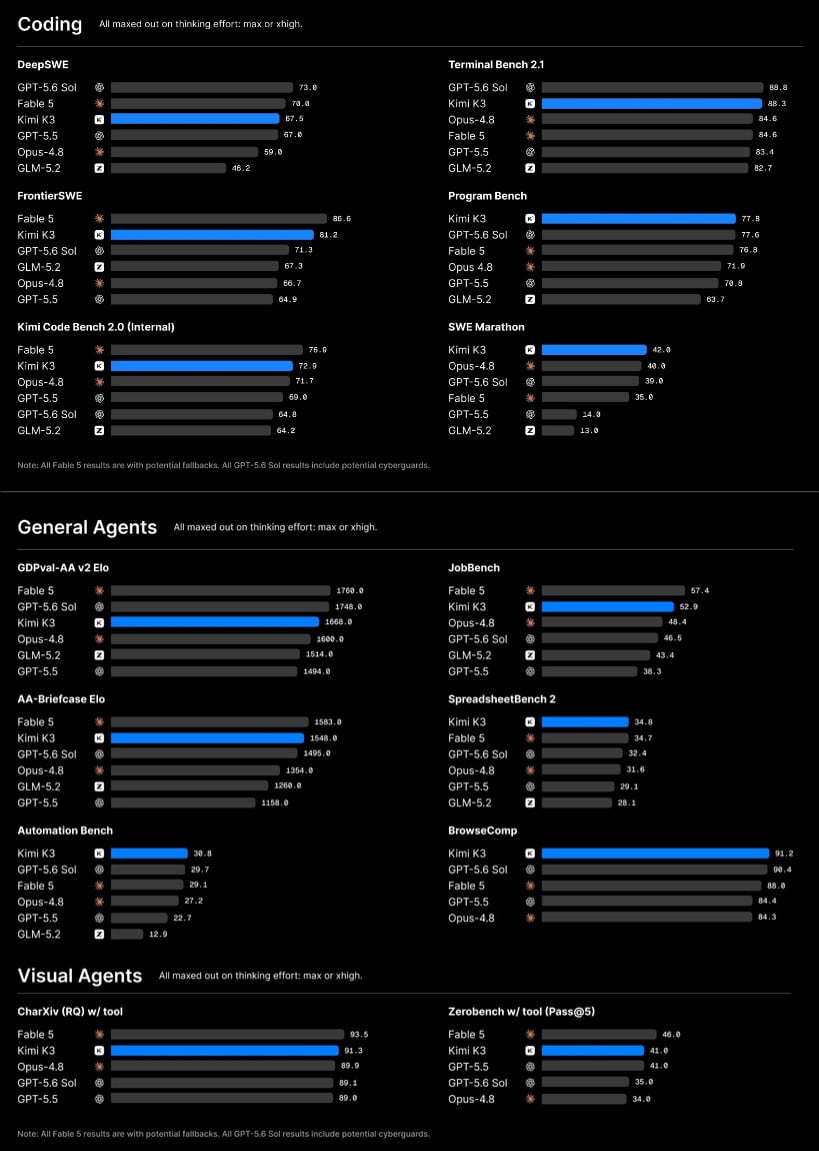
Moonshot itself acknowledges that in overall performance, Kimi K3 still trails the two strongest closed models, Anthropic’s Claude Fable 5 and OpenAI’s GPT 5.6 Sol. According to the company, however, it beats the rest of the tested field. Specifically, it outperformed Claude Opus 4.8 and GPT 5.5, models that are only a step behind the American leaders.
It has already caught up with its American competitors in programming
Kimi K3 attracted the most attention for its programming capabilities, although its lead is not quite as clear-cut as some headlines suggest. It finished first in the Program Bench test with a score of 77.8, narrowly ahead of GPT 5.6 Sol and Fable 5. It also holds first place in SWE Marathon. Elsewhere, however, the results are close. It finished second in Terminal Bench 2.1, a few tenths behind GPT 5.6 Sol; second in FrontierSWE behind Fable 5; and only third in the demanding DeepSWE test, behind both American favorites. Across the tested field, however, Kimi K3 reliably outperforms Claude Opus 4.8 and GPT 5.5.
It scored a truly convincing win elsewhere. In blind testing by evaluator Arena, developers preferred the Chinese model over every leading American competitor for frontend development. It finished first in six of seven categories, with only Fable 5 narrowly beating it in game development.
Moonshot also presents several impressive demonstrations. Kimi K3 reportedly completed in about two hours work that would take an experienced researcher one to two weeks. It reviewed more than twenty scientific papers, wrote three thousand lines of Python code, and created an interactive overview of the results. In another experiment, the model designed, optimized, and verified a chip based on its own architecture within a single session.
In terms of user experience, K3 still falls noticeably short of Fable 5 and Sol. The model tends to be overly proactive. When it encounters an ambiguous prompt, it sometimes makes its own decisions and does things no one asked it to do.
Strong demand for the model
Moonshot announced that in just two days after launch, user interest had sharply exceeded expectations and approached the limits of what its existing computing data centers could handle. The company therefore immediately halted sales of new subscriptions and redirected available capacity to existing paying customers. They were to remain unaffected by restrictions.
According to one overview, daily revenue jumped at least sixfold after launch, while the company’s annual recurring revenue climbed to three hundred million dollars. Moonshot is also preparing to split its membership into two plans, one of which will be dedicated solely to programming. Coding and agentic tasks generate many repeated queries and consume the most costly computing power.
Wall Street repeated the 2025 scenario
The market reaction was swift. Nvidia shares fell two percent on Friday as investors began reassessing how many AI chips are actually needed. The Philadelphia Semiconductor Index dropped by roughly ten percent over the week and lost more than twenty percent from its June record. The Nasdaq weakened by 1.4 percent on Friday. During trading, Apple briefly overtook Nvidia as the world’s most valuable publicly traded company as investors fled crowded chip positions.
It recalls January 2025, when China’s DeepSeek released an inexpensive model comparable to the leading American models of the time and Nvidia lost $589 billion in a single day. The market fell then and later recovered. Analysts now describe Kimi K3’s arrival more as an expected continuation of the trend than a shock. Chinese AI stocks also fell, however. In Hong Kong, Zhipu lost 28 percent and MiniMax 16 percent.
The concerns are justified. If Chinese companies can offer comparable artificial intelligence at a lower price, the need to buy expensive graphics cards in bulk may be lower than the market expected. This is compounded by U.S. restrictions on exports of advanced chips to China. Nevertheless, Moonshot trained its latest models on Nvidia H800 export chips.
Efficiency or brute force
Kimi K3 has reignited the debate over what will actually win the next phase of the AI race: raw computing power and massive infrastructure investment, or smarter use of memory and more efficient design. For Chinese companies, this question carries particular weight. If they can compete through efficiency rather than sheer chip volume, they can catch up with their American rivals despite limited access to the latest hardware.
At the same time, the price is nowhere near as low as is customary for Chinese models. Users pay fifteen dollars per million output tokens, putting it closer to the mid-range tier of American models than to the usual Chinese discounts. The real test will come on July 27, when Moonshot releases the model’s complete weights. From that moment, anyone will be able to download, run, and examine Kimi K3 themselves.
Moonshot CEO Yang Zhilin has led the company since 2023. The startup is one of the so-called Chinese AI tigers, well-funded domestic labs that have grown into genuine competitors to American companies. In May, Moonshot raised more than two billion dollars from investors, bringing the company’s total funding to more than $5.5 billion. It is now seeking another two billion, and in June its valuation climbed to thirty billion dollars. At the same time, it is preparing for an initial public offering in Hong Kong.
Sources: reuters.com and bbc.com