

French company Mistral AI has announced the official availability of Mistral Vibe 2.0, a significantly improved version of its terminal-based coding agent. It marks the Parisian startup's most aggressive entry into the AI software development assistant market, where it directly competes with American giants such as GitHub Copilot, Anthropic's Claude Code, and Google's Gemini CLI.
The release comes just days after Mistral CEO Arthur Mensch told Bloomberg Television at the World Economic Forum in Davos that the company expects to exceed €1 billion (approximately CZK 25 billion) in revenue by the end of 2026. Although this would still leave Mistral far behind its American competitors, it would solidify the company's position as Europe's leading representative in artificial intelligence.

From testing to a paid model
"The announcement is more of an upgrade and general availability," Timothée Lacroix, Mistral's co-founder, said in an exclusive interview with VentureBeat. "In December, we created Devstral 2, and at that time we released the first version of Vibe. Everything was free and in testing. We have now finalized and improved the CLI and are moving Mistral Vibe to a paid plan included in our Le Chat plans."
Mistral Vibe 2.0 is available through two subscription tiers. The Le Chat Pro plan costs $14.99 (approximately CZK 380) per month and provides full access to Vibe CLI and the Devstral 2 model, with students receiving a 50% discount. The Le Chat Team plan, priced at $24.99 (about CZK 630) per user per month, adds unified billing, administrative controls, and priority support for organizations.
Both plans include generous usage limits for continuous development work, with the option to continue beyond those limits through pay-as-you-go pricing based on API rates. The underlying Devstral 2 model, previously offered free of charge through Mistral's API during the testing period, is now moving to paid access priced at $0.40 per million input tokens and $2.00 per million output tokens.
New features
The updated Vibe CLI introduces several features designed to give developers more granular control over how the AI agent operates. Custom subagents allow organizations to create specialized AI agents for targeted tasks—such as deployment scripts, pull request reviews, or test generation—that can be invoked on demand instead of relying on a single universal assistant.
Multiple-choice clarification represents a departure from the behavior of many AI coding tools, which attempt to infer a developer's intent when instructions are ambiguous. Instead, Vibe 2.0 prompts users with options before taking action, reducing the risk of unwanted code changes. Slash-command skills allow developers to load preconfigured workflows for common tasks such as deployment, linting, or documentation generation through simple commands.
Unified agent modes allow teams to configure custom operating modes that combine specific tools, permissions, and behaviors, enabling developers to switch contexts without switching between different applications. The tool now also comes with continuous updates through the command line, eliminating the need for manual version management.
Focus on enterprise legacy code
Mistral is betting that its open-source approach, combined with extensive customization capabilities, will appeal to organizations concerned about sending proprietary code to third-party providers. The strategy targets a specific problem that Lacroix says affects enterprises with legacy systems. "The codebases that large enterprises work with are extensive and have been built over years and years and have not seen the web," Lacroix explained. "They potentially rely on large libraries or large domain-specific languages that typical language models are unfamiliar with. And so what we are able to do with Vibe CLI and our models is customize them to the customer's codebase and its specific intellectual property to provide an improved experience."
This customization capability addresses a limitation that frustrates many enterprise technology leaders: universal AI coding assistants trained on public code repositories often struggle with proprietary frameworks, internal coding conventions, and domain-specific languages that exist only within corporate walls.
Smaller, denser models challenge the "bigger is better" assumption
The Devstral 2 family of models that powers Vibe CLI is Mistral's bet that smaller, more efficient models can compete with—and in some cases outperform—massive systems built by better-funded American rivals. Devstral 2, a dense transformer with 123 billion parameters, achieves 72.2% on SWE-bench Verified, a widely used benchmark for evaluating the ability of AI systems to solve real-world software engineering problems.
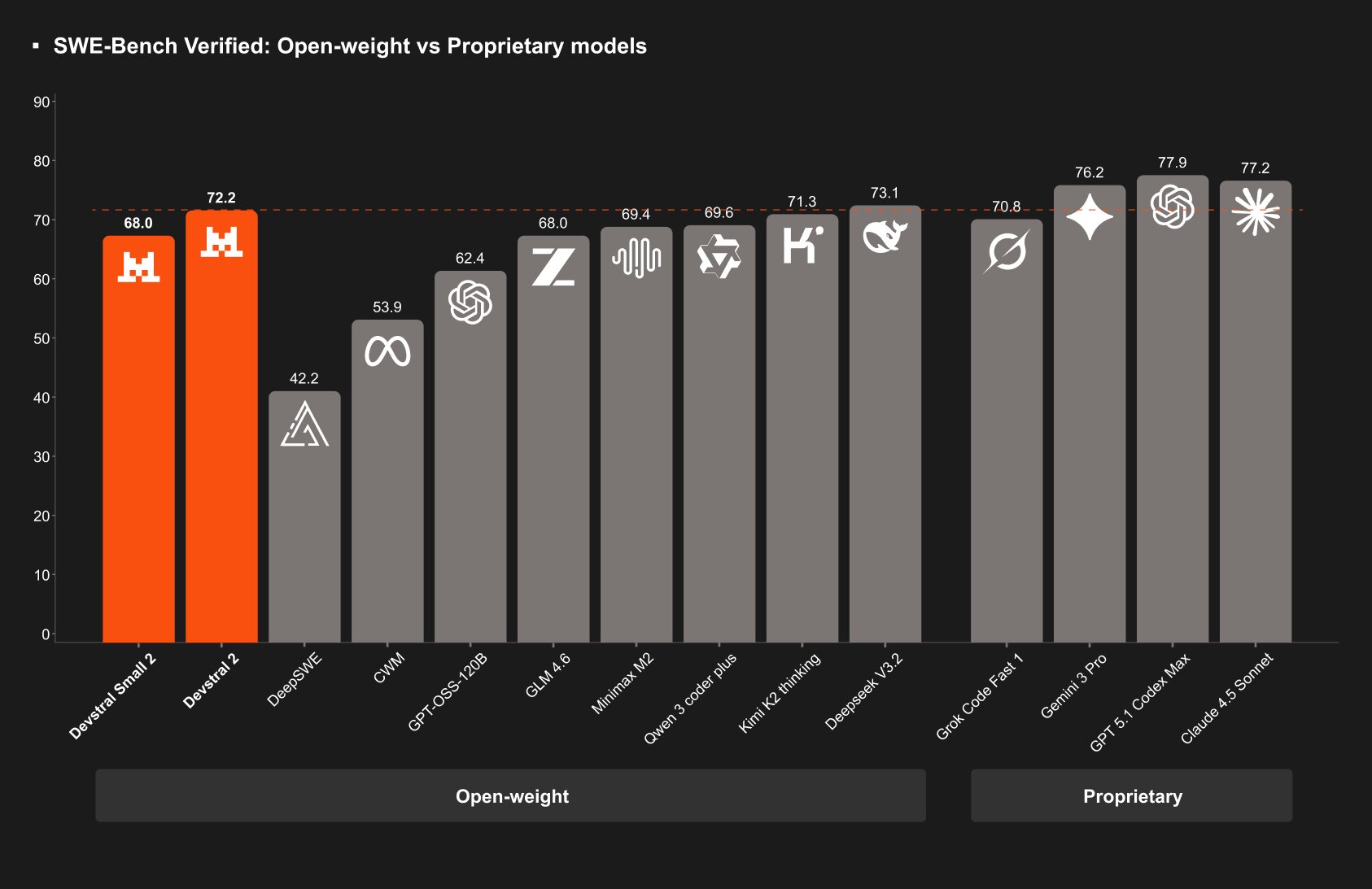
Perhaps more significantly for enterprise deployment, the model is approximately five times smaller than DeepSeek V3.2 and eight times smaller than Kimi K2—Chinese models that have attracted attention by matching American AI systems at a fraction of the cost. The smaller Devstral 2 Small, with 24 billion parameters, can run on consumer hardware, including laptops. "These two models are dense, which also means—the small model is something that can run on a laptop, which is great if you're working on a train," Lacroix noted. "But the fact that the larger model is also dense is interesting for on-premises or more resource-constrained use, where it is easier to achieve efficient utilization of a dense model rather than a large mixture of experts, and it requires less hardware to get started."
Banks want AI that never leaves their walls
For regulated industries—particularly financial services, healthcare, and defense—the question of where AI models run and who has access to the data they process is not merely technical, but existential. Banks cannot send proprietary trading algorithms to external AI providers. Healthcare organizations face strict regulations concerning patient data. Defense contractors operate under security clearances that prohibit sharing sensitive information with foreign entities.
Lacroix suggests that on-premises deployment capability, while important, is secondary to a more fundamental concern about ownership and control. "The fact that it is on-premises, I think, is less relevant than the fact that it is actually owned by the company and that it is wherever they feel safe moving this data—as in, they are not sending the entire codebase to a third party," he said. "I think that is important."
Mistral CEO rejects the idea that China is lagging behind in artificial intelligence
Mistral's positioning as a European alternative to American AI giants is gaining significance amid rising geopolitical tensions. At the World Economic Forum, Mensch was characteristically direct about the competitive landscape and dismissed claims that Chinese AI development is lagging behind the United States as a "fairy tale." "China is not behind the West," Mensch said in his interview with Bloomberg Television. The capabilities of Chinese open-source technology, he added, are "probably stressing CEOs in the US."
Mistral raised €1.7 billion in September, with Dutch semiconductor equipment giant ASML joining as a key investor, valuing Mistral at €11.7 billion (approximately CZK 295 billion).
You can watch related videos about Mistral Vibe 2.0 on their YouTube channel here.
Additional source: venturebeat.com


