

On February 1, a bombshell called MiniMax M2.5 hit the market. While giants like OpenAI and Anthropic are battling over who has the smarter model, MiniMax has changed the rules of the game. Its new model is not only powerful—it is also ridiculously cheap. How cheap? For one dollar, it runs continuously for an entire hour at a speed of 100 tokens per second. It is like hiring a programmer who works 24/7 and costs you less than a cup of coffee.
When AI Writes Code Faster Than Humans
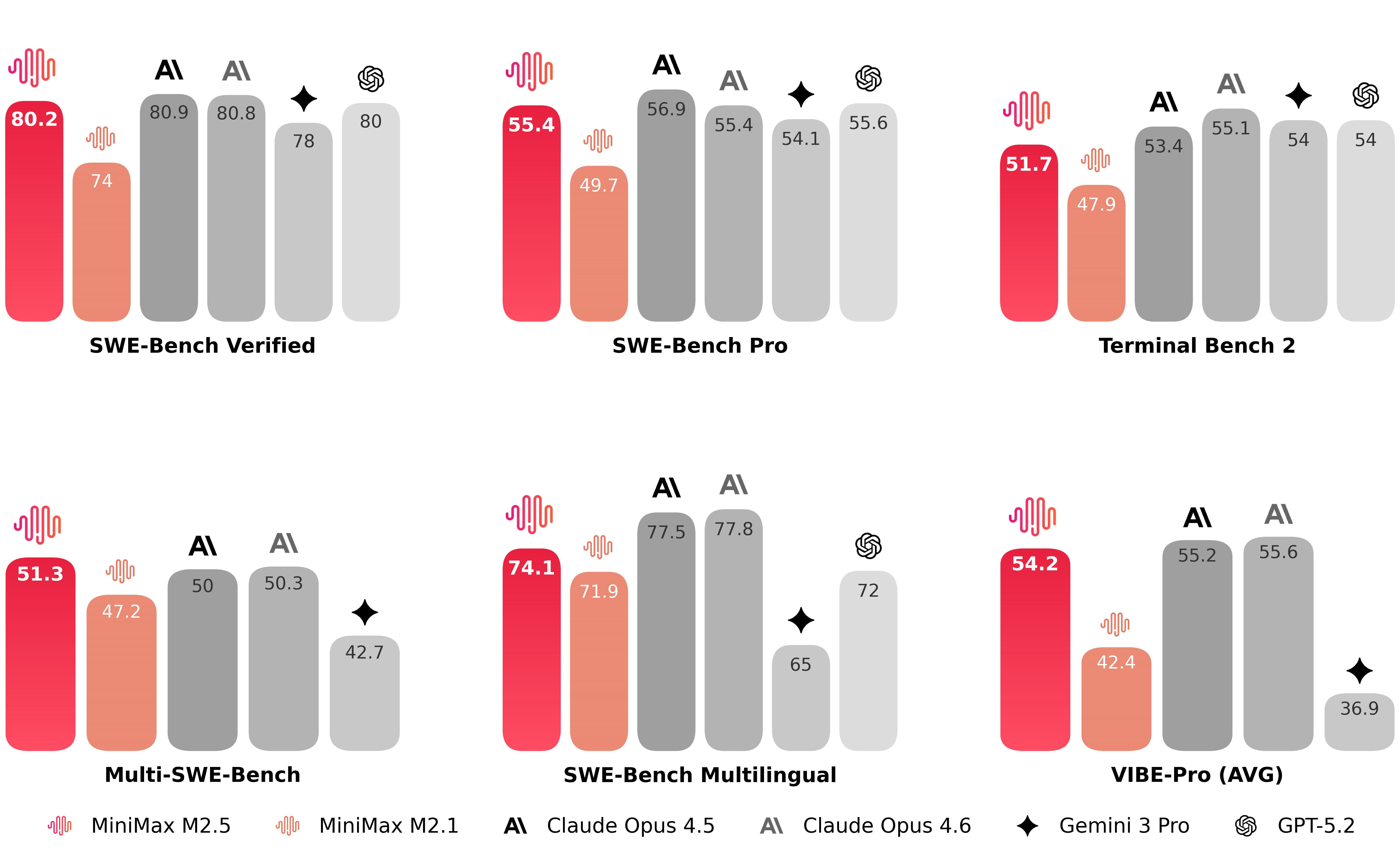
M2.5 has achieved something other models can only dream of. In the SWE-Bench Verified benchmark, it achieved an 80.2% success rate. What does that mean in practice? The model can fix real bugs in code, design the architecture of entire systems, and write applications from scratch. And not just in Python—it supports more than 10 programming languages, including Go, Rust, TypeScript, and Kotlin.
But here comes the crazy twist. MiniMax trained its model in 200,000 real-world environments. Not in simulations, not on synthetic data. In real projects. The model learned to write code like a senior developer—first breaking down the problem and designing the architecture, and only then starting to program.
Speed That Will Blow You Away
M2.5's speed is staggering. It completes tasks in the SWE-Bench benchmark 37% faster than its predecessor, M2.1. It matches Claude Opus 4.6, but costs just one-tenth as much. Imagine having four instances of this model running non-stop for an entire year. How much would that cost you? Ten thousand dollars. For the whole year. Four AI agents working without a break.
Why is it so cheap? MiniMax built its entire infrastructure around efficiency. The model runs natively at 100 tokens per second—twice the speed offered by the competition. At the same time, it has been taught to think economically. It does not solve problems through brute force, but intelligently. It uses fewer steps and fewer tokens while still achieving better results.
What Does MiniMax M2.5 Really Excel At?
- Office work? No problem
To understand this properly, we need to look at how MiniMax trained its model for office work. It did not rely solely on internet data. It brought in senior experts from finance, law, and the social sciences. They designed tasks, evaluated outputs, and taught the model how real work is done in Excel, Word, and PowerPoint.
The result? M2.5 can create a financial model based on your company's specific standards. It can write a research report with perfect formatting. It can put together a presentation that looks as though it was created by someone with ten years of experience. In the internal GDPval-MM benchmark, it achieved an average success rate of 59% against other models. - When AI Searches Like a Professional
Searching the internet sounds simple, right? But try finding the answer to a complex technical question. You have to browse dozens of pages, filter information, and verify sources. M2.5 does it like an expert. In the BrowseComp benchmark, it achieved 76.3% with context management. This means it can navigate complex websites, extract relevant data, and assemble it into a meaningful answer.
And here is another trick—the model has learned to be efficient. While its predecessor M2.1 needed more steps to solve a task, M2.5 can do it with 20% fewer steps. It does not search blindly. It knows what it is looking for and heads straight toward the goal. - MiniMax Agent: AI as a Colleague
MiniMax has deployed M2.5 in its MiniMax Agent product. And this is where things start to get really interesting. Users can create their own "Experts"—specialized AI assistants for specific tasks. Want an AI that conducts market research using your company's framework? No problem. Need an assistant that creates financial models according to your standards? Done.
So far, users have created more than 10,000 of these Experts. And that number is growing rapidly. MiniMax itself uses its model internally—AI handles 30% of all tasks at the company. In programming, it is even crazier: 80% of newly written code comes from M2.5.
A Race Against Time
Over the past three and a half months, MiniMax has released three models: M2, M2.1, and now M2.5. Its pace of improvement is faster than that of competitors such as Claude, GPT, and Gemini. In the SWE-Bench Verified benchmark, it is improving faster than anyone else.
What is behind it? Reinforcement learning on steroids. MiniMax created hundreds of thousands of training environments based on real tasks performed at the company. It built its own framework called Forge, which can train the model on different agents and tools simultaneously. The result? A 40x increase in training speed.
We are witnessing something big. AI is no longer a luxury toy for large companies. When a model costs one dollar per hour to run, anyone can afford it. Small startups. Freelancers. Students. Anyone who needs an intelligent assistant that never sleeps, never complains, and works for pennies.


