

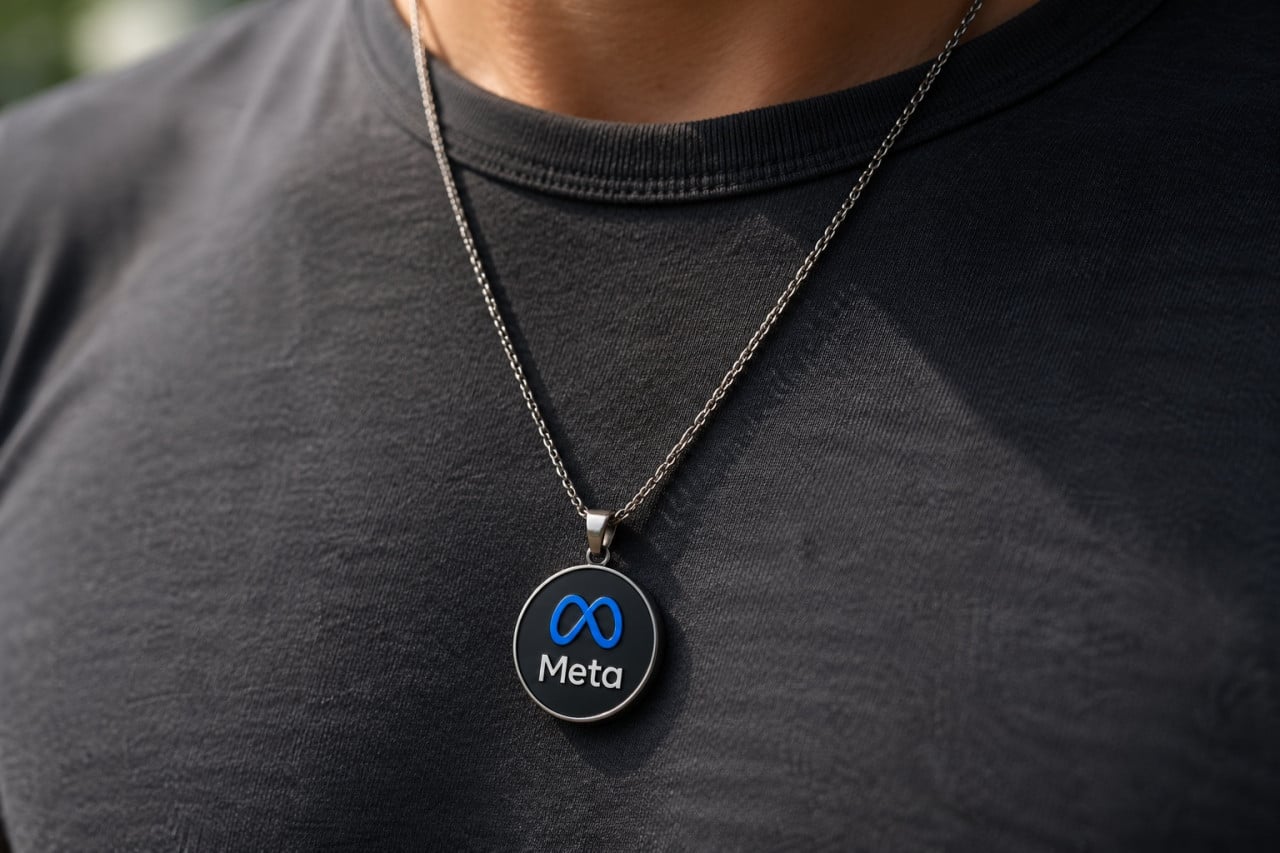
Zuckerberg's company wants wearable technology to stop being just an expensive experiment and start generating real revenue. At the heart of this plan is a device that you clip to your shirt or wear around your neck. It is intended to be an AI pendant that listens to what you say all day and then turns it into a summary for you.
The Information was the first to see an internal document written by Alex Himel, Meta's vice president responsible for wearable technology. What does the report reveal? Meta wants to sell 10 million wearable devices by the second half of 2026. It plans to expand its range of smart glasses, launch a subscription for business customers, and test the pendant at the same time.
The story of this device began before Meta even started developing it. At the end of 2025, it acquired the startup Limitless, which sold a clip-on device literally called Pendant. Users clipped it to their clothing, the device recorded everything happening around them, and then created transcripts, summaries, and a searchable database of their entire day.
When the company was sold, then-Limitless CEO Dan Siroker said that Meta's vision of "personal superintelligence" through wearable technology aligned perfectly with what his team had been working on. At the time, Meta described the acquisition as a way to accelerate the development of "AI-powered smart wearable devices."
Four new glasses models and a subscription for businesses
But the pendant is not the only thing Meta is working on. The report mentions four new smart glasses models that are expected to be released by the end of this year. Their working names? Modelo, Luna, RMB2 Refresh, and Mojito VIP. The third is apparently the next generation of Ray-Ban glasses, while the other three remain shrouded in secrecy.
The company is certainly no newcomer to the smart glasses market. In 2025, it sold more than seven million pairs of AI-powered Ray-Ban glasses and holds approximately 82 percent of the entire smart glasses market. In the spring, it added two new models designed specifically for people who wear prescription glasses, Blayzer and Scriber, starting at $499. So the foundation is already there.
Alongside the hardware, Meta is also preparing a new service called Wearables for Work. It will be a subscription aimed at business customers, offering features such as meeting transcription and integration with workplace platforms. This is no surprise. At the same time, Meta launched paid consumer plans for Instagram and WhatsApp. Hardware does not make enough money without recurring revenue.
The graveyard of AI gadgets
Wearable AI devices have their own graveyard. The Humane AI Pin burned through hundreds of millions of dollars and failed. Rabbit R1 faded into obscurity. Why should things be any different with Meta?
Meta's position is structurally different from those earlier attempts. It is not entering an untested market empty-handed. It comes with a functioning business, customers who actually wear smart glasses, and a partnership with EssilorLuxottica, the manufacturer of Ray-Ban and Oakley glasses. The pendant is not starting from scratch, but building on something people already buy willingly. Mashable remarked somewhat sarcastically that soon everything you wear on your body will be made by Meta.
However, all this optimism needs to be placed in the context of less encouraging figures. Reality Labs, the division that includes wearable technology, reported a loss of more than four billion dollars in the first quarter of 2026 alone, on revenue of less than $400 million. Since its creation, Reality Labs' losses have climbed to nearly $80 billion.
The pendant, glasses, and business subscription all need to prove that wearable AI technology is something people genuinely want to keep with them at all times. And that the people around them are willing to tolerate it.
Sources: techfundingnews.com and mashable.com


