

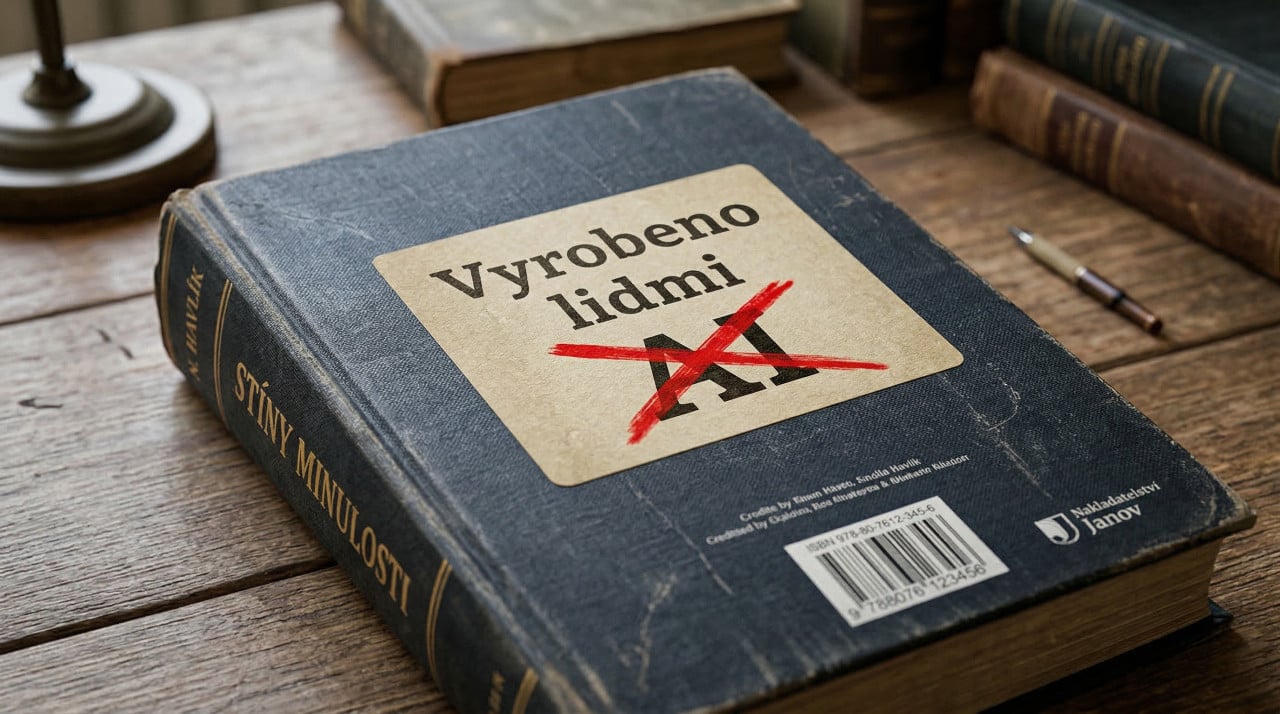
Remember the Fair Trade logo? The symbol on chocolate or coffee that tells us the people behind the product were paid fairly? Something similar is now happening in the world of books, films, music, and advertising. Organizations around the world are competing to create a universal label for content "made by humans". And behind it all lies one major fear: that artificial intelligence will quietly consume entire industries before we even realize it.
Labels such as "Proudly Human", "Human-Made", or "AI-free" are beginning to appear on movie posters, book covers, and websites. It is a response to the real threat that entire professions could disappear under the pressure of automation powered by generative artificial intelligence.
Eight initiatives, one goal, zero consensus
BBC News found that at least eight different initiatives are currently operating around the world, each trying to establish its own version of an "AI-free" certificate. They include companies and nonprofit organizations from the United Kingdom, Australia, and the US. Each has different rules, different visuals, and a different approach to verification. And that is precisely where the problem lies.
Consumer expert Dr. Amna Khan of Manchester Metropolitan University was clear: "AI is causing significant confusion, and competing definitions of what is 'made by humans' are confusing consumers. A universal definition is essential for building trust."
Some labels, such as no-ai-icon.com or notbyai.fyi, can be downloaded for free by anyone without any verification. Other systems, such as aifreecert, require payment and a rigorous audit by professional analysts. But even that is not enough. How exactly do you define "AI-free" when artificial intelligence is built into text editors, translation tools, or photo-editing software?
Research scientist Sasha Luccioni warns that an "AI or no AI" approach is too simplistic. "AI is now so ubiquitous that it is really difficult to determine what 'AI-free' means. We need more comprehensive certification systems, not just a binary approach," she says. Some experts therefore propose drawing a more specific line: a ban on generative AI, meaning tools that create text, code, music, or video based on human prompts. That is a different category from automatic typo correction, for example.
A film that boasts it was not made by a machine
One of the first prominent gestures came from the 2024 thriller Heretic, starring Hugh Grant. In the closing credits, the producers wrote: "No generative AI was used in the making of this film." A small sentence with a big message. British distributor The Mise en scène Company followed suit, adding a "No AI was used" stamp to the poster for its latest film. CEO Paul Yates explains it pragmatically: "We believe that human-created content has added economic value, and we want to capitalize on it."
At the other end of the spectrum is the Bollywood studio Intelliflicks, which instead boasts of producing films exclusively with generative AI. Faster, cheaper, without actors, without a crew. And it is precisely this reality that is driving the entire human certification movement.
Books, music, photography: The battle is expanding
The publishing world faces the same dilemma. Publisher Faber and Faber has begun printing a "Human Written" stamp on some books. Author Sarah Hall requested it for her novel Helm and described the theft of books used to train AI models as "creative theft on an industrial scale".
British company Books by People goes even further. It grants its own certificate to publishers who pay for an audit and regularly checks book samples for AI-generated writing. Co-founder Esme Dennys describes the situation: "Readers can no longer be certain whether a book reflects human experience or a machine imitation."
Australian company Proudly Human aims to build the strictest certification system in the world. Auditors examine every stage of the publishing process. Company head Alan Finkel is convinced that: "Self-declaration is not enough. That is why we have a full verification process to ensure that the material is genuinely of human origin." The company plans to expand into music, photography, and animation.
Does it matter?
It might seem like nothing more than a marketing gimmick. But behind it all lies a deeper question: Do we want to know what we consume? The case of the band Velvet Sundown last year showed how easily audiences can be deceived. The group became a viral phenomenon before it emerged that it had been generated entirely by artificial intelligence. No people, no stories, no emotions.
Without a unified certification system, we will continue to be left in the dark. Eight different logos, eight different standards, no real certainty. For now, we will have to wait and see when such a certification emerges, who ultimately succeeds in establishing it, and whether the world embraces it before it is too late.
Additional sources: thenews.com


