

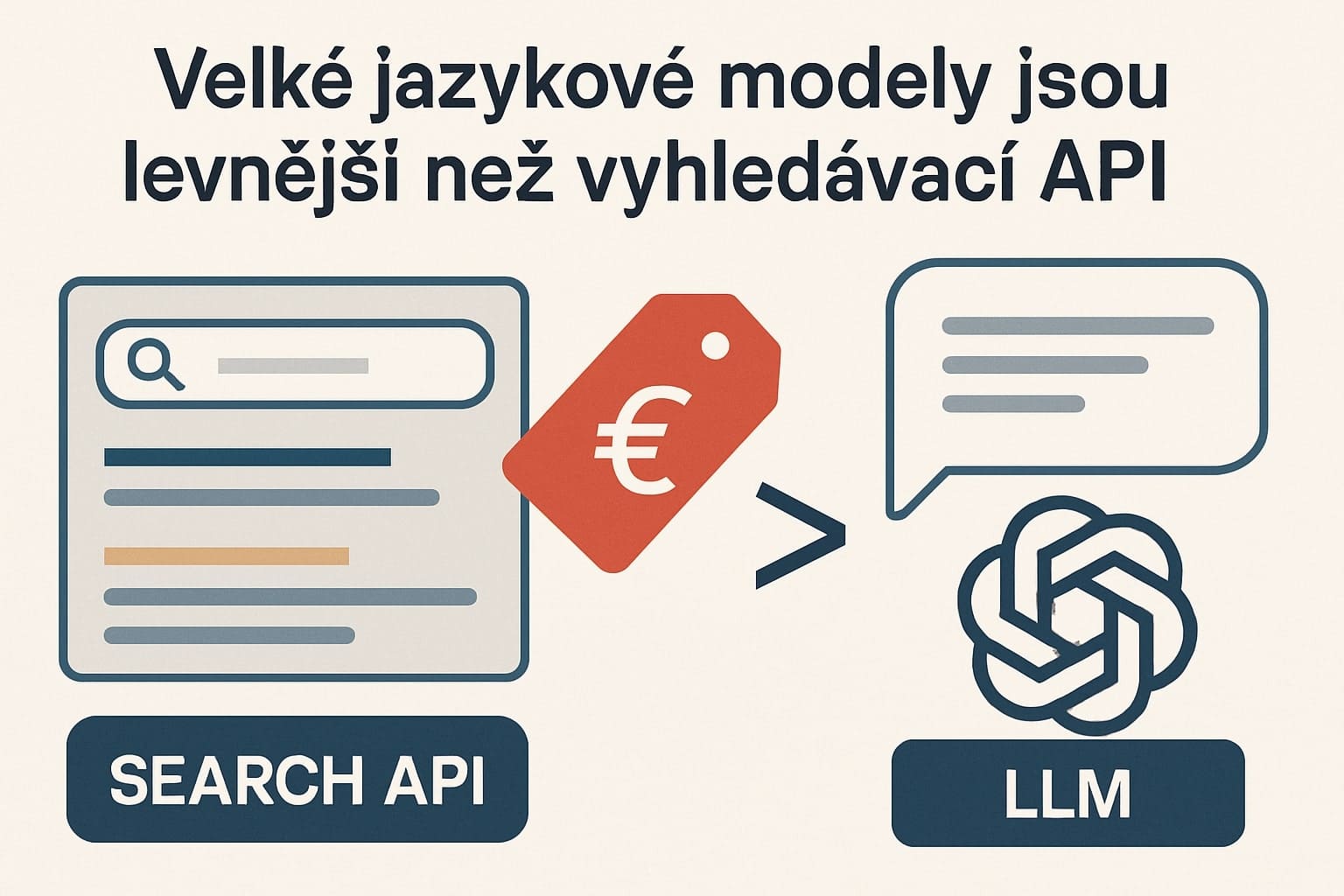
Large Language Models Are Cheaper Than Search APIs: A Cost Comparison in 2025
The Dramatic Price Difference Between LLMs and Traditional APIs
An analysis published on the Snellman.net blog in June 2025 reveals a surprising fact: large language models are dramatically cheaper than traditional search APIs. A direct comparison shows that using LLMs costs approximately $0.60 per 1,000 queries, while Bing's search API charges $15 for the same number of queries. This 25-fold price difference represents a fundamental shift in the economics of technology services.
The price gap is even more pronounced when compared with other search service providers. The Gemini API costs $35 per 1,000 queries, which is almost 60 times the cost of LLMs. Even the cheapest option from Brave, which offers a plan priced at $5 per 1,000 searches, is still more than 8 times as expensive as using large language models.
The True Cost of Infrastructure
The study from the Snellman.net blog notes that the total cost of LLMs includes not only the use of the model itself, but also additional factors such as infrastructure and orchestration. However, these added costs do not come close to closing the price gap between LLMs and traditional search methods. Even with these additional expenses, large language models remain the more economical choice.
Infrastructure costs include hosting, server management, and other technical requirements necessary to operate LLM services. Orchestration covers the coordination of the system's various components and the management of data flows. Although these factors increase the total cost, the resulting price still remains significantly below that of traditional search APIs.
Cost-Effective Batch Request and Discount Models
Batch requests offered by leading AI service providers represent a significant cost-saving opportunity. Anthropic, Google, and OpenAI all provide a 50% discount for batch requests, which can reduce LLM costs even further. This model is particularly advantageous for applications that do not require immediate responses and can tolerate some delay.
Batch requests work by allowing the system to process multiple queries at once during off-peak periods, when computing capacity is less expensive. This flexibility in request timing enables even greater savings and makes LLMs even more affordable for processing large volumes of data. Some providers also offer additional discounts for off-peak usage.
Variety in Providers' Pricing Structures
The search API market exhibits considerable variation in pricing structures among individual providers. While the Bing API charges $15 per 1,000 queries, Brave offers the cheapest plan at $5 per 1,000 searches. At $35 per 1,000 queries, the Gemini API is the most expensive option in this comparison.
This pricing diversity among traditional search services contrasts with the relatively consistent and low price of LLMs. Users of traditional APIs must carefully consider which provider offers the best value for money, while LLMs are generally highly affordable regardless of the specific provider.
Practical Implications for Developers and Businesses
The cost advantage of LLMs has a direct impact on the decisions developers and businesses make when selecting technology solutions. At a cost of just $0.60 per 1,000 queries, smaller businesses and startups can take advantage of advanced AI capabilities without placing a significant burden on their budgets. This affordability is changing the rules of the game in technological innovation.
The cost comparison also shows that LLMs offer not only a lower price, but often more comprehensive functionality than simple search APIs. While traditional search services primarily provide links to relevant content, LLMs can generate direct answers, analyze context, and provide sophisticated natural language processing at a fraction of the cost of competing solutions.


