Introducing the RoboBrain 2.0 AI Model
In early June, the Beijing Academy of Artificial Intelligence (BAAI) unveiled RoboBrain 2.0, an open-source AI model designed specifically to enhance the capabilities of humanoid robots in China. The model is described as the world's most advanced open-source "embodied brain," aiming to improve various types of robots, including humanoids, by addressing challenges such as limited model capabilities and a lack of training data. RoboBrain 2.0 represents a significant technological advancement in robotic intelligence and confirms China's growing ambition to become a global leader in artificial intelligence and robotics.
Features and Purpose of the Universal AI "Brain"
RoboBrain 2.0 serves as a universal AI "brain" for robots, enabling the creation of smarter and more adaptable machines across multiple sectors, such as healthcare, manufacturing, and services. The model was designed to provide robots with advanced decision-making capabilities, the ability to adapt to new situations, and the capacity to learn from various environments. By making RoboBrain open-source, BAAI encourages collaboration among researchers, developers, and industry partners both in China and around the world. This community-driven approach is intended to accelerate innovation and adoption in China's rapidly growing robotics industry.

Strategic Partnerships and Future Plans
At the launch event, BAAI Director Wang Zhongyuan highlighted partnerships with more than 20 leading companies and expressed a desire to expand collaboration further to support growth in "embodied intelligence." This strategy reflects China's efforts to build an extensive ecosystem around robotics technology, where various participants can contribute to the development and improvement of AI models. RoboBrain's open-source nature aligns with global trends toward transparency and collaboration in artificial intelligence research, potentially strengthening China's international standing in AI and robotics.

Outstanding Results Compared with Competitors
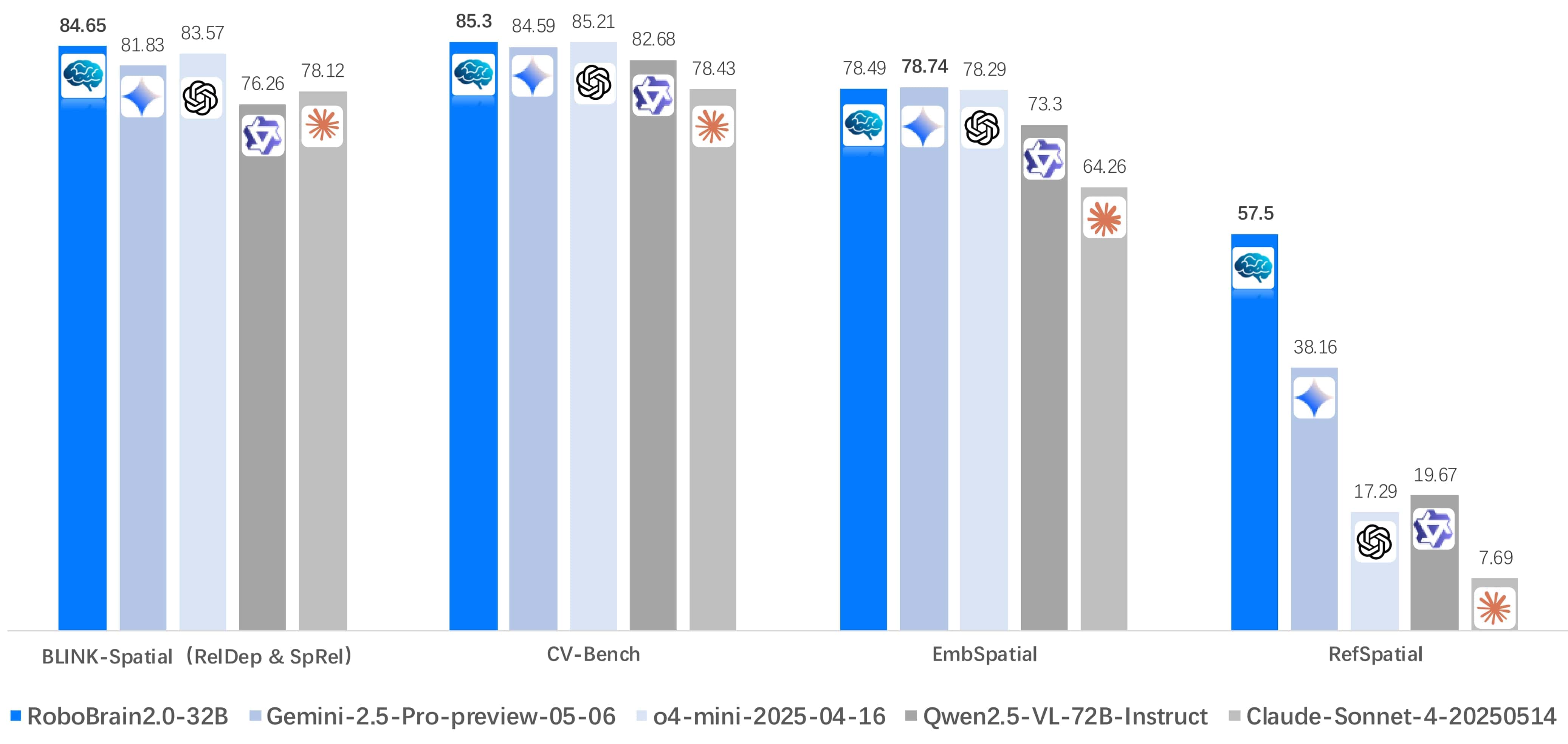
RoboBrain 2.0 achieves remarkable results in benchmark tests, clearly outperforming both open-source and closed-source competing models. Across four key embodied intelligence tasks, RoboBrain2.0-32B achieves the best results in its category, significantly surpassing models such as GPT-4V, Claude3, LLaVA-1.5, LLaVA-OneVision-7b, Qwen2-VL-7b, and RoboMamba across multiple robotics benchmarks, including OpenEQA, ShareRobot, and RoboVQA. Particularly impressive are its results in affordance prediction, where RoboBrain outperforms Qwen2-VL-7B by 14.6 AP and LLaVA-NeXT-7B by 17.3 AP on the AGD20K test set, demonstrating its superior ability to understand the physical properties of objects. In robotic manipulation, the model outperforms both open-source models such as LLAVA-OV-7B and InternVL2-8B, as well as closed-source solutions, confirming its position as a leading AI model in robotics with exceptional spatial reasoning and task-planning capabilities.