

Llama 4: Meta Unveils a New Generation of Multimodal AI Models
Meta AI has just released its new generation of AI models, which could change the game. What does Llama 4 bring, and why should you care?
A New Era of Multimodal Artificial Intelligence
The past weekend brought changes in the field of artificial intelligence. Meta (formerly Facebook) introduced its new generation of language models, which it calls “Llama 4.” This is not just another iterative improvement – Meta claims that it marks “the beginning of a new era of natively multimodal AI innovation.” What does that mean? Simply put, these models can work not only with text but also with images – all within a single integrated system. Imagine it as an AI that sees and understands the world similarly to us.
Meet the Llama 4 Family
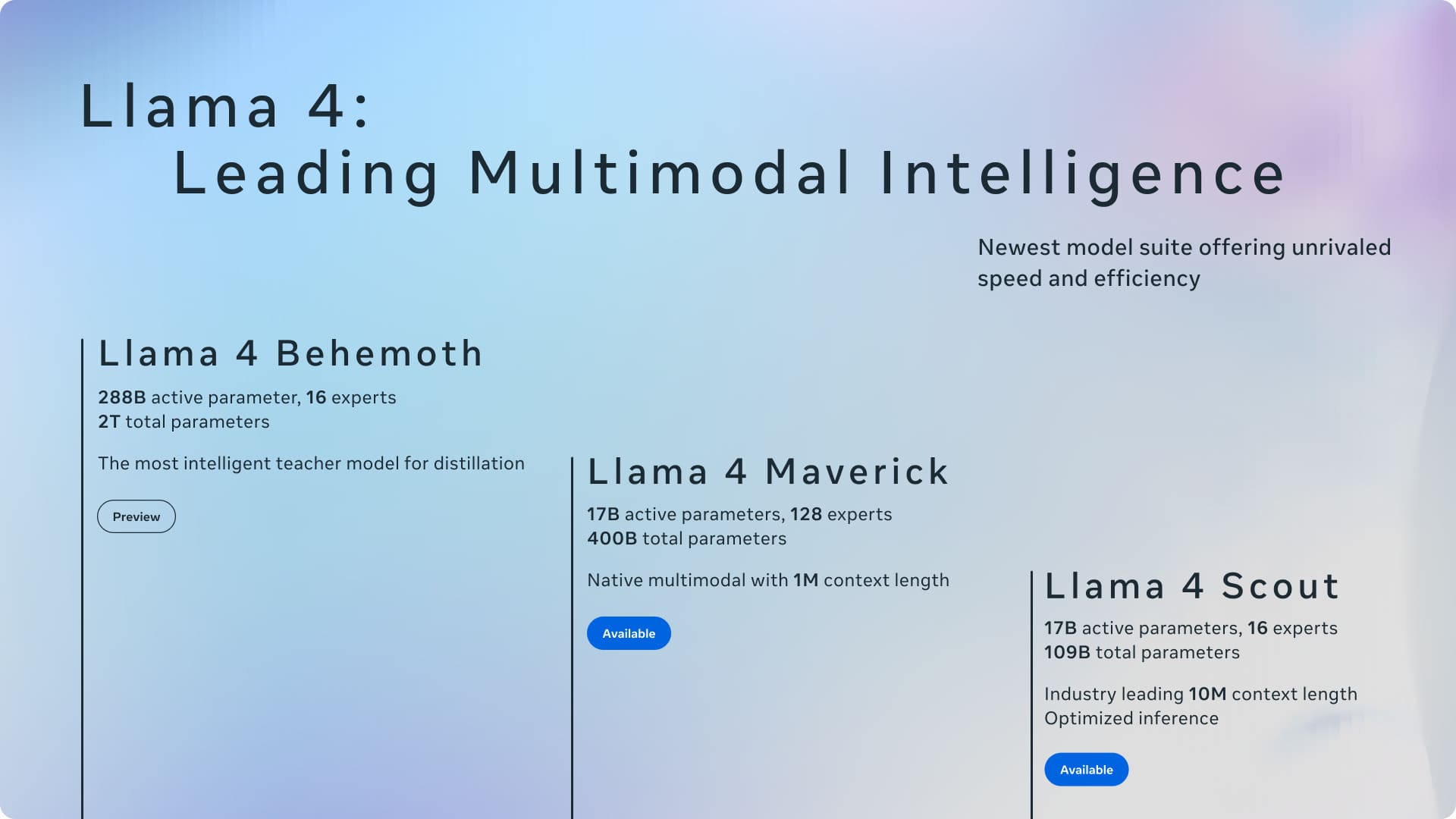
Meta introduced two models that are immediately available:
Llama 4 Scout
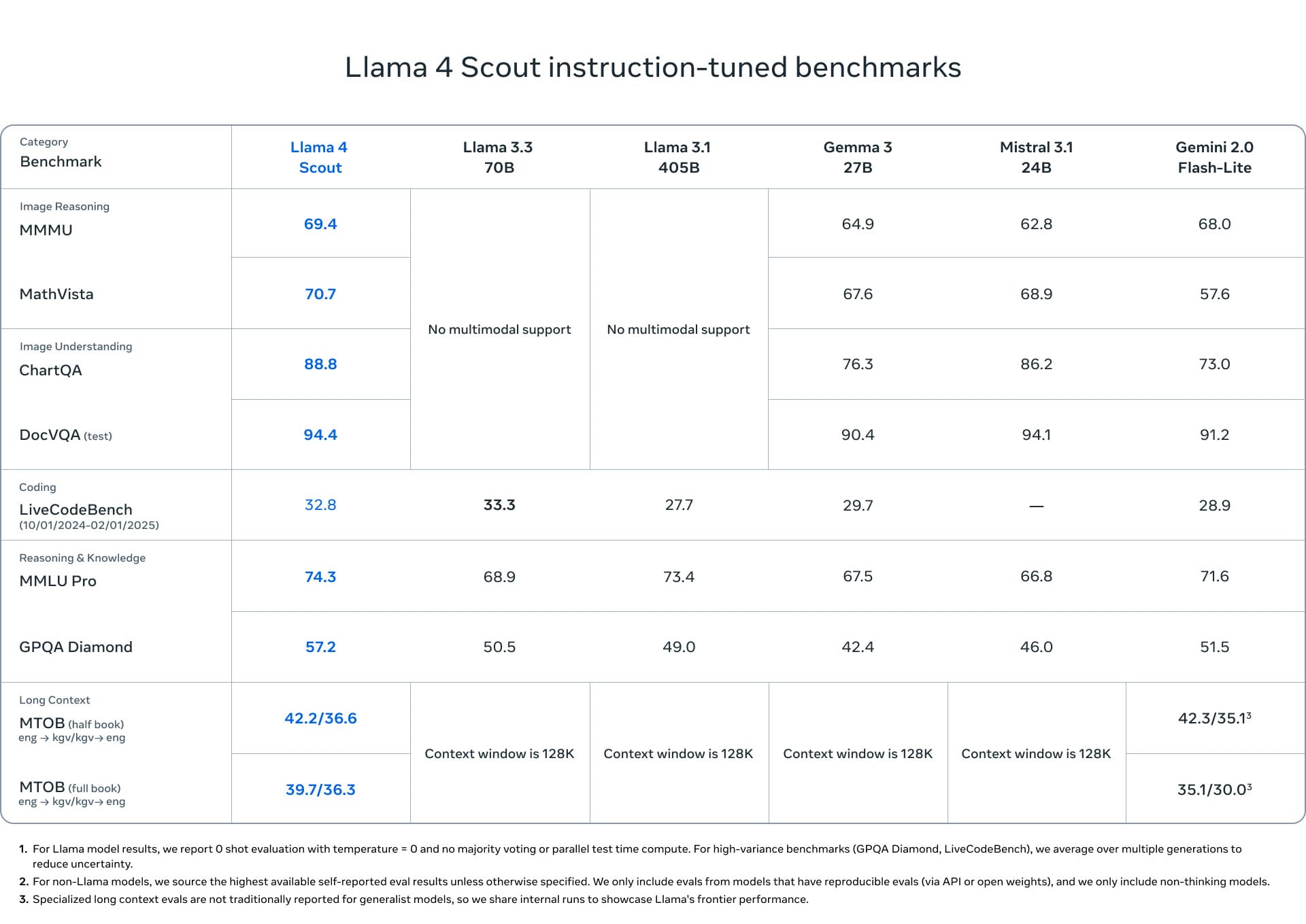
A smaller but exceptionally capable model with 17 billion active parameters using 16 expert modules (109 billion parameters in total). Scout boasts:
- Exceptional performance-to-size ratio
- The ability to run on a single NVIDIA H100 GPU chip (with Int4 quantization)
- An astounding context window of up to 10 million tokens (about 33x more than Llama 3!)
Llama 4 Maverick
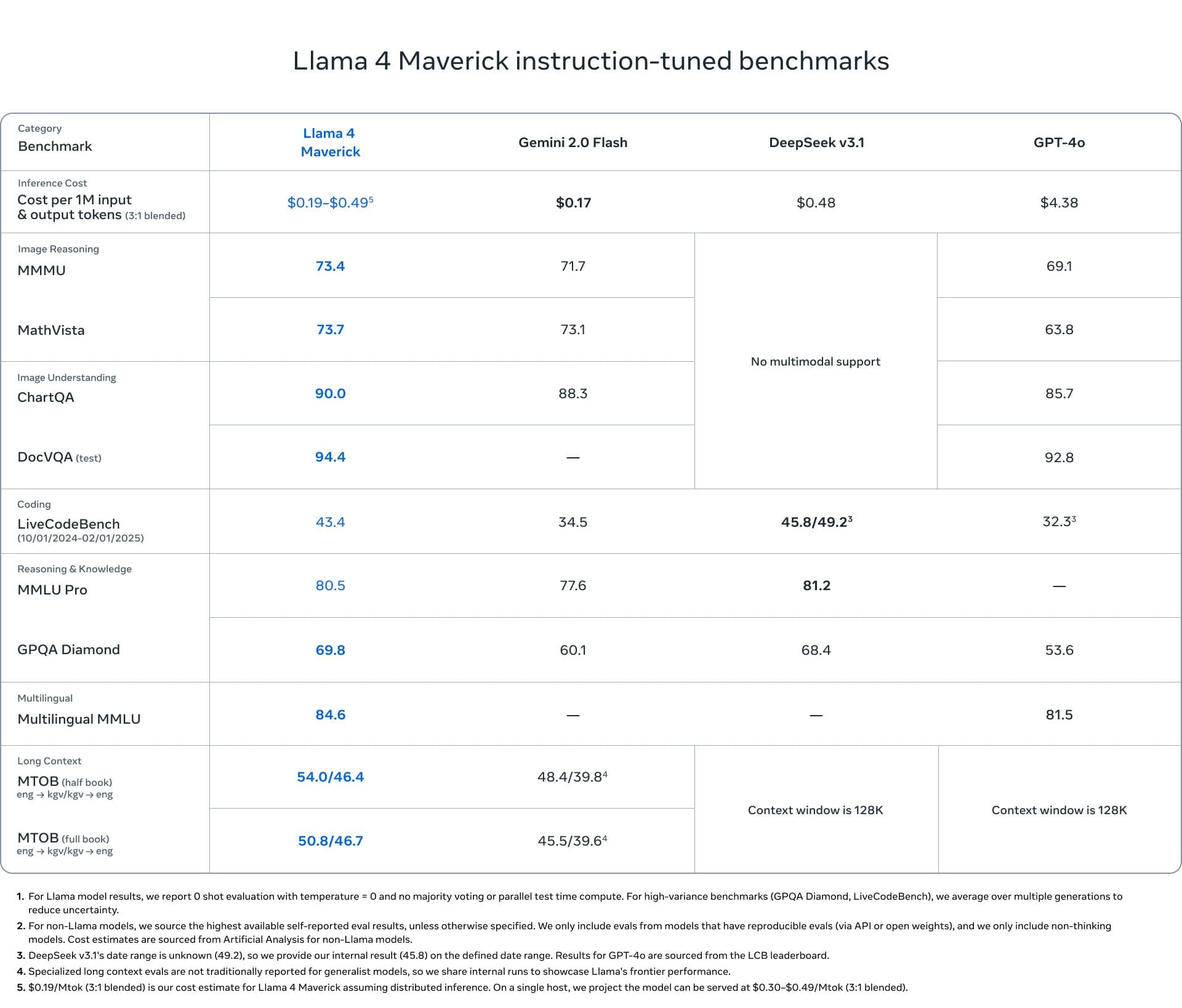
A more powerful sibling with 17 billion active parameters, using 128 expert modules (400 billion parameters in total). Maverick offers:
- Leading performance among multimodal models in its class
- Better results than GPT-4o and Gemini 2.0 Flash across a wide range of benchmarks
- Comparable results to the new DeepSeek v3 in reasoning and coding – with less than half the active parameters
The Secret Weapon: Llama 4 Behemoth
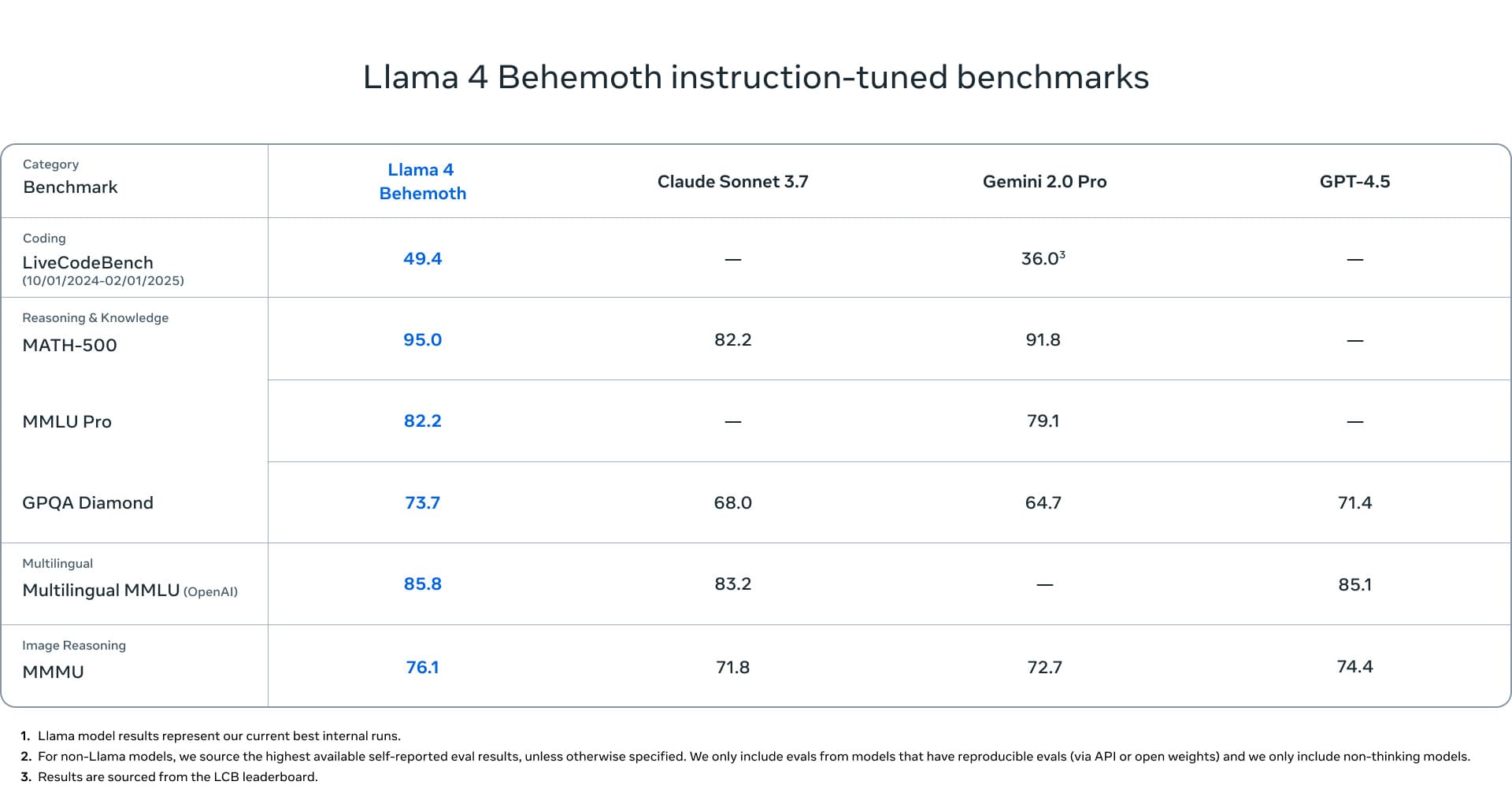
Meta also revealed a glimpse of its most ambitious project – Llama 4 Behemoth, a massive model with 288 billion active parameters and 16 expert modules, totaling nearly 2 trillion parameters. This colossus reportedly surpasses models such as GPT-4.5, Claude Sonnet 3.7, and Gemini 2.0 Pro in several scientific and technical benchmarks. Behemoth is not yet available – it is still being trained – but it served as a “teacher” for the smaller Scout and Maverick models. This approach, in which a large model teaches smaller ones, is one of the keys to why even compact Llama 4 models achieve such impressive results.
Technical Magic: What Lies Under the Hood?
For technology enthusiasts, the new Llama models are packed with innovations:
Mixture-of-Experts (MoE) Architecture
For the first time in the history of Llama models, Meta has implemented the MoE architecture, which dramatically increases efficiency. In MoE models, each token activates only a portion of the total parameters, meaning that the model can be much larger without computational demands increasing proportionally. In Llama 4 Maverick, for example, each token passes through a shared expert and one of 128 specialized experts. This explains why the model has 400 billion total parameters but only 17 billion active parameters.
Native Multimodality
Unlike many competing solutions, where image processing is merely “bolted onto” a language model, Llama 4 was designed as multimodal from the ground up. Meta calls this “early fusion” – text and images are combined at the early stages of processing.
Record-Breaking Context Window
With a context window of 10 million tokens, the Llama 4 Scout Model can process the equivalent of an entire encyclopedia at once. To put this into perspective, an average novel contains roughly 100,000 tokens, so the model could analyze 100 books at once. How did Meta achieve this? Through a new architecture called iRoPE, which uses interleaved attention layers without positional embeddings.
Unmatched Benchmark Performance
Meta claims that its models outperform the competition in all key categories:
- Llama 4 Scout outperforms models such as Gemma 3, Gemini 2.0 Flash-Lite, and Mistral 3.1 across a wide range of benchmarks.
- Llama 4 Maverick surpasses GPT-4o and Gemini 2.0 Flash in coding, reasoning, multilingual tests, long-context tests, and image benchmarks.
- In conversational tests, the experimental chat version of Maverick achieved an ELO score of 1417 on LMArena.
Safety First
Meta has devoted considerable attention to the safety aspects of its new models. It has implemented several layers of protective mechanisms:
- Data filtering during pretraining.
- Comprehensive post-training optimization for safe behavior.
- Open-source tools such as Llama Guard and Prompt Guard for detecting harmful inputs and outputs.
- A new Generative Offensive Agent Testing (GOAT) system for simulating attacks.
Interestingly, Meta also explicitly mentions the issue of political bias in AI models. It states that Llama 4 was designed to articulate both sides of controversial topics without bias and not favor certain opinions over others.
What Does This Mean for the AI World?
The release of Llama 4 comes at a time of intense competition in the AI field. Microsoft and OpenAI recently introduced GPT-4o, Google unveiled Gemini, and Anthropic released the Claude model. Meta is now proving that it does not intend to play second fiddle in this race. Most interestingly, while competitors generally keep their models under lock and key, Meta continues to pursue an open approach that allows the developer community to experiment with and improve the models. “We believe openness fosters innovation and is good for developers, good for Meta, and good for the world,” the company writes on its blog.
Meta suggests that the models introduced are only the beginning. At the LlamaCon conference on April 29, it plans to reveal more of its vision for giving Llama models “superpowers” for natural conversation, solving complex problems, and carrying out generalized actions. The combination of leading performance, multimodality, openness, and the efficient MoE architecture makes Llama 4 one of the most exciting developments in AI in recent times. The question remains how quickly the developer community will be able to leverage these capabilities and integrate them into practical applications.
How Can You Try Llama 4?
Meta remains faithful to its philosophy of openness. Llama 4 Scout and Maverick are already available for download from llama.com and Hugging Face. They will also be available through partner platforms in the coming days. If you do not want to deploy the model yourself, you can try the new generation of Llama directly in Meta products: WhatsApp, Messenger, Instagram Direct, or on the Meta.AI website.


