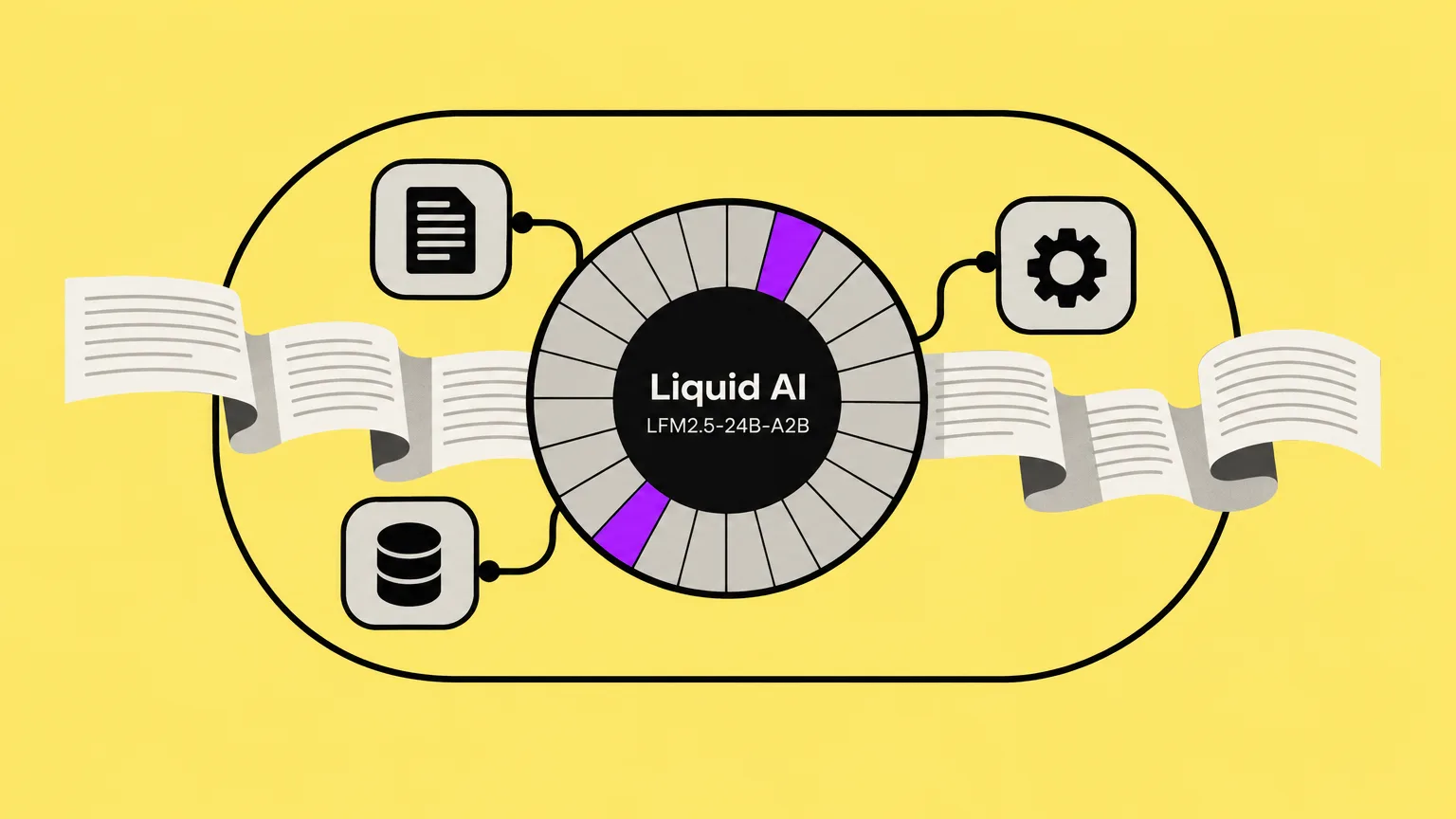
Liquid AI has released LFM2.5-24B-A2B, a reasoning model for local AI agents with 24 billion parameters, only 2 billion of which are active for each token. Its context window expands to 131,072 tokens from its predecessor. The model is available with open weights and documentation for running and fine-tuning it locally.
Longer context and reasoning before the answer
The release is the largest and final model in the LFM2.5 family. It changes how answers are generated compared with LFM2-24B-A2B: according to Liquid AI, it operates exclusively in reasoning mode, producing an explicit chain of thought before its final answer. The company aims to use its fast token generation to improve answer quality.
The context window has grown from 32,768 to 131,072 tokens. The tokenizer has also changed: Liquid AI says its vocabulary has expanded from 65,000 to 128,000 tokens to improve the processing of text written in non-Latin scripts.
Liquid AI also reports an increase in training scale. It raised pre-training volume from 17 trillion to 33 trillion tokens, followed by mid-training on 2 trillion tokens at a 32K context and another 300 billion at a 131K context. Both mid-training phases included tool calls and multi-turn sequences to prepare the model for agent tasks.
Agent benchmarks show strengths alongside weaker coding results
According to Liquid AI, the model leads or matches the compared competitors on five of eight agent and tool-use benchmarks. On AutomationBench, it scored 27.69, compared with 8.72 for Qwen3.6-35B-A3B. The company ran this test with a temperature of 0.6 and top_p of 0.95, with output length bounded by the model's context window.
The company reports a lead across all three instruction-following evaluations. On IFEval, the new model scored 96.75 against Qwen3.6-35B-A3B's 93.06. The coding benchmark SWE-Bench Verified (OpenCode) showed the opposite result: LFM2.5-24B-A2B scored 51.00, while Qwen reached 66.20. For knowledge-intensive tasks, Liquid AI recommends pairing the model with document retrieval or web search.
Liquid AI says the published results come from sealed evaluation environments, with all models tested through vLLM. It tightened the sandboxes after the model searched for ready-made answers in git history and on GitHub, PyPI and Hugging Face during specialization. For evaluations outside the specifically listed tests, the company used a temperature of 0.6 and a limit of 32,768 output tokens.
The individual agent benchmarks used different settings. Liquid AI ran BFCLv4 at a temperature of 0.001 with a 4,096-token limit, and LiveClaw at 1.0 with an 8,192-token limit. ToolSandbox used a temperature of 0 and a 1,024-token limit, with the same settings for its GPT-4o-2024-08-06 user simulator. WebArena allowed up to 40 browser actions at a temperature of 0.6 and top_p of 0.95.
| LFM2.5-24B-A2B | Qwen3.6-35B-A3B | Gemma-4-26B-A4B-it | Nemotron-3.5-Lightning (30B-A3B) | |
|---|---|---|---|---|
| AutomationBench | 27.69 | 8.72 | 5.46 | 2.61 |
| BFCLv4 | 65.01 | 65.00 | 57.09 | 53.78 |
| ToolSandbox | 80.71 | 75.02 | 72.09 | 75.13 |
| LiveClaw | 48.09 | 38.19 | 41.25 | 37.72 |
| PinchBench | 83.18 | 89.93 | 77.12 | 84.20 |
| WebArena Verified | 26.75 | 37.62 | 25.62 | 28.69 |
| GPQA Diamond | 74.42 | 83.69 | 74.90 | 72.42 |
| IFEval | 96.75 | 93.06 | 92.00 | 94.19 |
| IFBench | 74.69 | 64.21 | 47.44 | 71.67 |
| SWE-Bench Verified (OpenCode) | 51.00 | 66.20 | 25.80 | 53.40 |
A local agent demonstration without cloud API calls
Liquid AI demonstrated the model in Hermes Agent on a MacBook Pro with M5 Max. In that demonstration, it planned its approach and used tools on the device without calling cloud APIs. According to the company, individual steps in the cycle—from a request through a proposal and confirmation to tool execution—took well under a second.
The demonstrated setup included a record of the actions performed. Liquid AI also says the data remained on the device throughout the demonstration.
Speed on personal computers and a server GPU
In Liquid AI's local measurements, the model generated 184 tokens per second on an Apple M5 Max and 114 tokens per second on an AMD Ryzen AI Max+ 395. The company reports speeds up to 1.7 times those of the next-fastest model in the comparison group, along with the lowest memory use among those models.
On a single NVIDIA B300, Liquid AI measured aggregate throughput exceeding 21,000 output tokens per second at high concurrency. The test ran in SGLang 0.5.22 using BF16, with 1,024 input tokens and up to 256 output tokens per request. Each completed request was immediately replaced by a new one to maintain the target number of requests in flight.
Open weights and support for running locally
Both the base LFM2.5-24B-A2B-Base and the post-trained LFM2.5-24B-A2B are available on Hugging Face and in Liquid AI's Playground. The company provides documentation for local deployment and fine-tuning. Support at release includes llama.cpp with GGUF checkpoints and MLX for Apple Silicon.
Server deployment is supported through vLLM and SGLang, alongside the cross-platform ONNX inference format. An API in Liquid Console provides an alternative to local deployment. Pricing is $0.10 per million input tokens, $0.05 per million cached input tokens and $1 per million output tokens, with $2 in introductory credit included at registration.