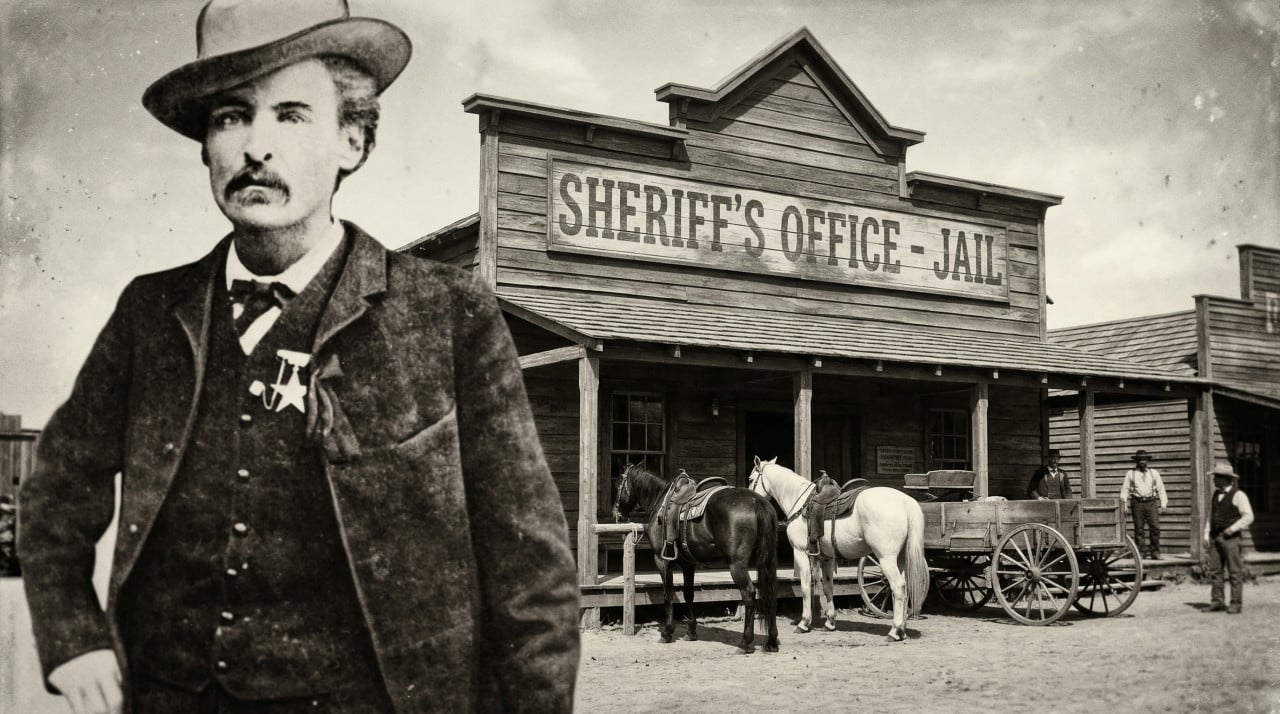
Much has been written over the years about Timothy Isaiah “Longhair Jim” Courtright. He is the only gunfighter Fort Worth can claim as its own. Tombstone, Arizona, has the Earps, Abilene, Kansas, has Wild Bill Hickok, and Fort Worth has Longhair Jim. He ended up on the wrong side of the law and the wrong side of a gunfight, but he is ours nonetheless.
He returned to Fort Worth in January 1886 after spending more than a year on the run from a murder charge in New Mexico. The charges against him there were still hanging over his head as he rebuilt his life in his hometown. He had already evaded one extradition warrant with the help of his friends in the police department. He had last served as city marshal until 1879, when voters removed him from office, yet he remained a man to be reckoned with. He capitalized on his reputation and his guns by opening a private detective agency that worked for anyone willing to pay. He supplemented his income by running an extortion racket—selling “protection” to saloon owners. Most of the time, however, he indulged in alcohol and spent hours at the gaming tables. When he drank, he was aggressive and quarrelsome. The gun skills he had once possessed faded over the years. He survived on his reputation and intimidation. Fate caught up with him on February 8, 1887, when he challenged Luke Short. The two stepped onto the sidewalk in front of the White Elephant Saloon, exchanged a few words, and before anyone knew it, former Marshal Courtright lay dead on the pavement—felled by the elegant gambler nicknamed “Little Luke.”
Courtright’s final appearance as a lawman came ten months earlier, during the Great Southwest Railroad Strike of 1886. It included an attack on a Texas & Pacific train at Buttermilk Junction and resulted in a congressional investigation. Courtright was a key witness in that investigation—a role for which nothing in his life to that point had prepared him.
The labor strike broke out in Marshall, Texas, in February 1886 as a wildcat strike against Jay Gould’s Texas & Pacific rail line. It pitted the nation’s largest labor organization (the Knights of Labor) against one of its largest railroad companies, all on the soil of the largest state in the Union. What began as a local action in Marshall quickly spread throughout the Missouri Pacific network, of which the T&P was a part. Fort Worth was a major railroad hub and a strongly unionized city—nearly a thousand of its residents worked for the T&P. The local Fort Worth Gazette commented that the Knights of Labor “seem to be stronger than the law in Fort Worth.”
Historians have named the event the Great Southwest Railroad Strike of 1886. Mayor John Peter Smith called the former marshal into service as a special deputy under the command of city marshal and Courtright’s old friend William Rea. Courtright also held the authority of a deputy U.S. marshal. His task was not so much to keep the peace as to guard the property of the Texas & Pacific company. True to form, Courtright subjected the strikers to “threats and intimidation,” completely alienating them. The strikers came to believe that the law was on the side of the railroad and against them. Mayor Smith defended the appointment by saying that “people who violate the law have no right to choose who arrests them.” Rancher Will Lake believed Courtright had been appointed because “he was capable of performing the duties entrusted to him.” As a former city marshal who had held office during the wildest period in Fort Worth’s history, he knew how to handle tough cases—whether with his fists or his gun. In retrospect, Courtright was a man who knew only one way to solve problems; he always brought a hammer where a scalpel would have been more appropriate.
Courtright selected seven deputies whose only qualification was that they were “Jim’s friends.” Together they formed an escort for a strikebreaking train dispatched by T&P officials in Fort Worth on April 3 to Alvarado, 27 miles south of the city. When the train reached Buttermilk Junction, two miles outside the city, it was attacked by a group of eight or nine men armed with Winchesters. Courtright and his men had only revolvers—a serious oversight under the circumstances. Three of his men fell in the gunfight. Courtright himself had two bullets pass through his hat, but otherwise escaped uninjured. He ordered the wounded loaded onto the train, which then backed all the way into the city. One of the wounded deputies, Dick Townsend, died that night, while the other two were in critical condition.
Courtright’s reputation suffered a severe blow because he had been in command and had personally ordered the hasty retreat. The San Antonio Light placed the blame for what it called the “Fort Worth massacre” squarely on his shoulders. He took it hard, although he continued to wear a badge and worked with Sheriff Walter Maddox and Marshal William Ream to search the surrounding countryside in an effort to track down the raiders.
Fort Worth authorities locked down the city. Heavily armed police officers and special deputies patrolled the streets. The governor was asked to send Texas Rangers and the state militia to restore order. Fort Worth was effectively under martial law. The federal government was involved, though only marginally. The trains carried mail, and the strike had stopped them. The fact that the strikers had resorted to violence raised the stakes and persuaded Congress to take a direct interest in events in Texas. The House of Representatives established a subcommittee headed by Texas Congressman W. H. Crain, which was to travel to Texas and conduct an investigation on the spot. They arrived in Fort Worth by special train on Thursday morning, May 6, where they were welcomed by the mayor and other dignitaries. The opera house was proposed as the most suitable location for the hearing, but it was ultimately held “in a shabby ground-floor room” in the newspaper office on the square. At around two o’clock that afternoon, they began their work and held two grueling sessions over the next two days. They were more interested in the “railroad disturbances” in general than in the attack at Buttermilk Junction itself, which was also reflected in the witnesses called—most of them were businessmen who condemned the unions and the strike.
Among those summoned on the first day was Deputy James [sic] Courtright. (No one called him “Longhair Jim” anymore.) When asked to describe the course of the gunfight, he emphasized that he and his men had been attacked by the strikers without any provocation. He did not mention, however, that when the shooting began, he was arresting Charles Dalton—one of the strikers who had blocked the tracks and stopped the train. When the bullets began to fly, Dalton escaped. After that, Courtright stated, they defended themselves. Under cross-examination, however, some witnesses were uncertain which side had fired first. It was clear that Special Officer Courtright had returned to Fort Worth with three wounded men and not a single prisoner. On Saturday, the congressmen packed up and returned to Washington. Nothing concrete came of their investigation, apart from a general government campaign against the Knights of Labor. The Great Southwest Strike ended peacefully a few days later, but the consequences of the attack at Buttermilk Junction occupied the Fort Worth authorities for a long time afterward.
Authorities continued to search the surrounding countryside and raid the homes of known members and supporters of the Knights of Labor. When Charles Dalton was arrested several weeks after the incident at Buttermilk Junction, Courtright went to the jail to identify him—which was crucial because none of the other attackers had yet been found. In the period equivalent of a police lineup, Courtright stood before Dalton’s cell and identified him. “I cannot be mistaken about the man,” he told a reporter who was present. As a duly appointed law officer, Courtright’s identification should have carried considerable weight, but Dalton was ultimately acquitted of all charges at trial. A few days later, Courtright was summoned to Parsons, Kansas, where authorities were holding another accused attacker, Tom Low. Courtright dutifully traveled to Parsons and identified the prisoner, even though, in truth, he could not say that he had seen him at the scene of the attack. Low was simply another leader of the Fort Worth strikers whom the authorities were rounding up.
Although Courtright was no longer a special deputy, the attack at Buttermilk Junction continued to haunt him. He managed to sober up and tear himself away from the gaming tables long enough to testify at the January 15, 1887, hearing of accused attacker Henry Henning. He was called as a witness for the state, which sought to have Henning held in custody until trial. Courtright’s testimony was very vague in describing the details of the attack. He merely “believed” that Henning had been one of the attackers, but could not “swear to it with certainty”—which was not what the prosecutors wanted to hear and contradicted what Courtright had said eight months earlier. He also testified that Deputy Dick Townsend had been shot in the back at point-blank range, which contradicted the evidence and the testimony of the other witnesses. Defense witnesses, who could only have been other train guards or members of the T&P crew, testified that Courtright had spent most of the gunfight pressed to the ground, more concerned with saving himself than with organizing his men. Henning was denied bail, though not thanks to Courtright. Another of the accused attackers who was later captured told officers that Courtright had been their principal target. The fact that he had escaped without a scratch led some to conclude that Courtright had been present but had not joined the fight—which cast a dark shadow over the former marshal’s personal courage.
Henry Henning did not stand trial until June 1887, four months after Luke Short had removed Longhair Jim Courtright from the scene. The defense effectively used Courtright’s testimony before the subcommittee to undermine the state’s case. In addition, defense witness O. F. Darby, who had been a train guard at Buttermilk Junction, testified that the first shots had been fired by Courtright’s deputy, James Thompson. Henning was nevertheless convicted and sentenced to life imprisonment, but Courtright’s reputation suffered another blow.
When John R. Hardin, identified as the leader of the attackers, was brought to trial—six years after the battle at Buttermilk Junction—he was acquitted. The Dallas Morning News attributed the prosecution’s failure largely to Courtright. The newspaper found no substantial difference between the two sides in the dispute and wrote: “This verdict is largely attributable to the reputation of Jim Courtright, a local desperado who commanded the group of guards aboard the train that Hardin and his gang attacked.” By then, Jim Courtright could no longer defend himself or his honor—with his fists or by any other means. He had always been a man of action, not words. That was precisely why he was such a woeful witness. The man once celebrated as the marshal who brought law and order to Fort Worth had outlived his own legend. The day after his death, the Dallas Morning News summed it up this way: “With Courtright’s death passes a figure who played a prominent part in the history of Fort Worth... He was brave to the core.”