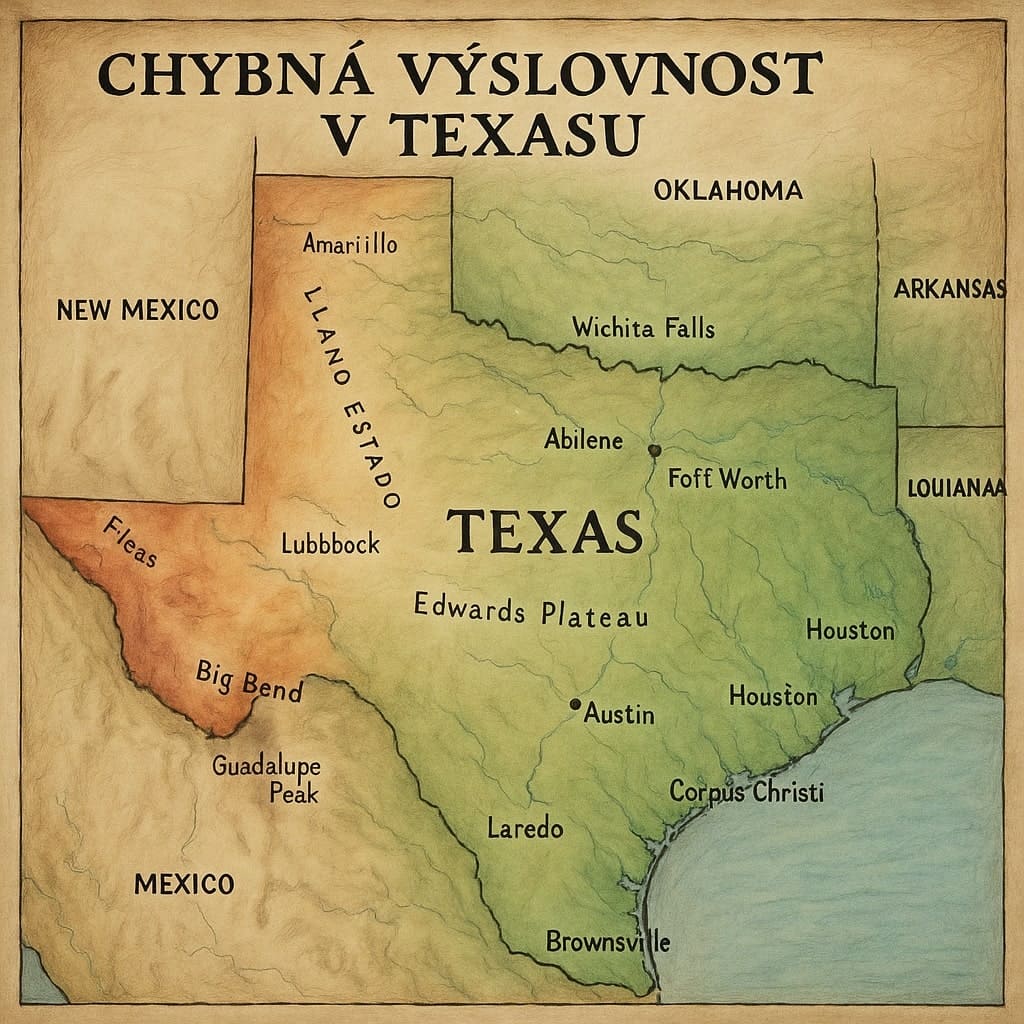
There is a list of the most commonly mispronounced words in Texas. Of course, they are not exclusively Texan—many are typical of the entire American South, but they are certainly common in Texas. And that does not mean that all Texans mispronounce all these words, or that their mispronunciation is exclusively Texan, but it does mean that some of us Texans mispronounce them and most of us mispronounce some of them. So here we go:
• "BRAY-mer" instead of the correct pronunciation "BRAH-muhn" for the cattle breed brought to Texas from India in the mid-19th century (Brahman): "I'd watch out for that big Braymer bull if I were you." The correct name of the breed is, of course, Brahman, but somewhere along the way in Texas, the "n" was lost, an "r" was added, and the first "a" was lengthened.
• "Waterburger" instead of "Whataburger": It is correctly pronounced "WHAT-a-burger," but many of us prefer "Waterburger": "Can I get two Waterburgers with cheese, and can you make my fries Watersize?" Watersize meaning large fries.
• "Bob wire" or "bob war"** instead of "barbed wire": It is actually "barbed wire," but many of us, especially those who have daily intimate experience with it, say "bob wire."
• Closely related to this is "chesterdrawers" instead of "chest of drawers": It took me a long time to learn the correct spelling of these two expressions. Before that, I simply thought Bob made wire and Chester made drawers.
• Then there is "probably": We like to get rid of at least one "b" and say "probly." But some of us get rid of both "b"s and just say "prawly." "You goin' to the dance tonight? I reckon' so, prawly " (Are you going to the dance tonight? I guess so, prawly).
• Many members of the older generations say "warsh" instead of "wash": George Warshington. Warshington, D.C. They warsh the clothes and the dishes, too (George Warshington. Warshington, D.C. They warsh the clothes and the dishes, too).
• "Libery" instead of "library" is quite common. It reminds me of the old joke about a Texan who went to Harvard and stopped a student on campus, saying: "Can you tell me where the libery's at?" (Can you tell me where the libery is?). The reply came: "Here at Harvard, we say 'library, not 'libery, and we do not end our sentences in prepositions." (Here at Harvard, we say 'library,' not 'libery,' and we do not end sentences with prepositions.). So the Texan says: "Excuse me. Can you tell me where the library's at, jackass?" (Excuse me. Can you tell me where the library is, jackass?).
• "Dreckly" instead of "directly": "I'll do it dreckly." Contrary to what you might think, "dreckly"/"directly" does not mean immediately, but rather "As soon as I get around to it."
• "Purty" is commonly used instead of "pretty," even paradoxically, as in "She's purty ugly" (She is pretty ugly). "Sorry to tell you, but that old truck of yours is lookin' purty ugly" (I'm sorry, but that old truck of yours looks pretty ugly).
• "Purt'-near" instead of "pretty near": "I reckon I'll be purt'-near done with that fence by supper tomorrow."
• Some of us, including President George W. Bush, say "nucular" instead of "nuclear": "Can't let them Russkies get more nucular arms than we got" (We can't let those Russians have more nucular weapons than we do).
• Texans say "dudn't" and "wudn't" instead of "doesn't" and "wasn't": "He dudn't have to worry about not inviting me, because I wudn't have gone anyway!"
• "Thang" instead of "thing" is another one, and "everything" is "ever-thang." "Hand me that thang over there."
• "Calvary" instead of "cavalry." When people need help, they send for the cavalry, not Calvary. Calvary is the name of the hill where Jesus was crucified.
• "Kindly" instead of "kind of": "He looked kindly peaked." ("Peaked," by the way, is pronounced "PEEK-id," much as "naked" is often pronounced "NECK-id," and it means sickly or emaciated.)
• "Salmon": The letter "l" in the word salmon is supposed to be silent. So do not order "smoked salmon" with the "l" pronounced.
• We may add an "h" to the end of the word "height," creating "heighth": "What's his heighth, about 185 cm?" This may come from an attempt to be consistent with the words "width" and "breadth."
• When we are not adding an "h," we are dropping some. Many Texans lose the "H" in Houston and just say "YOU-ston": "I'm heading down to Youston for the weekend."
• You may hear a woman say: "My husband takes me for granite" (My husband turns me into granite). We have a lot of granite in Texas. The Capitol is built from granite quarried from Granite Mountain near Marble Falls. But the expression is "taken for granted," not "taken for granite," which might be worse.
• "Tia-juana": "I went down to Tia-juana for my niece's wedding. I came back with the Tia-juana two-step." It is actually just Tijuana: No extra "a." When you say "Tia-juana," you are saying "Aunt Juana." Texans have, of course, been mangling Spanish words for centuries, so this is just one of many examples. (Tijuana is the most populous city in the Mexican state of Baja California, located on Mexico's northwestern Pacific coast.)
And this is only part of the list of mispronunciations.