

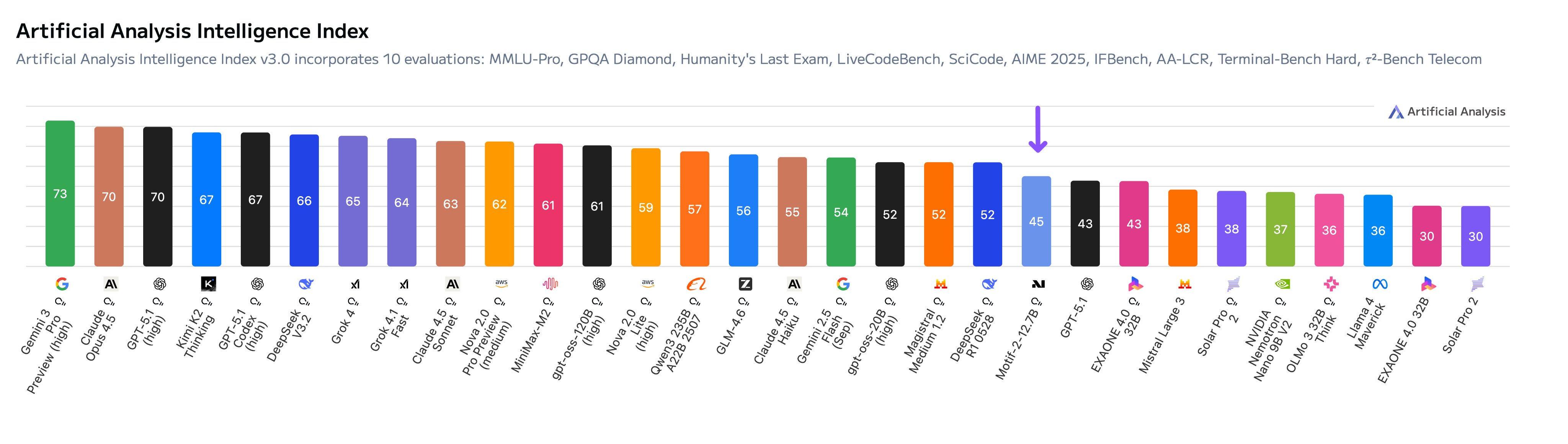
In recent days, an interesting development in artificial intelligence has emerged from South Korea. The startup Motif Technologies released a model called Motif-2-12.7B-Reasoning, which has only 12.7 billion parameters but nevertheless achieved excellent test results. According to the independent laboratory Artificial Analysis, the model scored 45 points on the Intelligence Index and became the leading model from Korea. It even outperformed some larger models, such as OpenAI's standard GPT-5.1. This open model with freely available weights is designed for reasoning and shows that even smaller teams can compete with major players from the US and China.
Motif Technologies, which is based in South Korea, has focused on creating models for enterprises. Its model was trained on 187 billion tokens of data, including Korean patents and research reports. Training took only three months, and the model achieved a score of 64.74 on the Korean KMMLU benchmark. In some areas, this is better than GPT-4. The company also published a white paper on arxiv.org, where it describes its approach, including hybrid parallelism and memory optimization on Nvidia H100 hardware.
What Motif Technologies discovered
1.) One of Motif Technologies' key findings is that synthetic reasoning data helps only when its structure matches the style of the target model. In tests, they found that coding performance depends on which "teacher" model generated the reasoning traces during fine-tuning. If the data does not match the format, step length, or level of detail, it can even reduce performance, despite appearing to be high quality.
For companies, this means that simply generating large amounts of data from large models is not enough. It is necessary to verify whether the data matches the desired output in real-world use. Motif emphasizes that internal testing loops are more important than copying external datasets.
2.) Motif trained its model with a context length of 64 thousand tokens, which is not merely a simple tokenizer adjustment or checkpointing. They used hybrid parallelism, careful data partitioning, and aggressive activation checkpointing to make it work on standard hardware. This enabled stable training without major issues.
For enterprises, this is a warning: The ability to process long contexts cannot be added later. If your work involves retrieval or agentic workflows, context length must be part of the plan from the outset. Otherwise, you risk costly retraining or unstable modifications.
3.) In its reinforcement learning fine-tuning (RLFT) process, Motif emphasizes difficulty-based filtering—they retain tasks whose success rate falls within a certain range. Instead of blindly scaling up reward-based training, they reuse trajectories across policies and expand clipping ranges for greater stability.
This addresses common business problems such as performance degradation or loss of stability outside testing. Motif shows that reinforcement learning is a system-level concern, not merely a question of the reward model. Without filtering, reuse, and task balancing, this process can destabilize otherwise well-prepared models.
4.) Motif uses kernel-level optimizations to reduce memory pressure during reinforcement learning. Techniques such as loss function optimization enable advanced training stages. In enterprises, where memory is often a challenge, this highlights the need to invest in low-level engineering.
The company also emphasizes data quality and quantity—it curated 187 billion tokens of Korean data, including specialized sources. It created unique pretrained and instruction-tuned models for complex sentences and conversations. Its open strategy includes releasing models such as Llama-3-Motif-102B on Hugging Face, which supports the ecosystem. In addition, it offers a Personal AI service for easily customizing models with minimal data, including templates for conversations, image generation, or code.
Motif Technologies, a 🇰🇷 Korean AI lab, has just launched Motif-2-12.7B-Reasoning, a 12.7B open weights reasoning model that scores 45 on the Artificial Analysis Intelligence Index and is now the leading model from Korea
— Artificial Analysis (@ArtificialAnlys) December 10, 2025
Key benchmarking takeaways:
➤ Open weights:… pic.twitter.com/KcZxrt4jPF
Emphasis on localization and accessibility
Motif Technologies shows that models tailored to a specific language, such as Korean, can outperform global giants on local tasks. This also applies to other languages, such as Japanese, where global models often fail to capture nuances. The company offers models on Hugging Face for easy testing, such as Motif-102B, which can be customized with proprietary data for an internal chatbot.
This approach makes AI more accessible to smaller companies without the need for massive infrastructure. Motif-2-12.7B-Reasoning is competitive with larger models thanks to disciplined training design, not merely its size.


