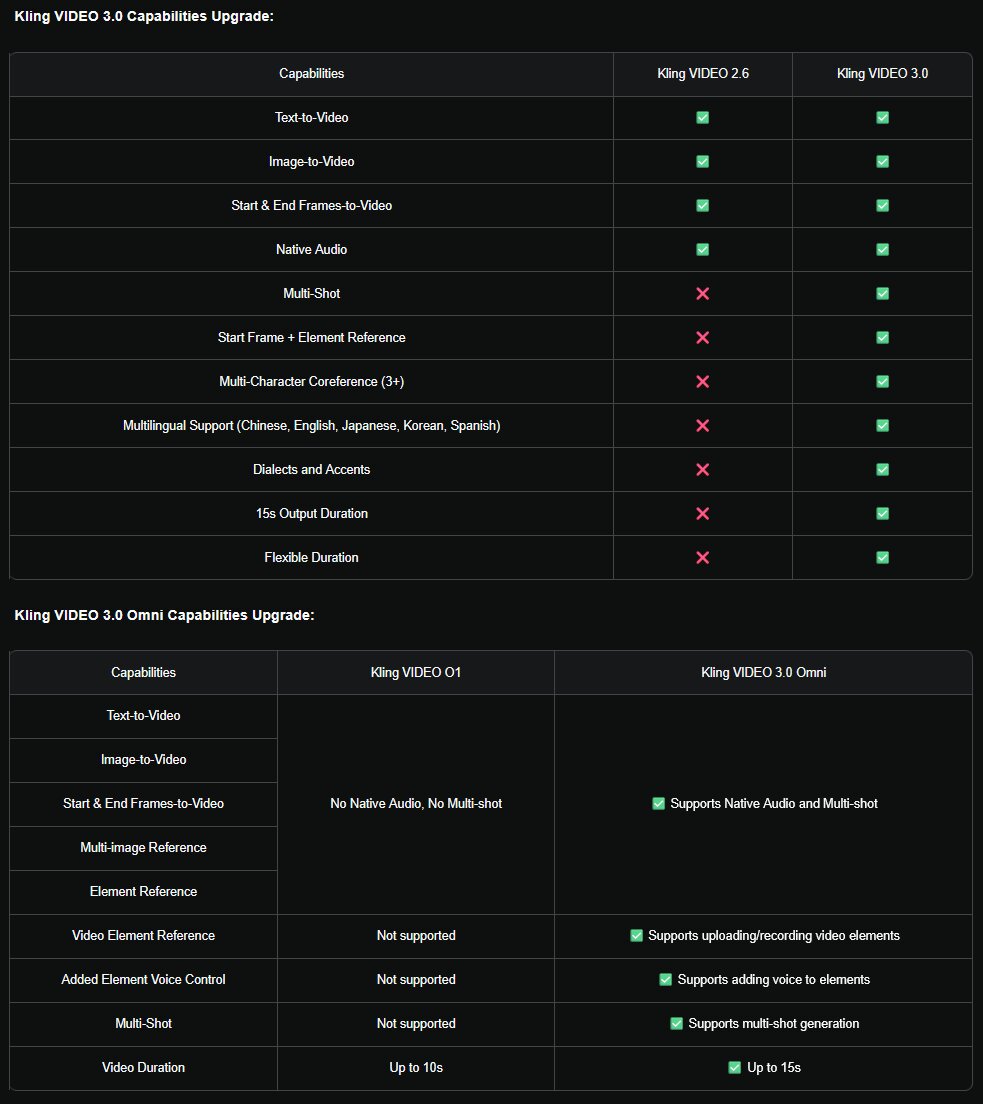
Kling 3.0 represents the latest generation of the AI video creation model introduced by Kling AI. This model includes four variants: Video 3.0, Video 3.0 Omni, Image 3.0, and Image 3.0 Omni. The main innovation is the transition from simple generation of individual shots to a scene-structured workflow, which allows creators to plan, generate, and edit video much more precisely.
The model supports video lengths from 3 to 15 seconds, output resolutions of 720p and 1080p (up to 4K for image models), and generation with or without audio. These parameters actively define pacing, rhythm, and narrative structure as early as the generation stage.
Multi-shot scene generation
One of the most important changes in Kling 3.0 is the introduction of scene-defined multi-shot generation. A single video can consist of 2 to 6 scenes, with creators explicitly describing what happens in each scene and assigning a specific duration to each segment. This approach gives creators direct control over how the video unfolds, including shot order, transitions, and narrative beats. Scene boundaries provide a clear structural framework that makes Kling 3.0 outputs easier to design, iterate on, and integrate into real production workflows.
The Video 3.0 Omni model adds a multi-shot storyboarding feature, where the duration, shot size, perspective, story, and camera movements can be specified for each individual shot. It also supports dynamic camera angles such as shot-reverse-shot or cross-cutting with smooth transitions.
Start and end frame control
Kling 3.0 introduces start and end frame control, a capability that was not available in the previous Kling 2.6 version and significantly expands creative flexibility. Creators can define both the starting and ending frames of a generation, or constrain the model using only an end frame to control how motion develops.
This makes it possible to guide scenes toward a precise visual outcome, match generated shots to existing footage, or maintain continuity between shots without having to regenerate entire sequences. For iterative workflows, frame-level constraints reduce randomness and give creators more predictable control over motion behavior.
Elements and object management
Another key capability of Kling 3.0 is the ability to add elements to a scene, such as additional characters, products, or objects, and keep their presence and behavior consistent throughout the video. Combined with improved character referencing and object consistency, this allows creators to work with multiple subjects while preserving identity, proportions, and spatial relationships across scenes and over time. This is particularly important for branded content, product storytelling, and character-driven narratives, where continuity is critical.
Physically accurate camera behavior
Kling 3.0 places a strong emphasis on physics-driven motion, improving how gravity, inertia, and environmental interactions affect both object movement and camera behavior. Motion remains coherent over time, even in scenes involving interaction, impact, or complex movement. This makes Kling 3.0 particularly effective for camera movement, including pans, tracking shots, and reveals, as well as for scenes where physical behavior needs to feel natural. The model excels at cinematic camera movements, macro shots, and product visuals.
Synchronized audio
Kling 3.0 supports video generation with or without audio, with audio designed as a first-class component of the scene. When audio is enabled, motion and sound are generated together with attention to fine details, such as micro-sounds, environmental textures, and subtle audio cues that reinforce physical interaction, timing, and spatial presence.
The model offers lip synchronization, currently in English and support for up to 2 custom voices. This level of audio fidelity makes it possible to evaluate pacing, rhythm, and narrative flow during early iterations and supports a wide range of use cases.
Editing and generation as a continuous workflow
A defining characteristic of Kling 3.0 is the convergence of generation and editing. Scenes can be extended, modified, and refined after the initial generation, including changes to scene length, framing constraints, motion behavior, and elements, without having to restart the process.
On the Higgsfield platform, shots generated with Kling become editable footage that can be shaped through motion design, typography, transitions, and timing adjustments, allowing the creative intent to evolve without disrupting continuity.
What is Kling 3.0 best for?
Kling 3.0 performs best in scenarios where structure, realism, and consistency are essential. It excels at camera movement, where controlled pans, tracking shots, and reveals benefit from stable motion logic and scene-based generation. Macro shots are another strong area, as detailed framing requires stable textures, lighting, and subtle motion details, making Kling 3.0 well suited for product visuals and material studies. Its physics-driven behavior supports scenes involving movement, impact, and environmental interaction, where believable motion over time matters more than isolated visual moments.
Audio-driven content benefits from flexible audio generation, allowing creators to prototype rhythm and pacing at an early stage or layer in audio later. For character referencing and long-term consistency, Kling 3.0 maintains identity across scenes and durations, supporting character-based storytelling, brand mascots, and recurring visual systems.
Kling 3.0 is available with exclusive early access for Ultra subscribers and is gradually being rolled out to the public. The model is integrated into platforms such as Higgsfield for editing workflows, where it becomes part of a system in which generative video supports real creative processes and enables iteration through design decisions instead of repeated regeneration.