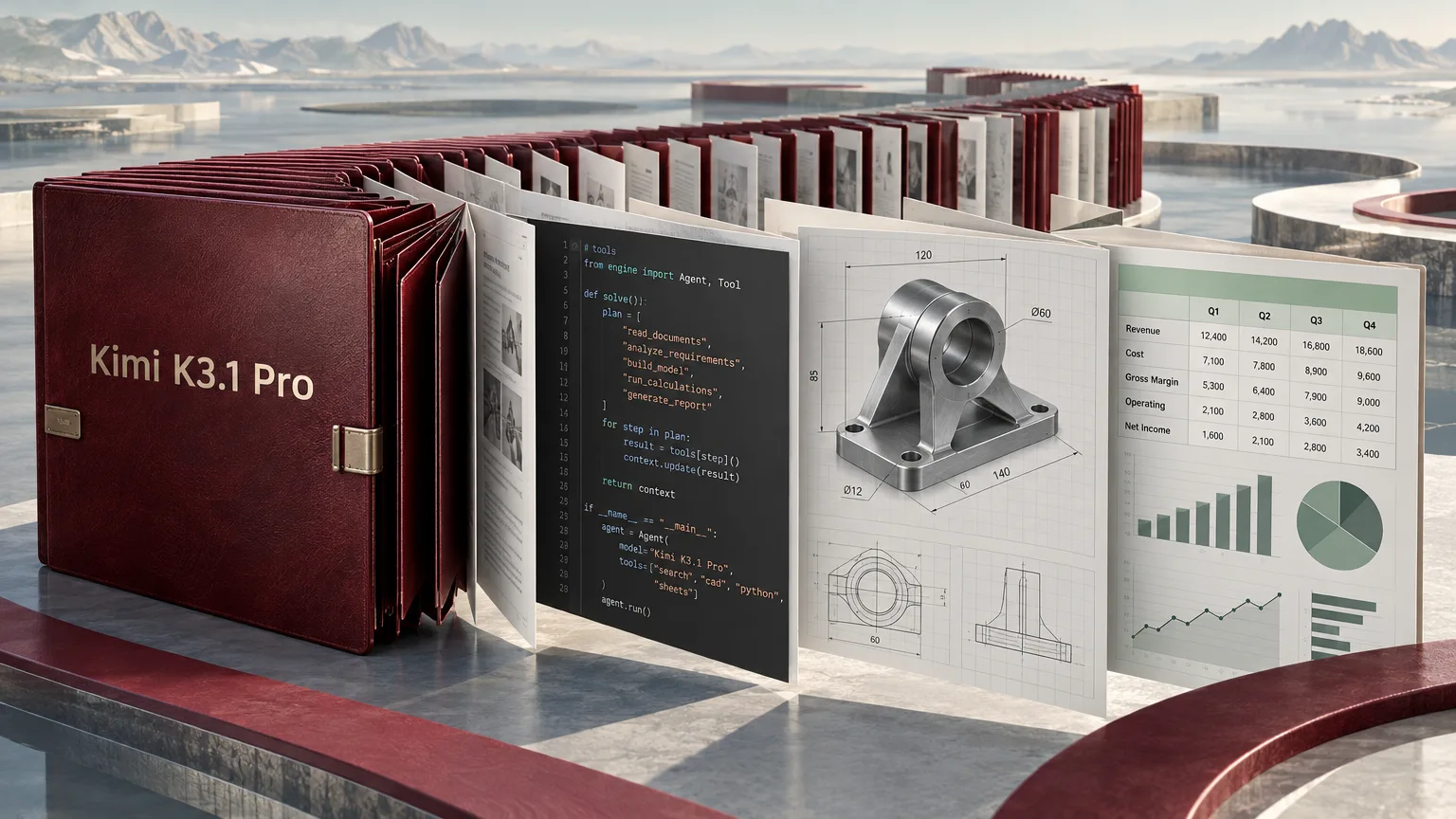
Moonshot has launched Kimi K3.1 Pro, a model focused on long-running agent tasks in software development, parametric 3D modeling and financial analysis. It combines a million-token context window with multistep tool use to work with extensive source material and carry out successive actions in editors, command-line environments and specialized applications.
The same architectural foundation, with an emphasis on tools
K3.1 Pro builds on the original Kimi K3’s architecture. It uses a mixture-of-experts transformer with 2.8 trillion parameters in total, activating 104 billion for each token. The new version emphasizes agent workflows in which the model uses a command line, makes edits, runs tests and works with specialized applications across multiple steps.
The context window holds one million tokens, and the model natively supports multimodal input. The long context is designed for material such as large software repositories, corporate filings and collections of transcripts.
Between GPT-6 Astra and Claude Opus 5.5 in Moonshot’s terminal comparison
In Moonshot’s published comparison, Kimi K3.1 Pro scored 65.7% on Terminal-Bench 4.0. It finished ahead of GPT-6 Astra at 58.2%, but behind Claude Opus 5.5 at 66.4%. Kimi’s result came from a run using the Kimi Code harness.
Terminal-Bench 4.0 tests agents on command-line tasks under resource constraints. Within an isolated environment, they must navigate repositories, modify files, execute commands and resolve errors. The testing harness can substantially affect scores because it controls tool calls, retries and context management.
From game engines to parametric CAD models
Moonshot has tuned the model to work with the Unreal Engine and Unity game engines, as well as Godot and Blender. CAD software is another target. The intended workflow starts with creating digital assets and assembling scenes, then extends to animation and rendering.
For this area, the company published results on BenchCAD, which evaluates the reconstruction of 3D objects from multiple views using generated CAD code. According to Moonshot, K3.1 Pro scored 92.7% in a tool-enabled configuration. It trailed both named competitors in that comparison: Claude Opus 5.5 scored 96.2%, while GPT-6 Astra reached 95.9%.
Financial models with linked statements and traceable formulas
In its financial demonstrations, Moonshot showed a discounted cash flow valuation of Nvidia and a leveraged buyout model. These included linked financial statements and traceable formulas. Other examples were an investment committee presentation about CATL and a report on the quantum-computing sector with source citations.
In the company’s internal evaluations, K3.1 Pro improved over K3 by 7.2 points in financial modeling and 11.6 points in financial research. In simulated business operations, Moonshot reported a score roughly 4.2 times that of the previous version.
Moonshot also reports a score of 64.4 on OfficeQA Pro v2, which it describes as the best result to date. For financial tasks, the company additionally claims a 65% reduction in hallucinations.
Access through Kimi Work, Kimi Code and the API
The model is available through three routes at launch. Kimi Work handles document and spreadsheet tasks, while Kimi Code provides an environment for command-line software development. The third option is the Kimi API.
The K3.1 Pro Highspeed variant is intended for interactive tasks and higher-throughput workloads. Moonshot claims two to three times faster inference for this version.
Moonshot plans to release the model’s weights roughly two weeks after launch. Self-hosting depends on that later release.