Chinese company Moonshot AI has released a new artificial intelligence model, Kimi K3.1 Pro. According to its own tests, it closely trails Anthropic's Claude Opus 5.5 in programming and outperforms OpenAI's GPT-6 Astra in some tasks. The company is offering it at a significantly lower price than the previous version and promises to release the so-called open weights by November 4. This means that anyone will be able to download the model and run it on their own servers without depending on Moonshot's services.
Much more training
It is an improved version of last year's Kimi K3 model, which the company subjected to much longer and more demanding post-training. The model learned through trial and error across hundreds of different fields, from programming and finance to working with 3D graphics. To make such training work reliably, Moonshot's engineers had to overhaul virtually the entire backend, from the computing infrastructure to the secure testing environments in which the model tries out its solutions.
It belongs to the category of giant models with roughly three trillion parameters. It can work with a context window of one million tokens, which, put simply, means that it can keep entire extensive documents or large software projects in mind at once. Alongside the standard version, the company also released a Highspeed variant that responds two to three times faster.
Endurance beyond programming
Moonshot is targeting the model primarily at programming and long-running tasks in which AI must proceed independently, step by step. Kimi K3.1 Pro fixes bugs in real code, builds entire projects, and can work with the Unity, Unreal Engine, and Godot game engines. According to the company, the websites and interactive 3D scenes it creates have better composition, typography, and animations.
One company experiment demonstrates just how far its persistence extends. The model was tasked with teaching a simulated human to walk. It worked with an open anatomical model of the human body containing 296 skeletal components and 402 muscles. Over the course of 167 tasks and 420 checks, it independently evaluated the results, searched for errors, and adjusted the movement controls. The character, which initially collapsed within a few seconds, eventually walked smoothly with alternating steps for more than 11 seconds. When it was unable to improve the arm movement, the model did not keep trying the same thing indefinitely. It examined the simulation itself, discovered 36 errors in the shoulder muscle calculations, fixed them, and only then restarted the training.
3D models on demand
Working with spatial relationships is one of the new model's strengths. From a text prompt, sketch, or photograph, it can infer an object's shape and proportions and create a usable 3D model. It performs particularly well with mechanical components, architectural models, and custom-made furniture. It can independently write and run scripts for programs such as Blender or CAD software and continue modifying the model in them.
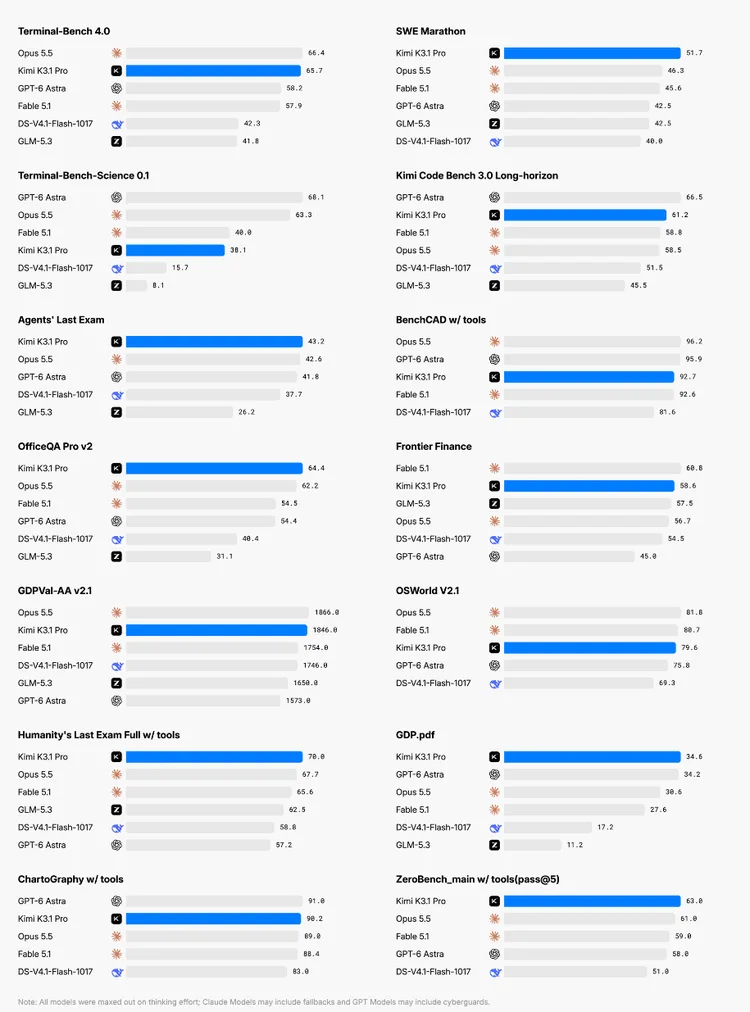
In BenchCAD, a test that examines the accuracy of reconstructing 3D objects from images taken from several angles, it scored almost 93 percent. Claude Opus 5.5 and GPT-6 Astra perform slightly better, both at around 96 percent. The company has also launched a 3D Make feature on its website and in its app, where users can view, edit, and download 3D models for 3D printing or export them as videos.
Finance and fewer fabrications
Moonshot also trained the model extensively on financial analysis. In OfficeQA Pro v2, where AI searches for and verifies figures across real financial documents, it achieved the best result of all the models compared. In internal tests, it improved over K3 by roughly 7 points in financial modeling and nearly 12 points in financial research. In a simulated company management task, it performed approximately four times better than its predecessor.
Accuracy is crucial in finance, so the developers also focused on reducing fabrications. In an internal stress test full of trick questions, the proportion of fabricated claims fell from more than 23 percent with K3 to roughly 8 percent. However, the company notes that the test is deliberately designed to be difficult and that these figures do not reflect normal use. GPT-6 Astra made the fewest errors in the test.
The company deliberately curtailed its hacking capabilities
As the model's capabilities grew, so did concerns about its misuse for attacks on software. The developers discovered that skills for finding and exploiting security vulnerabilities were subtly entering the model through ordinary training data. They therefore deliberately removed this data from the downloadable version.
The difference is noticeable. The unmodified version solved more than 90 percent of the tasks in an internal software attack test, while the final K3.1 Pro solved 81 percent. Moonshot says that the model deliberately lags behind the best closed models from competitors in this area. At the same time, it believes that the freely available model will primarily help those who want to secure their own software, including legacy systems.
Comparison with competitors
In the Terminal-Bench 4.0 test, which examines the completion of real-world command-line tasks, K3.1 Pro scored just under 66 percent. It thus outperformed GPT-6 Astra, which scored 58 percent, and fell only slightly behind Claude Opus 5.5, which scored 66.4 percent. In an internal test of long programming tasks, it improved from 56 to 61 percent compared with K3.
However, Moonshot conducted most of the evaluations itself, and the models being compared did not always work with the same tools. A more independent perspective is provided by Artificial Analysis, which awarded the model 55 points in its intelligence index. At the time of publication, this placed it among the very best.
Price is the main attraction
The new model's strongest selling point is its price. Through the API, the standard version costs $2 per million input tokens and $10 per million output tokens. If parts of the text are repeated and the model has them stored in its cache, the input price falls to 20 cents. The previous K3 cost $3 and $15, so the new model is one-third cheaper. According to developer and blogger Simon Willison, it therefore costs the same as GPT-6.1 Sol and half as much as Claude Opus 5.5.
The faster Highspeed variant costs twice as much: $4 for input and $20 for output. The price for cached text remains the same. The two versions do not differ in intelligence or context size, so Highspeed makes sense in situations where a person is waiting for a response, such as with programming assistants or customer support.
Availability
Kimi K3.1 Pro is available on the Kimi.ai website and in mobile apps for iOS, Android, and HarmonyOS. It can also be used in the Kimi Work desktop app from version 3.1.0 for Windows and Macs with Apple chips, in the Kimi Code programming tool via the /model command, and through the API under the names kimi-k3.1-pro and kimi-k3.1-pro-highspeed. API customers can enable a mode in which the company does not store their data, and the model is also available through the OpenRouter service. In the enterprise version of Kimi, the new model is disabled by default and must be enabled by the organization's administrator.