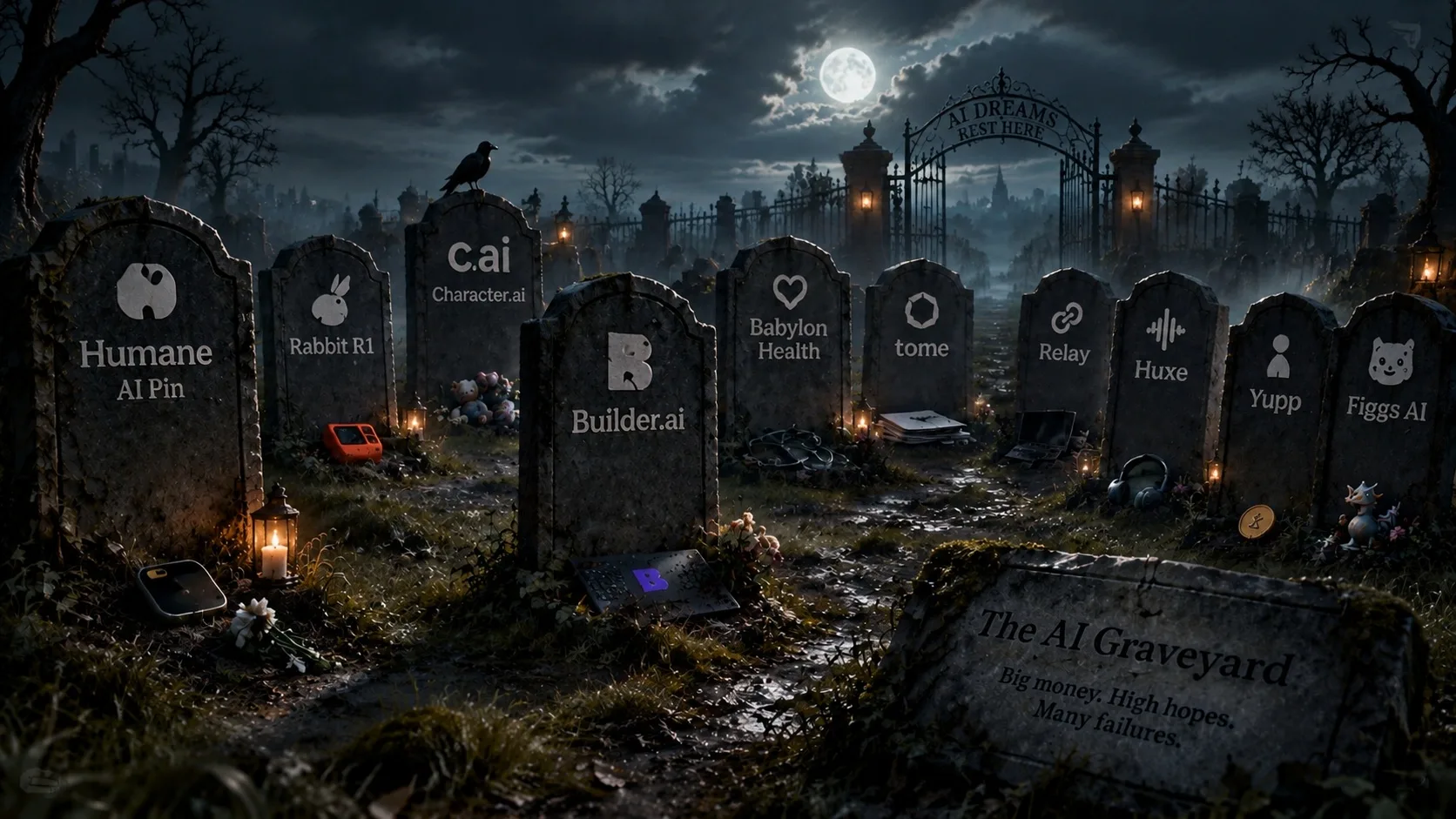
Money is pouring into artificial intelligence like no other industry, but that does not guarantee anyone success. Analysts at S&P Global Market Intelligence calculated that large companies will ultimately abandon roughly 42 percent of their AI projects. Meanwhile, the VCbacked database lists 390 defunct AI startups. The reasons keep recurring: high operating costs, weak user interest, lawsuits, or simply the fact that a technology giant began offering the same thing for free. Here are ten stories showing how easily a promising company can become a cautionary tale.
Humane AI Pin: the smart badge that did not work
Humane wanted to break people of the habit of looking at their phones. Its product was a small badge pinned to clothing that was supposed to perform smartphone tasks using artificial intelligence. The device generated enormous excitement, but the reality fell short. It struggled with performance, and the company even had to warn customers against using its charging case because of the risk of a battery fire. In February 2025, Humane discontinued the badge, and HP bought most of its assets for roughly $116 million.
Rabbit R1: a celebrated launch, an underwhelming result
Rabbit took a similar path. Its pocket assistant, the R1, was first unveiled at CES in January 2024 and was supposed to handle various tasks for its owner. Shortly after launch, the company reported selling one hundred thousand units. However, the first reviews described the device as unfinished, unreliable, and offering few useful integrations with other services. Rabbit did not give up and continues to improve the device. It is also developing a portable computer for people who want to program using ordinary sentences.
Character.ai: from a billion-dollar valuation to bankruptcy
Character.ai was founded in 2021 by two former Google researchers, Noam Shazeer and Daniel De Freitas. The app allowed people to talk to chatbots that often imitated celebrities or characters from movies and books. It became a hit among young people. According to available information, Google paid $2.7 billion in 2024 to license the technology and brought both founders back to the company.
Then the problems began to mount. Families filed lawsuits alleging that the chatbots had contributed to suicides and self-harm among teenagers. Disney sent a cease-and-desist letter demanding that the company stop using its characters without permission. Last fall, Character.ai barred minors from open-ended conversations, and in early 2026 it settled with several plaintiffs alongside Google. That was not enough, and at the beginning of October the company filed for bankruptcy. Ironically, the first interested buyer is Disney itself, which is offering $20 million for a license to part of the intellectual property. The sale is expected to be completed by December.
Builder.ai: artificial intelligence powered by people
London-based Builder.ai was founded in 2016 by Sachin Dev Duggal. The company promised that small businesses could build an app or website without any programming knowledge. All they had to do was describe their requirements to a virtual assistant named Natasha. But according to later findings, hundreds of programmers in India were working behind the promising facade.
Technology was not the only problem. The company was accused of inflating revenue, its board had to recalculate the figures, and the founder left in February 2025. Its main creditor then froze the money in its accounts, and in May the company declared bankruptcy. Not long ago, it was valued at around $1.5 billion, and experts now cite it as a textbook example of fake AI, in which a company embellishes its capabilities to attract funding.
Babylon Health: the doctor in your pocket that gave bad advice
Babylon Health was founded in London in 2013 with the slogan of putting a doctor in your pocket. Its chatbot was supposed to advise people with minor ailments on its own and ease the burden on Britain’s overstretched healthcare system. Senior politicians also rallied around the app. But doubts emerged early. In 2018, the company claimed that its chatbot had achieved a score of 81 percent on the general practitioner exam, something that was never independently verified. Physician David Watkins publicly demonstrated how the chatbot reassured a patient with symptoms of a heart attack that they could manage the situation at home. One former employee even claimed that the supposed algorithm was merely a basic decision tree in Excel.
Babylon never turned a profit and burned through hundreds of millions of dollars. After it left the New York Stock Exchange, a planned merger with MindMaze also fell apart in 2023, and the company ended up in bankruptcy. Most of its assets were acquired by eMed.
Tome: twenty million users and no revenue
Tome offered a tool for easily creating presentations. Users only had to write a few sentences, and the app would turn them into a finished presentation. Roughly twenty million people tried the tool, but few were willing to pay for it. The company laid off employees, shifted its focus to sales teams, and shut down its presentation product entirely on April 30, 2025. It deleted user data. The founders are now developing Lightfield, an AI-powered customer relationship management system.
Relay and Huxe: when a big neighbor overtakes you
Some startups were not killed by their own mistakes, but by competition. For five years, Relay developed a Zapier-like tool that allowed people to automate email and task workflows using AI agents. Once OpenAI, Google, and others added similar features directly to their services, Relay lost its reason to exist. It shut down in August, and its team joined Google to work on Chrome.
The same fate befell Huxe, an app created by former Google developers who had worked on NotebookLM. Huxe could turn written text into podcast-style audio in which two voices discussed a topic. It shut down in May 2026, partly because services with enormous listener bases, such as Spotify, began offering similar features.
Yupp and Figgs AI: enthusiastic users are not enough
Yupp operated as a free playground where people could compare responses from hundreds of AI models side by side. At its peak, it offered more than eight hundred of them, including models from OpenAI, Google, and Anthropic. Users could vote for the best answer and receive cryptocurrency in return. According to the founders, however, the service never found a sufficiently strong position in the market, and it shut down in March 2026.
Figgs AI, meanwhile, attracted fans of role-playing and storytelling. People could create their own AI characters and chat with them. The service attracted more than a million users, but operating it for free was too expensive for the developers, so they shut it down after a year.
Even the giants are not safe
Even the biggest companies can make mistakes. In March of this year, OpenAI shut down the Sora video platform, which was hampered by high costs and the fact that users did not return to it. In July, the company then redesigned ChatGPT as a large app with several modes. Users found it confusing and cluttered, so OpenAI soon restored the original design. Apple repeatedly delayed its new AI-powered Siri and ultimately paid $250 million to settle a dispute over how it had promoted the capabilities of the iPhone 16.
Enormous sums from investors lie behind the failures of these smaller companies. The startups in the VCbacked database raised more than thirty billion dollars combined, even though half of them received no more than five million and most commonly shut down immediately after their first major investment. Humane raised $230 million, Character.ai secured $150 million at a billion-dollar valuation, and both Microsoft and Qatar’s sovereign wealth fund invested in Builder.ai.
Sources: techcrunch.com, wireunwired.com and vcbacked.co