In the world of AI, quality comes at a price. Closed models such as GPT or Claude are a great example, having built their lead over the competition on massive investments and closely guarded code. But that is now changing! The open-source AI model Kimi K2.6 from the Chinese company Moonshot AI is taking a completely different approach, fundamentally changing the rules of the game.
What does an “open-source model” actually mean?
An open-source model is one whose basic building blocks are freely available. Anyone can not only download such a model, but also modify it and integrate it into their own projects without having to pay an external provider. This is a fundamental difference compared to closed models. These are like a black box: you submit a query and receive an answer, but you can never look under the hood.
And where can you find the Kimi K2.6 model? It is already available through the kimi.com platform, mobile app, and developer API.
Kimi K2.6 is a master of programming
The greatest strength of this AI model is its precise work with code. And we are definitely not talking about simple tasks and exercises, but complex, real-world projects that take hours to complete.
We have two examples directly from the developers. In the first case, the developers used the K2.6 model to speed up another AI model on a Mac. The task was simple: take an existing AI model and make it as fast as possible. And K2.6? It tackled the task like an experienced programmer. It tested different approaches, analyzed the results, went back, and improved the code. It worked this way for over 12 hours and performed more than 4,000 operations. What is more, it did all this in Zig, a language that only a handful of programmers in the world know how to use. And the result? The model’s performance increased from 15 tokens to 190 tokens per second, more than a tenfold improvement. And K2.6 accomplished all of this faster than LM Studio, a tool designed specifically for this type of task.
The second example involved improving old financial software. This task was even more demanding. K2.6 examined the old financial transaction processing system for more than 13 hours, identified its weak points, and rewrote over 4,000 lines of code. The result was a system capable of processing more than twice the volume of transactions in the same amount of time.
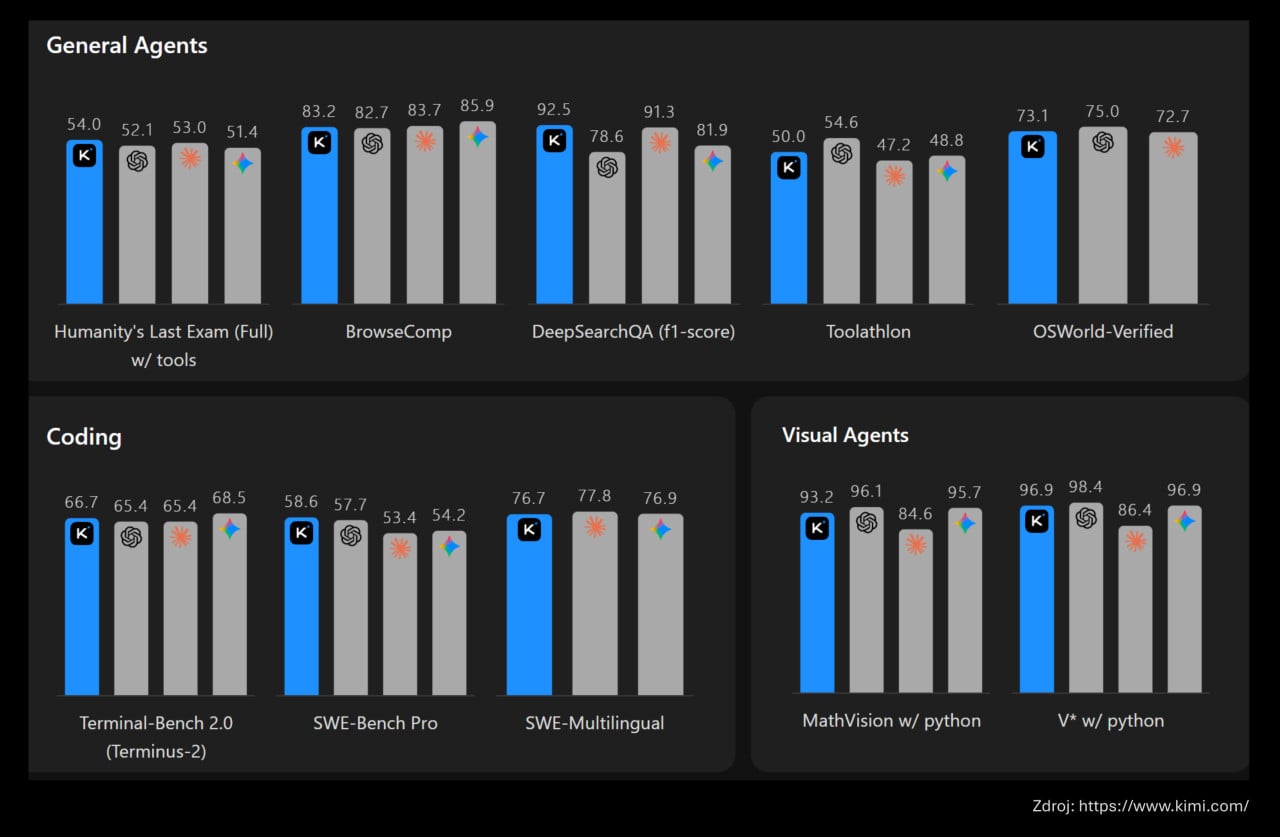
The exceptional capabilities of this open-source AI model are also demonstrated by its results in standardized benchmarks. For example, in the SWE-Bench Pro test, K2.6 scores 58.6%, while GPT-5.4 scores 57.7% and Claude Opus 4.6 only 53.4%.
Agent swarms as a team of capable assistants
One of K2.6’s most interesting features is the so-called “Agent Swarm.” What does that mean? Imagine having an entire army of specialized AI agents working side by side and coordinating with one another instead of a single assistant.
K2.6 can launch up to 300 sub-agents at once, which can collectively handle over 4,000 steps, nearly three times as many as the previous K2.5 version. In practice, this means that the model can create a complete research report, presentation, spreadsheets, and website from a single prompt, all without human intervention.
Thanks to its autonomy, this open-source AI model will appeal even to complete beginners. From a simple text description, it can build an entire website, including the design, animations, and user login functionality. In internal tests, it performed comparably to Google AI Studio, one of the leading tools for creating websites with AI.
Should closed models be worried?
Models such as GPT or Claude certainly do not need to panic. However, they should definitely be wary of Moonshot’s K2.6. In many tests, this AI model catches up with—and sometimes even outperforms—paid models at a fraction of the cost.
Nevertheless, closed models still perform better in some areas, such as general reasoning or visual tasks. However, K2.6 points to a clear trend: the quality of open-source models is improving. And that is definitely good news for the entire world of AI, as it brings better AI capabilities and makes them accessible to everyone.
Source: kimi.com