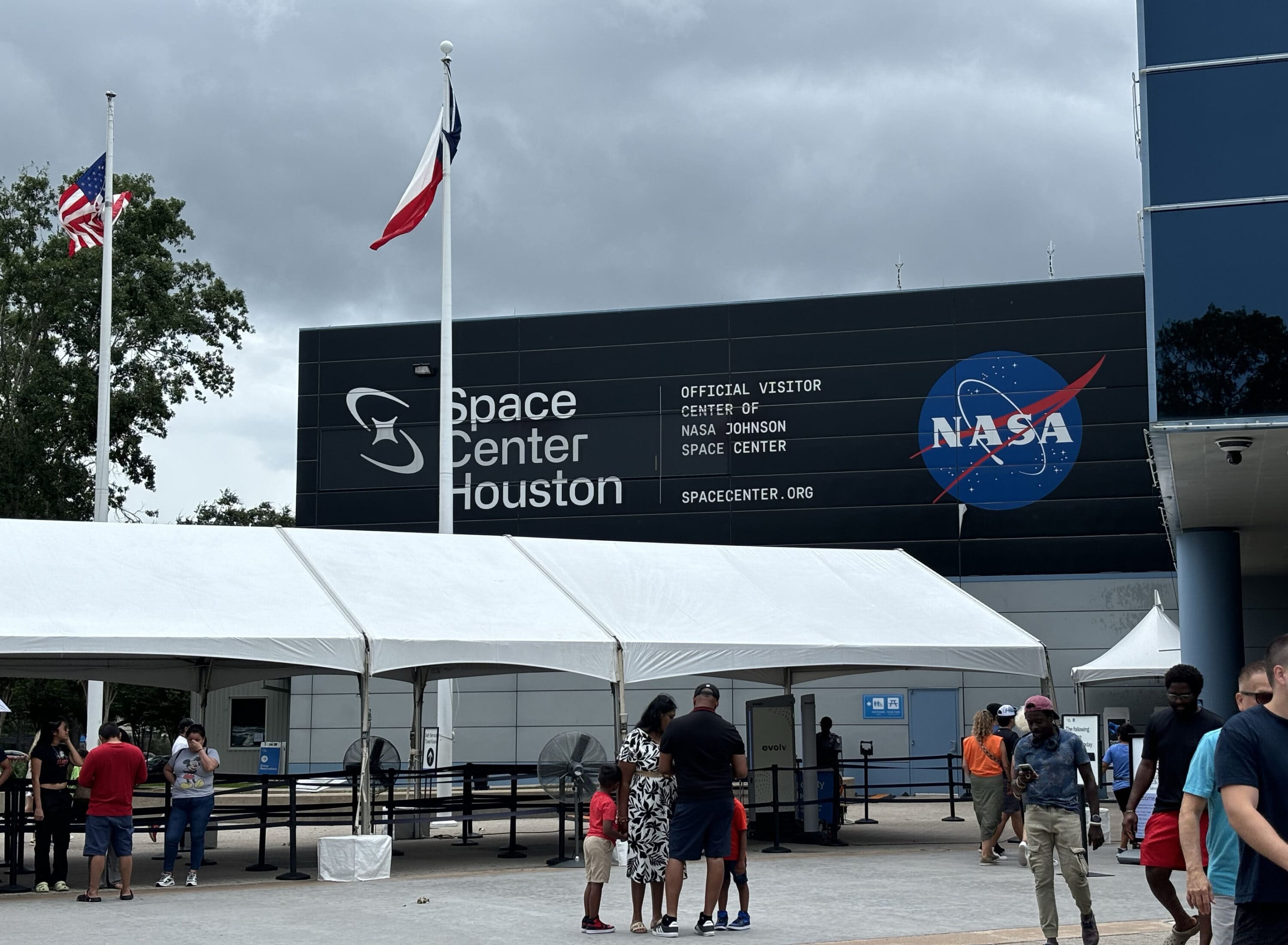
The first word spoken on the Moon that was meant to be heard on Earth was “Houston.” It was the first word of the phrase uttered by Neil Armstrong after successfully landing the lunar module with Buzz Aldrin on July 20, 1969:
“Houston, Tranquility Base here. The Eagle has landed.”
Before this announcement, several words were spoken during the descent—“Contact light. Okay, engine stop”—but they were part of the communication between the astronauts as they navigated the descent and landing. The first words intended for Earth were those that officially announced the Eagle’s safe landing on the Moon, and those words began with “Houston.”
The fact that Houston was so central to the success of this mission was, in a way, predicted about 100 years earlier by Jules Verne in his novel From the Earth to the Moon. This is, of course, the same Jules Verne who wrote Twenty Thousand Leagues Under the Sea, Journey to the Center of the Earth, and Around the World in Eighty Days—the father of modern science fiction.
Verne’s 1865 novel From the Earth to the Moon concerns a shot to the Moon. And it really was a shot to the Moon, because in the book the space endeavor was led by gun enthusiasts—the Baltimore Gun Club—who wanted to build an enormous space cannon and fire a giant projectile from it at the Moon.
The drawings of this projectile that illustrated the book show it looking remarkably like the Apollo capsule. It had room for three people, just like the actual lunar expedition that came 100 years later. It was made of aluminum, which was also used in the Apollo capsule. Even the physics of Verne’s lunar voyage was impressively accurate for its time, except for the unbearable acceleration that the people inside the projectile-shaped capsule would have experienced. Incidentally, Verne named his launch cannon the Columbiad. The command module for the Moon landing was called Columbia.
How does Texas figure into the book? Verne calculated that the best place from which to fire such a projectile at the Moon would be either Texas or Florida. It would have to be near or below the 28th parallel. He discussed Brownsville as a possible launch site. (Interestingly, SpaceX is now building a facility there.) He mentioned Corpus Christi, as well as Galveston Bay near Houston. As an option in Florida, he named “Tampa Town.” The real Tampa lies across the entire state from the Kennedy Space Center at Cape Canaveral, which became the site of the actual launch to the Moon a little more than 100 years later.
Other predictions by Verne concerned politics. Verne was French by birth and residence, and he made only one trip to the United States in his lifetime, in 1867, when he visited New York and Niagara Falls. Yet he maintained a lifelong fascination with America, where not only this novel but more than 30 others were set. In From the Earth to the Moon, he wrote a remarkable chapter about how Florida and Texas both wield their political power and powers of persuasion to secure the space launch. Something similar actually happened 100 years later. The debate was essentially settled by President Lyndon Johnson, a native Texan. His political maneuvering resulted in Florida receiving the launch site and Texas the control center.
It is fascinating to examine the arguments Verne had each state make in the novel. Representatives of both states meet at a hunting lodge. The Texans argued that they had a larger population—330,000 compared with Florida’s 50,000. Texas had the best cotton, the best iron ore, the purest oil, and the most valuable live oak for ships. Tampa said that they had the best bay for importing supplies. Ha, the Texans replied. “You mean a bay clogged with sand?” After all, the Texas side countered, “Galveston Bay could hold all the naval fleets in the world!”
And then Florida brought out the big argument: “The space launch should go to a state that is truly American.” The Texans turned red: “Outrageous—a wretched little strip of land like Florida dares compare itself with Texas. Texas did not simply sell itself to the Union for five million dollars. It won its own independence at San Jacinto, when Sam Houston defeated Santa Anna and drove the Mexican armies out of the state”—after which Texas “voluntarily joined the United States of America.”
Moreover, the Texans argued that when the time came for the actual shot to the Moon, that little strip of land called Florida “would never withstand the shock of the blast; it would fall apart at the very first shot.”
“Fine, let it fall apart,” Florida replied.
The Florida side then pointed out that all the Texas sites lay well below the 29th parallel, while Tampa Bay was exactly on the 28th, perfectly positioned for a shot to the Moon.
And so Florida won, at least in the book; a century later, it also secured the actual launch site.
In real life, however, I think Texas got the better deal because it received the control center (and the large budgets). And it got the first word as well. The first formal word spoken on the Moon was neither “Tampa” nor “Florida.” It was “Houston.”
I cannot help thinking that Sam Houston, that old frontiersman and cunning general, would have been proud to know that his name stood at the forefront of yet another revolution.